I live on the Pike/Pine corridor. A neighbor of mine — a serious theater person, trained at the highest levels, years of work in this city, real roots here — moved to New York last year. Not enough work in Seattle.
Let that land for a moment. Not a kid who couldn't get a break. Not someone chasing Hollywood. Someone who chose Seattle on purpose, who gave this city years of serious work — and who eventually concluded that Seattle couldn't sustain what he was trying to do here.
This week, hundreds of high school theater students from across Washington State are in Seattle for the Washington State Thespian Festival 2026, doing workshops and performances and getting backstage tours of the city's great theaters. To all of you — and to your parents, and your directors, and everyone who drove you here from Spokane or Bellingham or Olympia: welcome.
And on those backstage tours, ask some real questions.
At the 5th Avenue Theatre:
The 5th Avenue is one of the most beautiful theaters in America — a 1926 landmark with a ceiling modeled on Beijing's Temple of Heaven, gold dragons on the walls, a history of sending productions to Broadway. It is your festival's platinum sponsor.
It also announced this week that it is cutting 14 staff positions and launching an emergency fundraising campaign to cover a $7.5 million deficit. It needs $6 million in the next six months or it may have to stop producing its own shows entirely — no more work built here, rehearsed here, cast from local talent. Just a road stop on someone else's tour. (Seattle Times)
Ask:
- Before the pandemic, the 5th had about 18,000 subscribers. Now it's at 10,000. Who were those 8,000 people, and where did they go?
- When a convention is in town and 10,000 people are staying in hotels two blocks away, how many of them end up in your seats?
- If someone flies into Seattle for a conference and wants to see a show tonight, how do they find out you exist?
That last question isn't rhetorical. The answer, right now, is: mostly they don't. There is no TKTS booth on Pike and Pine. In New York, Times Square has a booth where you can walk up and buy a discounted ticket to whatever's playing tonight. London has one in Leicester Square. The booth isn't just a convenience — it's a signal. It says: we have so much theater that we need to staff a booth to help you choose.
The Visit Seattle welcome booth at 1st and Pike — funded by $10 million a year in hotel assessments — is unstaffed most of the time.
At Union Arts Center:
Union Arts Center is what you get when two of Seattle's most important companies — ACT Contemporary Theatre and Seattle Shakespeare — merge because neither can survive alone. Five performance spaces in a 1925 landmark at 7th and Union. It is remarkable.
It is also connected by internal tunnel to the convention center where you've been spending your festival.
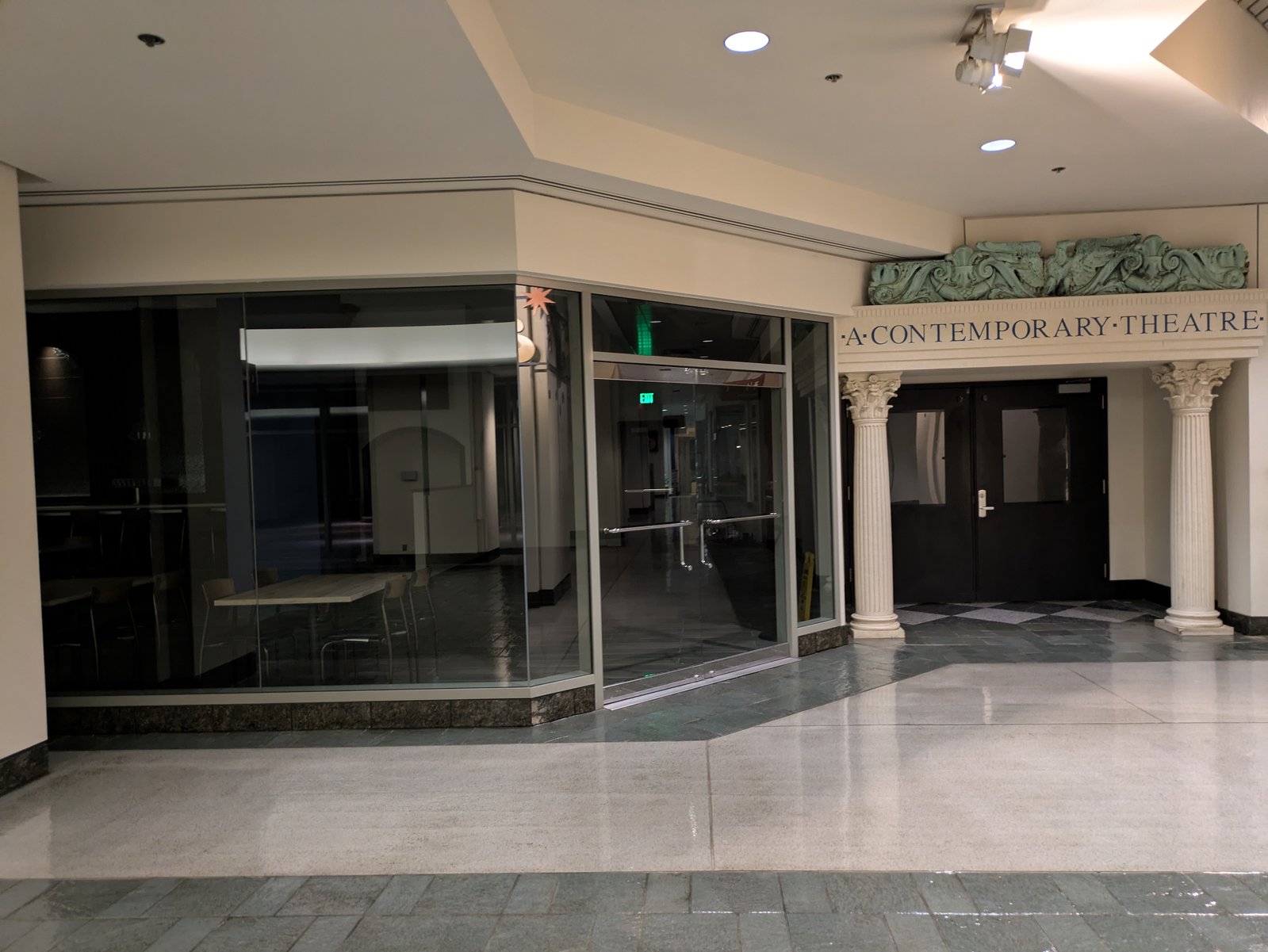
Walk down to the main corridor. The Galleria. See those white columns? The carved green relief? The words ·A·CONTEMPORARY·THEATRE· carved in stone?
That's the entrance to one of Seattle's most important theaters—the same ACT and Seattle Shakespeare that perform at Union Arts Center. It's literally connected to where you're spending your festival.
[You try the door.]
Oh, that door has been locked for years.
Why?
Not enough foot traffic. People don't walk through here anymore.
Why?
Well, we built a new convention center two blocks away. Two billion dollars!
Why?
We were turning away business! So we needed a new building! And that's why the street-facing half of this one is locked up most of the year. But that's not our fault.
Why?
Look, we'd love to fill both buildings every single day. All you need to do is pay our contracted rates. We're committed to the authentic Pacific Northwest experience—that's why we have an exclusive food and beverage partnership with Aramark. Their employees have deep roots in the community. The company's from Philadelphia, but the employees, salt of the earth. Great chicken wraps! We actually make more on food than venue rental. You look hungry. Potato chips? Apple? Anyway, come back in five or ten years, we're going to fix this place up nice. Corporate retreats, pickleball, who knows, we'll figure it out once we get more money from the state. I mean, how else are we going to compete with Las Vegas—they have shows every night! But we have two buildings, so... anyway, are you kids here for college fair, or Comic-Con? We have so many events I can't keep it all straight. But yeah, that door's locked and there's nothing we can do about it. Hands are tied.
Here's your challenge: Create a 60-second artistic response to this locked door and everything you just heard. Whatever moves you as an artist—song, monologue, interpretive dance, spoken word, mime, movement piece.
React accordingly. Film it. Post it.
Tag it: #ACTChallenge #WAThespians #LetsPutOnAShow
You're theater kids. You know what to do with a locked door and a bureaucrat.
At the Paramount:
The Paramount is the anchor of what should be Seattle's theater district — a 1928 movie palace directly across Pine Street from the convention center. When a national convention wants to hold its gala in a real theater, this is the call. STG runs it well.
Ask: What would it look like if the convention center actively pointed people your direction — wayfinding, a ticket booth in the lobby, partnerships with the hotels? What would it take for Pike and Pine to feel like a theater district instead of a theater on a street?
At Seattle Rep:
Seattle Repertory Theatre is at Seattle Center. A two-minute monorail ride from where you're standing — board at Westlake, a couple blocks from the convention center, and you're there.
Seattle Center is already what a civic campus looks like when it works: the Rep, McCaw Hall, KEXP, MoPOP, open plazas that host events year-round. Each institution makes the others more valuable. It is proof that public investment in cultural infrastructure compounds.
A short monorail hop from Westlake to a world-class theater campus. Ask at the Rep: How many convention visitors make this trip? How would they even know to?
The building you're in right now:
You are spending two days in a 435,000-square-foot public building whose street-facing theater entrance is locked from the outside — it opens only from the inside, so patrons can exit through it but no one can enter from the street. It is three blocks from one of the most beautiful theaters in America. That locked theater door sits in the building's main corridor, an empty restaurant beside it. It was built with public bonds, on public land, and is supposed to deliver civic benefit to this community.
There is a proposal to change that — to open this building as a public commons, 365 days a year. Food hall. Maker space. Civic programming. Performance space. A reason to be on Pike Street at 3pm that doesn't require a convention badge. The organizations that would program it are already proving the model works in scrappier spaces. The exclusive catering contract that controls the building runs through at least 2029, with options to roughly 2033. Read it: commons.conventioncityseattle.com
Here is what we want to say to you directly.
A lot of people who love theater — who grew up doing exactly what you're doing this week — eventually conclude that if they want a real career, a real scene, a real community of people who take this seriously, they have to leave. New York. Los Angeles. London. That's where the ecosystem is. That's where the doors are open.
My neighbor didn't leave because he failed here. He left because Seattle didn't build the ecosystem that would have kept him. That's a different problem — and it's a solvable one.
But here's what the adults won't tell you: you don't have to wait for them to solve it.
You don't have to move to New York to have a theater scene. You don't have to accept the locked doors and empty spaces and broken connections as permanent. You could stay and build something completely different. Or come back after college and find the ecosystem waiting — because you built it.
This state has extraordinary theater. You're proving it right now. The talent is here. The stages are here. The people who care are here — hundreds of them, this week, in a convention center on Pike Street.
What's missing isn't just connective tissue. It's vision. It's someone willing to look at a locked door and see opportunity instead of obstacle. It's someone who understands that "the way things are" is not the same as "the way things have to be."
You are the most receptive audience in the world for the argument that theater should be central to a city's identity. You also have something the adults don't: you're not invested in preserving what's breaking. You can build what's missing.
That locked door at ACT? Don't just try the handle. Imagine what's behind it. The empty restaurant space next to it? Picture it full of theater kids like you, talking about shows, workshopping scenes, making the connections that turn individual artists into a community.
The convention center with a street-facing theater entrance that's been locked for years? Design what could happen behind it. Maker spaces. Performance labs. Showcases where Seattle artists get discovered by Seattle audiences instead of hoping someone in New York will notice them.
The Commons proposal (commons.conventioncityseattle.com) isn't just about opening a building. It's about opening possibilities. For your generation. For the generation you'll teach. For the people who might choose Seattle not despite the scene, but because of what you're building.
You're inside a building where theater is incidental to the city's identity, three blocks from buildings where theater is central, with locked doors in between. You know exactly what needs to be fixed because you just walked through it.
You also know something the city planners and arts administrators don't: what it feels like to be a theater kid in 2026. What you need to thrive. What would make you stay. What would make you come back. What would make this the city where the next generation chooses to build their careers.
The adults are having meetings about committees to study working groups to consider maybe possibly opening that door. Someday. If the funding works out.
You could pick the lock.
Not literally. (Well, maybe literally.) But you could stop waiting for permission to create the theater ecosystem you want to be part of. Start the collective. Book the space. Produce the work. Make the connections. Build the audience. Prove the model.
You could be the generation that looks back at this week and says: that's when we decided to stop leaving and start building.
The oldest line in the business: let's put on a show.
The barn is right there.
And if the door is locked? You know how to make an entrance anyway.
Ivan Schneider is the founding editor of the Convention City Dispatch. He lives on the Pike/Pine corridor.
#ACTChallenge #WAThespians #SeattleTheater #SeattleCommons #LetsputOnAShow #PickTheLock
Updated June 13, 2026: An earlier version of this column said the convention center "sits empty roughly 250 days a year." That figure is retracted. The SCC's own records show the Arch is busy most of the year — about 274 use days in 2025, with only ~91 days of no activity at all — so it is not empty most of the year. The civic-access point stands, but it rests on the building's locked street-facing theater entrance — the old ACT theater door in the Arch's main Galleria corridor, locked from the outside and opening only from the inside (patrons exit through it; no one enters from the street), with an empty restaurant beside it — not on whole-building occupancy. The body has been recast to that locked-entrance point. Separately, the body text said the catering contract "expires January 2027," matching an error this article's correction note (above) already flagged; the body now matches the note — the Aramark exclusive F&B contract started January 1, 2025 and runs through at least 2029, with two-year options to roughly 2033. Source: SCC records-request data; PFD board Aramark slides, March 31, 2026.