The following is a scenario analysis — not a forecast — using the Downtown Seattle Association's State of Downtown format to explore one possible trajectory for the Pike/Pine corridor. The Commons proposal referenced throughout is detailed at commons.conventioncityseattle.com.
A Neighborhood Finds Its Spine
A Letter from the President & CEO
Downtown Seattle Association
Downtown Seattle's story is rarely linear. It is a story of neighborhoods that absorb pressure, adapt, and emerge stronger — not because the path was obvious, but because enough people chose to see what was possible rather than accept what was in front of them.
Five years ago, this report documented real progress alongside real headwinds. Visitors were returning. Light rail ridership was climbing. The waterfront transformation was complete. And yet the data told a more complicated story: hotel demand softening, retail jobs declining, worker foot traffic still at roughly two-thirds of pre-pandemic levels. The Pike/Pine corridor — ten blocks connecting Pike Place Market to the convention district — remained the gap in downtown's recovery narrative.
Today that gap is downtown's greatest asset.
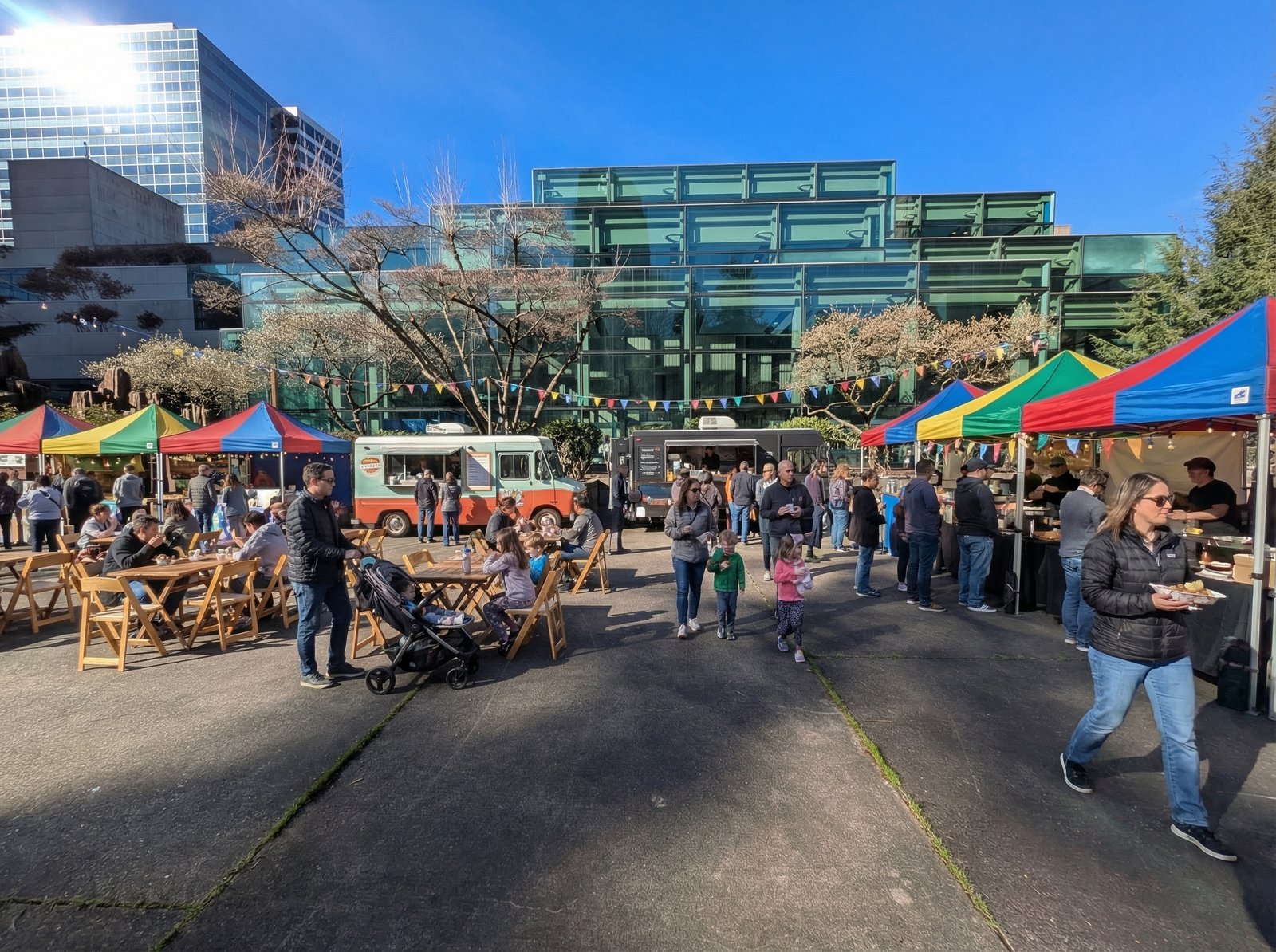
Seattle Commons, which opened at the former Washington State Convention Center Arch building in 2028, has done what daily activation always does: it made the street around it worth being on. The corridor that once absorbed the closure of anchor tenants and cycled through vacant corners now anchors the most visited block in downtown Seattle. In 2030, the Arch block registered more daily foot traffic than any comparable block in the city center. Street-level business openings along the full Pike/Pine corridor — Boren Avenue to the waterfront — have outpaced closures for three consecutive years.
The numbers elsewhere could reflect what happens when a neighborhood finds its spine.
Downtown's residential population now exceeds 125,000 — nearly one in six Seattleites. Dining, hotel, recreation, arts and entertainment jobs have grown 38% since 2026, recovering ground lost during the pandemic years and adding new positions the corridor could not have supported before daily activation. Hotel demand, which softened through 2025 and 2026, has grown in each of the past four years. The 5th Avenue Theatre, two blocks from the Commons, reported its highest subscription numbers since 2019. Light rail boardings at the four downtown stations exceeded 14 million in 2030.
The ripple extended in every direction. The former Saks Off 5th space at Westlake Center — vacant since 2024, on the same level as the monorail station — reopened in 2030 as a permanent maker market and demonstration floor. Step off the monorail from Seattle Center and walk into daily robotics demonstrations. The private landlord made the call. The Commons made it obvious. Two stops south on the 1 Line, Pioneer Square absorbed nearly 850,000 square feet of net new creative and technology occupancy in three years — the largest intake in the neighborhood's recorded history.
None of this was inevitable.
In early 2026, the question facing this city was whether a 435,000-square-foot public building — open most of the year for conventions but never to the neighborhood, with no public programming, no community access, and no reserved public-benefit floor — was an asset or a liability. The answer depended entirely on what decision was made about the building's underused public-facing capacity. The Downtown Seattle Association, working alongside city leadership, Seattle Center, and a coalition of neighborhood stakeholders, made the case that activation was the only viable path — for the building, for the corridor, and for the convention center's long-term financial stability.
This trajectory requires coordinated action across multiple stakeholders — none more important than the leadership that has guided downtown's recovery through 2026.
In this scenario, an opening in the building's service contracts created the room the city needed; the rest followed from that decision. [Note, per the correction above: this scenario was written before the Aramark contract terms were known. There was no early-2027 Aramark transition — the exclusive food-and-beverage contract started January 1, 2025 and runs through a base term ending 2029, with two two-year options that could extend it to roughly 2033. The trigger described here is hypothetical.]
Seattle in 2031 is a denser, more connected, more visited city than it was five years ago. The waterfront is complete. The light rail network reaches Everett, Tacoma, and Redmond. FIFA 2026 showed the world a city ready for the international stage — a prologue, as it turned out, to something more lasting. The free Pike/Pine Connector shuttle, now in formal route designation talks with King County Metro, carried 400,000 trips in 2030 — running up Pike to Boren and back down Pine to the waterfront, stitching the corridor together one ride at a time.
President & CEO Downtown Seattle Association
Downtown Seattle 2031 Report Card
LIVE Residential Population 95% increase since 2010 / 2031 estimate: 125,400
- Downtown's residential growth accelerated through the late 2020s as corridor activation made the neighborhood more livable, not just more visitable.
- One in six Seattleites now calls downtown home.
WORK Total Number of Jobs 52% increase since 2010 / 2031 estimate: 334,200
- Downtown recovered the jobs lost in 2025 and added new ones, led by hospitality, creative industries, and early-stage technology concentrated in the activated corridor and Pioneer Square.
SHOP Brick-and-Mortar Retail Jobs 18% increase since 2027 / 2031 estimate: 9,100
- Street-level retail vacancy along the full Pike/Pine corridor — Boren Avenue to the waterfront — fell to its lowest level since 2015.
- Six vendors who built their following at the Commons food hall have signed permanent leases on the corridor since 2029. Four are within two blocks of the Arch.
PLAY Dining, Hotel, Recreation, Arts & Entertainment Jobs 38% increase since 2026 / 2031 estimate: 37,200
- Hotel demand has grown in each of the past four years. Average pre-cruise hotel stay increased from 1.1 nights in 2026 to 1.8 nights in 2030 — tens of thousands of incremental room nights annually from passengers extending their arrival to spend time at the Commons.
- The 5th Avenue Theatre reported its highest subscription numbers since 2019.
- The Commons food hall draws an estimated 3,500 visitors on a typical weekend day. Every weekend, not one in August.
- The Commons hosts more than 1,200 programmed events annually.
Downtown by the Numbers
84% meeting room occupancy at 800 Pike in 2030 — and waitlists. Organizations that built their operations around Commons programming have begun leasing permanent space in the corridor rather than compete for rooms.
400,000 Pike/Pine Connector trips in 2030. In talks with King County Metro for official route designation.
5 consecutive years downtown's diversity index has risen.
Pioneer Square: A New Golden Age
There is a moment in every neighborhood's history when the pieces that were always there finally align. For Pioneer Square, that moment was 2028.
Seattle's oldest neighborhood had everything a creative economy requires: historic brick buildings with floor plates that accommodate makers, artists, and early-stage companies; two light rail stations connecting it to the regional system; Occidental Park anchoring its public realm; the waterfront two blocks west; the stadiums defining its southern edge. What Pioneer Square lacked was a reason to be there on a weekday that wasn't a Seahawks game or a First Thursday gallery walk.
The Commons provided that reason — not directly, but gravitationally. When the Arch block activated in 2028, the founders and creative professionals who found their network there needed space to build. The Commons is a gathering place, not an office. Pioneer Square, two stops south on the 1 Line, offered exactly what the next stage required: affordable square footage in buildings that felt like somewhere rather than nowhere, walkable to the waterfront, adjacent to the stadiums, and priced at a fraction of South Lake Union.
Six minutes by bike from Occidental Park to the Arch block. The 1 Line in two stops. Close enough that the founders who met at the Commons think of Pioneer Square not as a different neighborhood but as the next room.
The market responded before the planners predicted it would.
Between 2028 and 2031, Pioneer Square absorbed an estimated 847,000 square feet of net new creative and technology occupancy — the largest three-year intake in the neighborhood's recorded history. Street-level vacancy fell from 28% in 2027 to 9% in 2030. The art gallery district, which had contracted steadily since 2019, stabilized in 2029 and grew in 2030, supported by a resident creative population that hadn't existed at this scale before. Occidental Park, long a beloved but underutilized public space, now anchors a lunchtime crowd on weekdays that the neighborhood's businesses had never previously been able to count on.
The startups tell the story most precisely. Of the 34 ventures formally incorporated by founders who met at the Commons between 2028 and 2030, 21 took their first real office in Pioneer Square. Several cited the same factors independently: light rail access from anywhere in the region, historic buildings with character that newer construction couldn't replicate, rents that made early-stage risk manageable, and proximity to the Commons where their networks still lived. Three have since raised significant outside funding. One has relocated employees from San Francisco, citing Seattle's livability and Pioneer Square's specific quality of place as factors that made the talent pitch easier.
Their office is in an 1890s brick building on First Avenue South. Two blocks from Occidental Park. One block from the light rail station.
Six minutes by bike from the Arch.
This is what activated corridors do. They don't fill only their own blocks — they extend their logic outward along the lines of least resistance. In Seattle's case that line runs underground, two stops south, from the Arch block through the Symphony station to Pioneer Square. The Commons sits at the top of that chain. Pioneer Square caught what flowed down it.
The neighborhood that was always ready is finally, undeniably, arrived.
The Convention City Dispatch covers the neighborhood at the intersection of Downtown, Capitol Hill, and First Hill, with the Washington State Convention Center at its geographic center.
The 2026 State of Downtown report is real. The building is real. The clock is real.
Read the Commons proposal: commons.conventioncityseattle.com The Convention City Dispatch: dispatch.conventioncityseattle.com
Updated June 13, 2026: Two figures in the body have been corrected to match the convention center's own records. (1) The scenario's load-bearing "Aramark transition, completed on schedule in early 2027" was wrong — the exclusive food-and-beverage contract started January 1, 2025 and runs through a base term ending 2029, with two two-year options that could extend it to roughly 2033; there is no 2027 transition, and the in-body trigger is now marked hypothetical. (2) An earlier version described the building as "sitting empty 250 days a year." That figure is retracted: a public-records request returned the agency's booking data showing the Arch was active most of the year (~192 unique live days in 2024). The scenario's premise is the building's lack of public access and programming, not whole-building emptiness — the line has been corrected to that frame. This piece remains a scenario analysis, not a forecast.