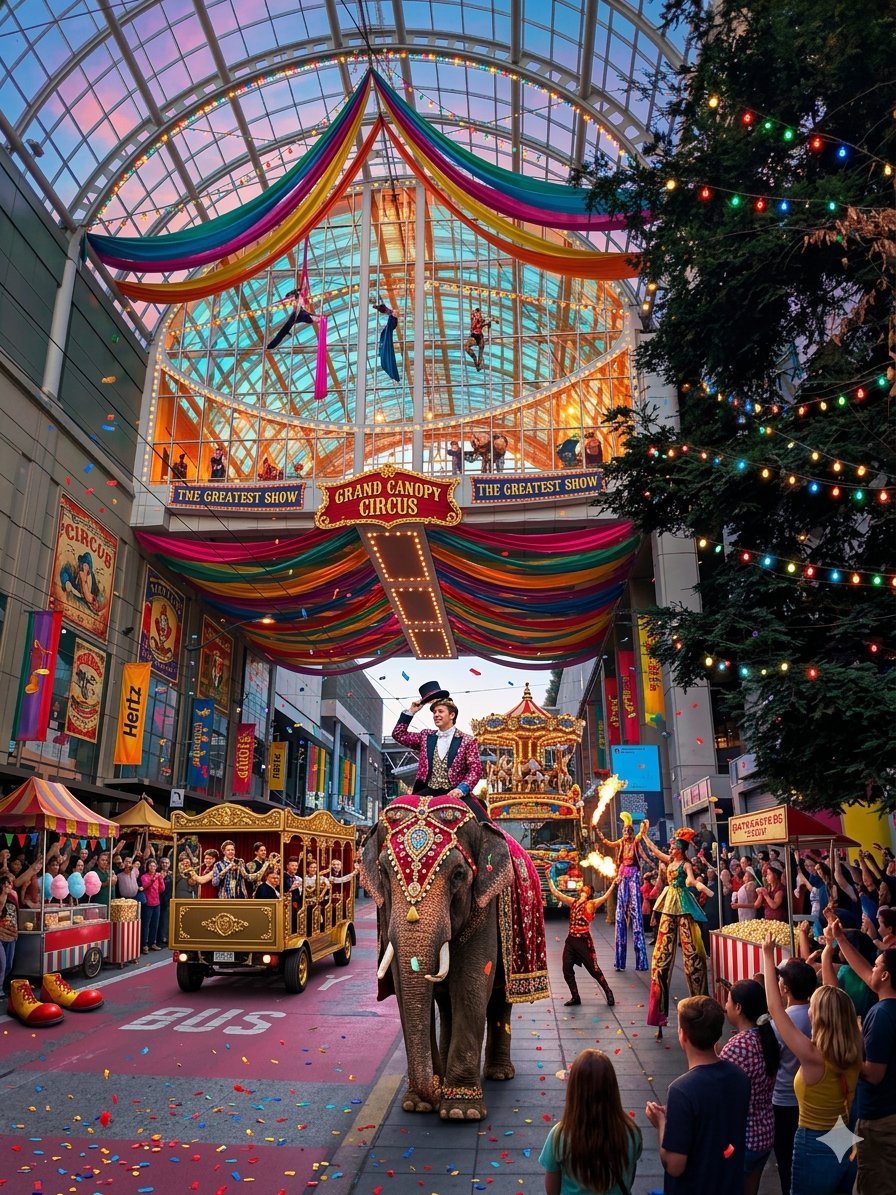
This fall, Seattle voters may be asked to back a billion-dollar-plus bond measure to save Seattle Center and other cultural institutions from decline.
"Rather than having another 25 or 30 years where we continue to kind of hold together Seattle Center with duct tape and good intentions, let's make a real investment in the cultural heart of our city." — Rob Johnson, executive director of the Seattle Center Foundation, in "Seattle Center proposal grows beyond $1B", Seattle Times, March 14, 2026.
Yes, and.
The problem is that there's another big event space in Seattle looking for public funds at the same time.
In roughly two months, Seattle Convention Center will publish its 2025 financial statements. SCC's finances are tenuous — the CEO calls it "scary" — with low cash reserves, operating losses, and lodging tax revenue just covering the debt payments for the $1.9 billion Summit. Meanwhile, SCC still operates the Arch, a 37-year-old underperforming complex. A request for public money — Arch renovation, capital infusion, backstop extension — is inevitable. And underneath all of it: the convention market is softening. Not cyclically — structurally.
The Seattle Convention Center ask is arriving at the same moment as the Seattle Center bond campaign.
How do you evaluate the two? Which projects offer the optimal combination of risk and return?
We start by looking at their respective business plans and track records.
Seattle Center seeks funding to maintain facilities that work well for their intended purposes. Their books are clean, their operations are net positive, and they've successfully expanded scope to include management of Waterfront Park.
Seattle Convention Center seeks to repurpose a facility whose business model was already under stress before the Summit opened. The pandemic changed convention demand in ways that may be structural, not cyclical. Current event levels may be a ceiling, not a floor. The Summit was a $1.9 billion bet on a demand forecast that predated all of that, and the bet hasn't paid off.
Now, citing a "pressing need to recapitalize Arch," SCC management wants public funds to double down. Without new money, all it takes is a few bad convention years, a softening hotel market, a couple of planners who choose Nashville — and it's wiped out.
It's not a good loan. But they may get it anyway, because the alternative may be worse — allowing the Arch to continue its current trajectory: maintenance deferred, its street-facing 800 Pike wing (Zone D) opening on fewer days not more — that entrance opened just 22 days across 7 events in 2025 — more commercial vacancies in the surrounding blocks.
The Case for the Commons
There's a better way forward.
The proposal — detailed at commons.conventioncityseattle.com — is to have the City of Seattle buy the Arch from the Public Facilities District (PFD) that runs Seattle Convention Center — pick a number, let's say $150 million, about 10 percent of the Seattle Center ask — financed through a city Limited Tax General Obligation bond, a council authorization that doesn't require a ballot measure and doesn't touch the property tax capacity the Seattle Center bond needs. Seattle Center operates the Arch as a year-round public commons. SCC retains a leaseback for the convention days it still needs.
The governance is already there. The Mayor, the King County Executive, and the Governor each appoint three members of the PFD board. The same officials who need to approve the Commons control the votes. No new legislation required. An interlocal agreement between existing public entities — with a Tacoma precedent already on the books.
This is not a complicated transaction. It is a decision. And the window to make it cleanly narrows as the PFD's state backstop approaches its 2029 expiry — the moment the whole capital structure is already up for renegotiation. The exclusive Aramark food-and-beverage contract covering both buildings runs on a base term through 2029 with two 2-year options that could extend it to about 2033, so the further into that term a transition starts, the higher the cost of unwinding it.
The fit.
Stand beside the Paramount Theatre on 9th Avenue, between Pike and Pine.
You are at the geographic center of Seattle. Not approximately, not poetically — mathematically. Midpoint between the northern city limit at 145th Street and the southern boundary where Seattle follows the Duwamish. Midpoint between Alki Point to the west and the Lake Washington shoreline to the east. Those two lines cross here, beside this theater, on this block.
The Space Needle is a mile away.
Just around the corner is the Arch — the glass skybridge spanning Pike Street at the fourth floor, connecting two buildings and giving the complex its name. Six stories, four ballrooms, 205,000 square feet of exhibition halls, a fourth-floor atrium. And on roughly 90 days a year — by the convention center's own booking records — it sees no activity at all, with no public programming and no community access on any of the rest, in a building large enough to run three major festivals simultaneously.
Meanwhile, Seattle Center's programming season runs Folklife to Bumbershoot.
That's not a criticism. It's meteorology. Seattle Center runs events from February through November — 25 Festál cultural festivals, Folklife, SIFF, PrideFest, Bite of Seattle, Bumbershoot. It is an impressive calendar. But much of it is outdoors, on weekends, and weather-dependent. January is dark. Tuesday in February is dark.
Rob Johnson, executive director of the Seattle Center Foundation, told the Seattle Times this week he's pushing for $1.3 to $1.5 billion on this fall's ballot to renovate Seattle's cultural infrastructure — the Armory, Benaroya Hall, the 5th Avenue, the Paramount. All of it real. All of it overdue.
But a renovated Armory is still one building at the center of an outdoor campus in Seattle. The bond buys better acts. It doesn't extend the season. It doesn't put a roof over the circus.
The Arch does.
Indoors. Climate controlled. Four ballrooms. 68 meeting rooms with built-in sound. Multiple festivals running simultaneously on a February Saturday that couldn't happen on the Seattle Center lawn regardless of how much you've spent on the Armory. Climate Pledge Arena extended Seattle Center's effective calendar to 365 days not by being bigger than what came before it but by having a roof. The Arch is the same argument — applied to everything else Seattle Center wants to do — already built, already sitting one monorail stop from the main campus, across the street from the Paramount.
The 1962 World's Fair gave Seattle a campus. The 2023 convention center addition accidentally gave Seattle Center its downtown annex. All anyone has to do is open it.
The benefits.
For SCC: Reserves go from $25 million to $175 million — ample runway at current burn. The Arch comes off the operating books. The annual loss shrinks. The balance sheet going into the 2029 state backstop conversation looks like a reform in progress, not a rescue in progress. The Summit focuses on what it does well: national and international conventions, the high-value bookings the lodging tax was designed to support. The leaseback means no lost convention capacity.
For Seattle Center: A downtown extension already built, already transit-connected, one monorail stop from the main campus. An indoor year-round venue that runs the calendar the outdoor campus can't — February festivals, simultaneous programming, events that don't wait for Seattle to allow them. A revenue base that grows as activation grows and eventually flows back to the campus — and toward the bond debt.
For the city: Equity in a building instead of a guarantee. An activated corridor at the geographic center of Seattle. An LTGO bond authorized by council — no ballot measure, no 60 percent threshold, no competition with the Seattle Center bond for voter appetite or property tax capacity. The building the city paid for in lodging tax for 37 years, finally serving the city.
For King County: The restructuring narrative that makes King County Conventions possible — Summit plus Meydenbauer, one regional sales team, one booking calendar, a pitch to national planners that Denver and Nashville can't match. A legacy infrastructure move that outlasts administrations.
For the Governor and the state: A restructuring story to tell the legislature in 2029. Not a blank check renewal for a multiple-facility PFD that hasn't changed its model — a reformed regional convention authority with a stabilized balance sheet and a public commons generating daily value on Pike Street. The backstop renewal becomes defensible.
For people: 435,000 square feet open 365 days a year at the geographic center of Seattle. Markets, festivals, performances, civic programming, a reason to be on Pike Street on a Tuesday in February that doesn't require a convention badge.
And on the right weekend — when everything is working, when the bond has done its job and the Commons is open and the waterfront is complete — Seattle runs a three-ring circus.
Seattle Center: Bumbershoot at full scale, the outdoor campus doing what it was built for, the bond's investment on full display.
The Commons: Folklife with a roof — indoor stages, night programming, the festival finally freed from Memorial Day weather, running simultaneously a mile up the monorail line.
The waterfront: Festál after dark, cultural festivals spilling down Pike Street to Elliott Bay, the completed waterfront as Seattle's third stage.
Three rings. One city. The monorail and the corridor connecting all of them.
That's what the tent is for.
Financial analysis, restructuring model, and geographic methodology at commons.conventioncityseattle.com.
Ivan Schneider is the founding editor of the Convention City Dispatch. He lives on the Pike/Pine corridor.
Updated June 13, 2026: Three figures in the original have been corrected against the convention center's own records. (1) The Aramark food-and-beverage contract does not expire January 2, 2027, and that date was not "the natural restructuring hinge." The contract started January 1, 2025, runs on a base term through 2029, and can extend to about 2033 via two 2-year options; the timing argument has been re-anchored to the 2029 state-backstop expiry, when the capital structure is up for renegotiation anyway. (2) The Arch does not lack "public programming about 250 days per year." A public-records request returned the agency's booking data — 194 event days / 274 use days in 2024, with roughly 91 days of no activity at all. The line now states the ~90 fully-dark days and keeps the supported point: no public programming or community access on the building's other days. (3) The description of the Arch "dark more days not fewer" overstated a whole-building trend; the audited event count has actually risen. The declining-access trend is specific to the street-facing 800 Pike wing (Zone D), whose street entrance opened on just 22 days across 7 events in 2025 — corrected accordingly. The public-commons argument is unchanged.