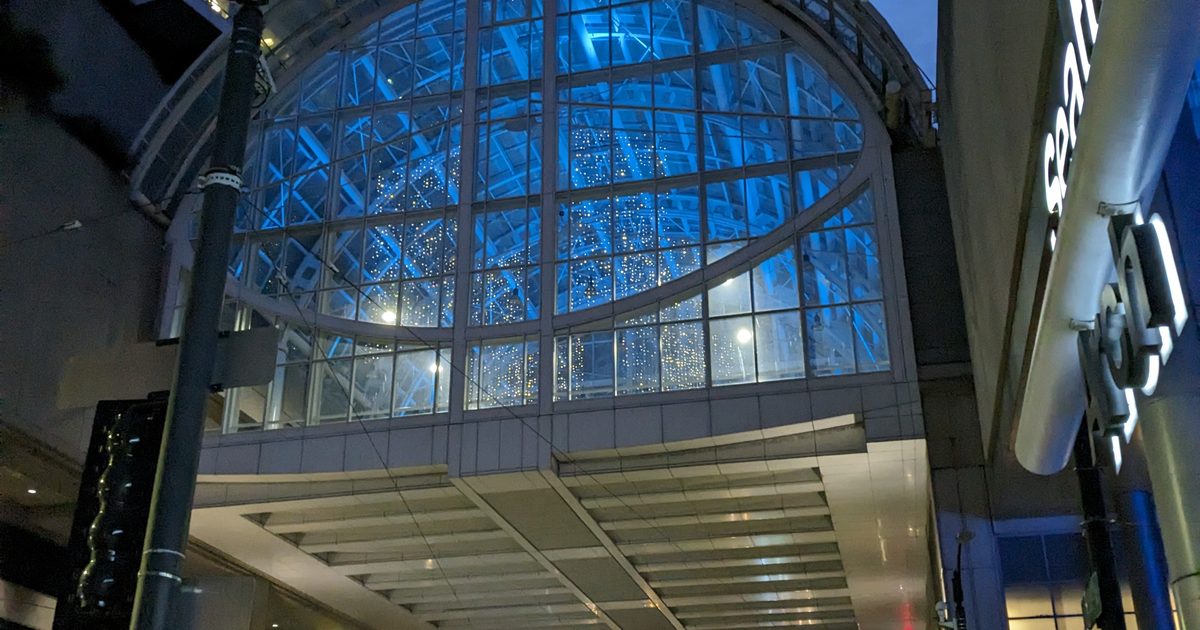
I wrote a piece for The Urbanist that claimed, on the basis of the public calendar, that the Arch is dark[1] most of the year. The CEO sent me different numbers. I requested the full details via public records request, and SCC responded quickly, and I'm glad they did. It's good for everyone if we have a set of facts upon which we can all agree.
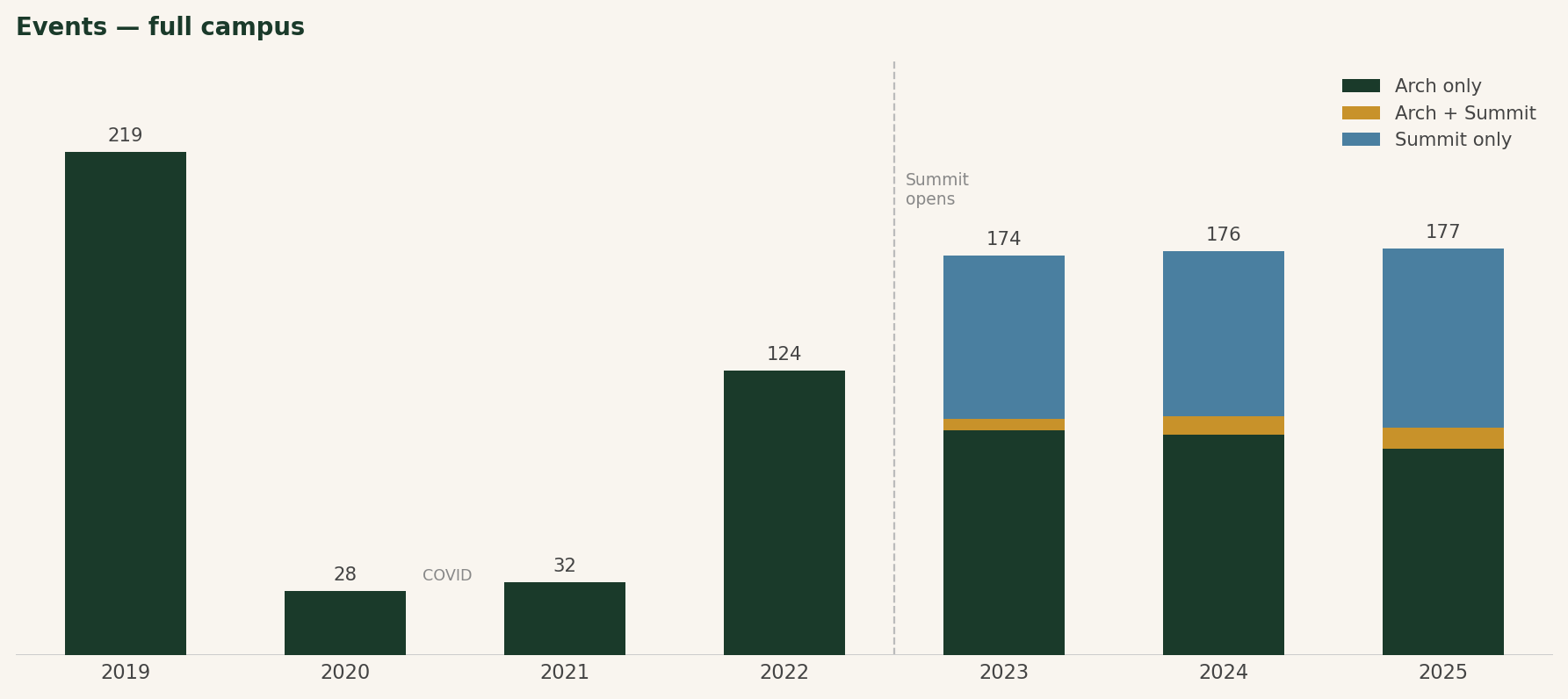
I had based my assessment on the SCC website's public calendar, which listed 115 event days in 2025 — implying 250 days with no activity. SCC's internal records, which include events not listed on the website calendar, show the Arch had 194 event days[2] and 274 use days that year. And so it's official: the Arch is not dark most of the year.
But it's not all light and sunshine either.
What I care about as a local resident is the street-level experience on Pike Street. So how do we reconcile the official counts with my personal experience of walking through what feels like a dead corridor?
Let's take this one side of the street at a time.
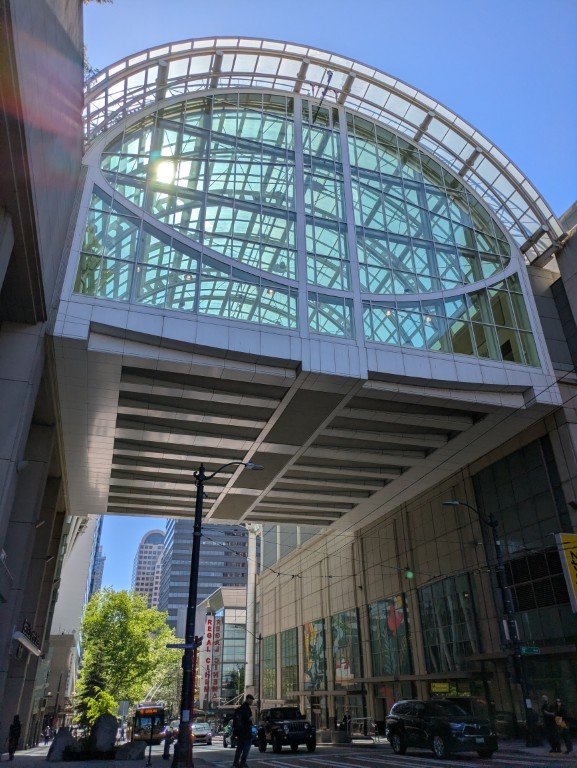
The Arch has two addresses. 705 Pike, on the south side of Pike Street, is open daily. 800 Pike, across the street, has its own entrance — almost always locked.
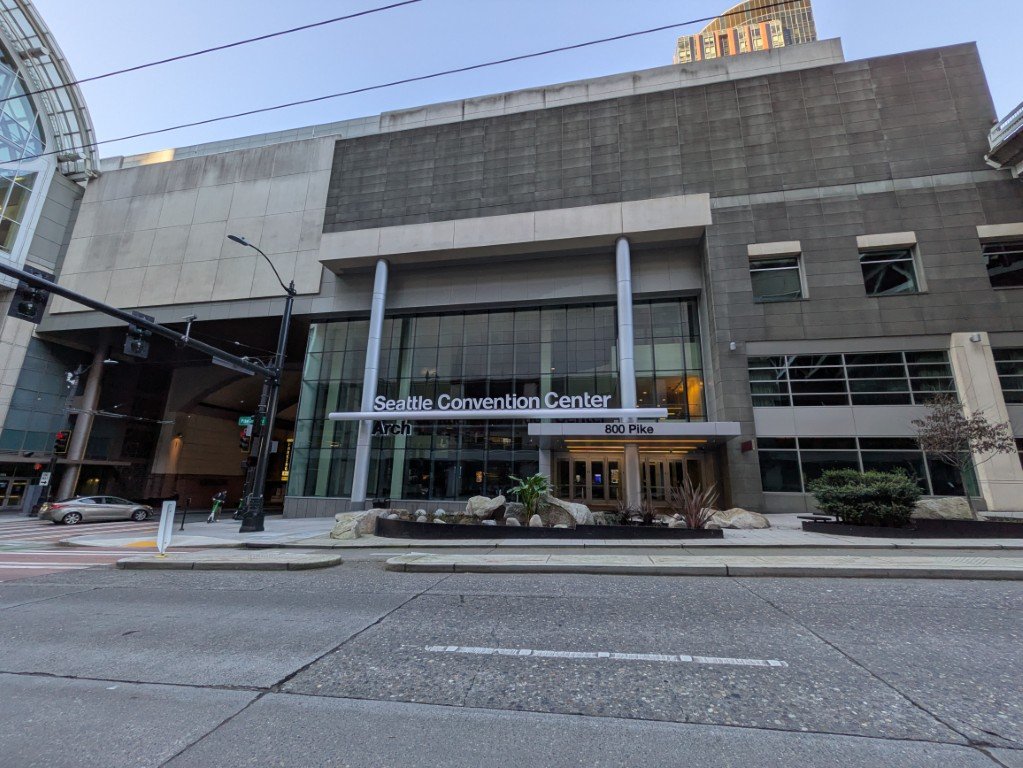
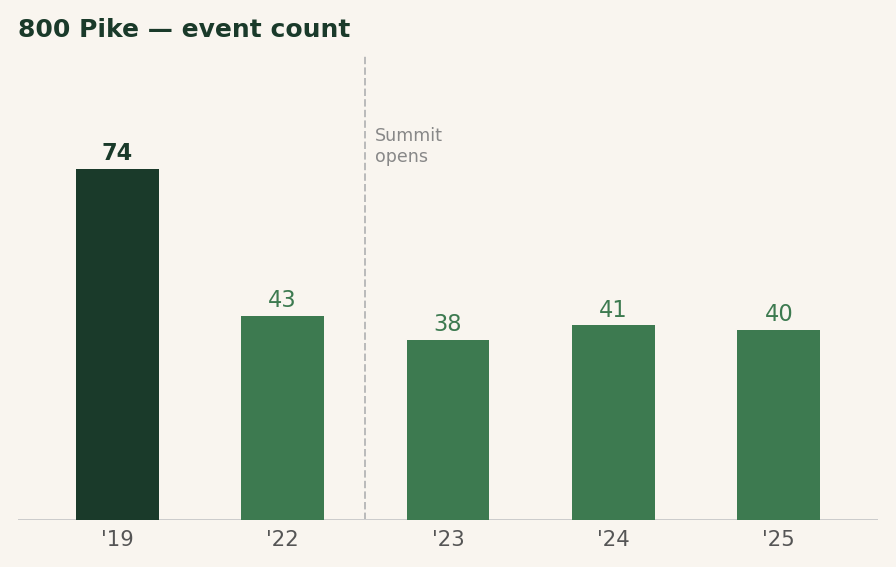
In 2019, 800 Pike logged 184 event days over 74 events. In 2025, 123 days for 40 events. Much of the remaining activity is on the upper floors: Tahoma and the rooms adjacent to Hall 4EF, accessed via the Skybridge from the convention center's main halls. When a major convention runs Hall 4EF, it often books rooms in 800 Pike as overflow — without opening the street-facing entrance.
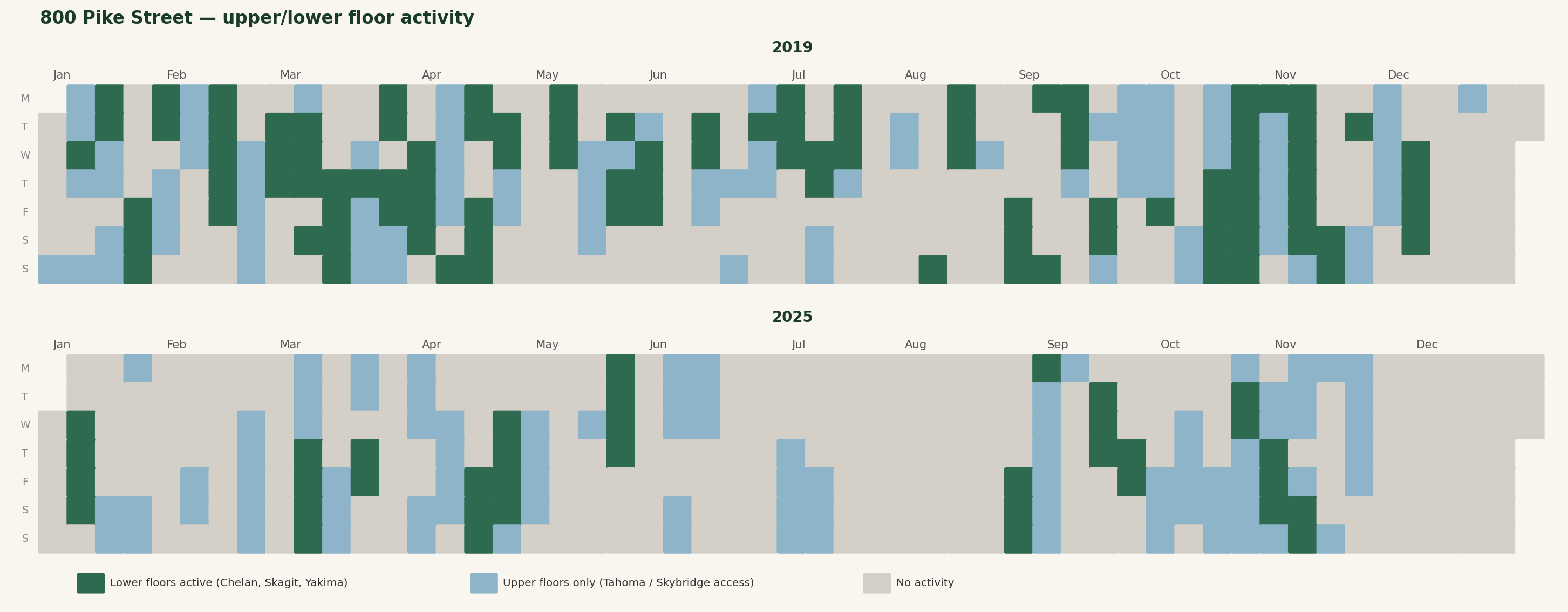
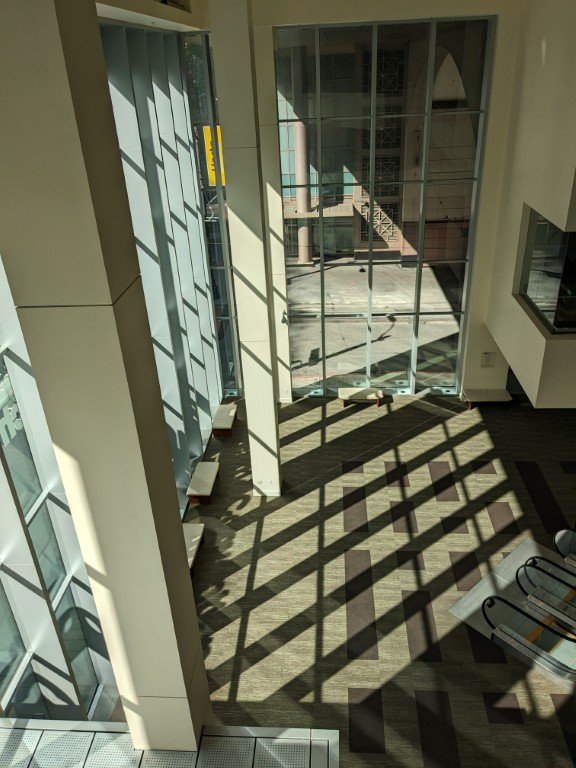
Thirty-eight events used the lower floors in 2019, spanning 101 event days.[3] In 2025, only 12 events used the lower floors, and of those, just seven actually opened the street entrance — on 22 days in an entire year.[4]
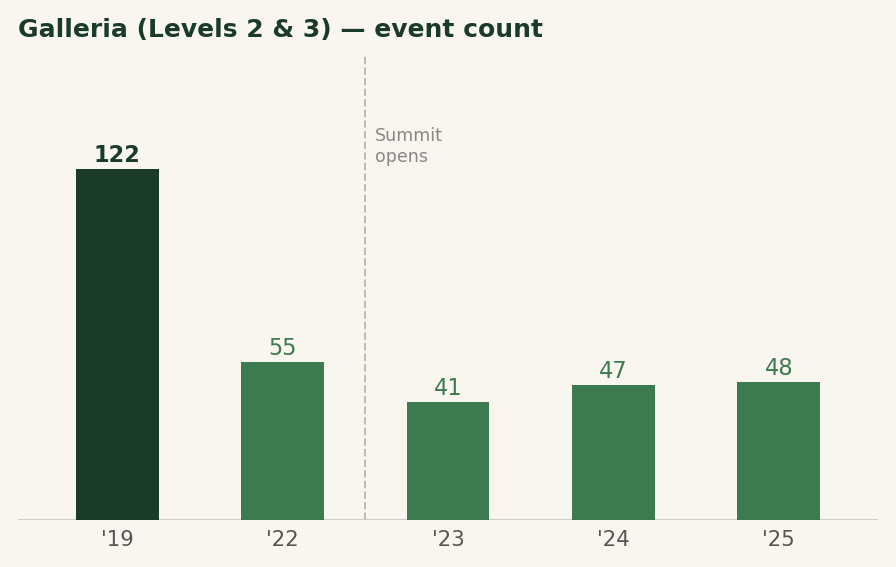
On the south side, 705 Pike is a different story — it's open from morning until night. But the small meeting rooms map a similar arc of decline. The Galleria breakout rooms — Level 2 and Level 3 — hosted 122 events in 2019. Since the Summit opened with larger, more numerous meeting rooms, bookings have dropped by more than half: 41 in 2023, 48 in 2025.
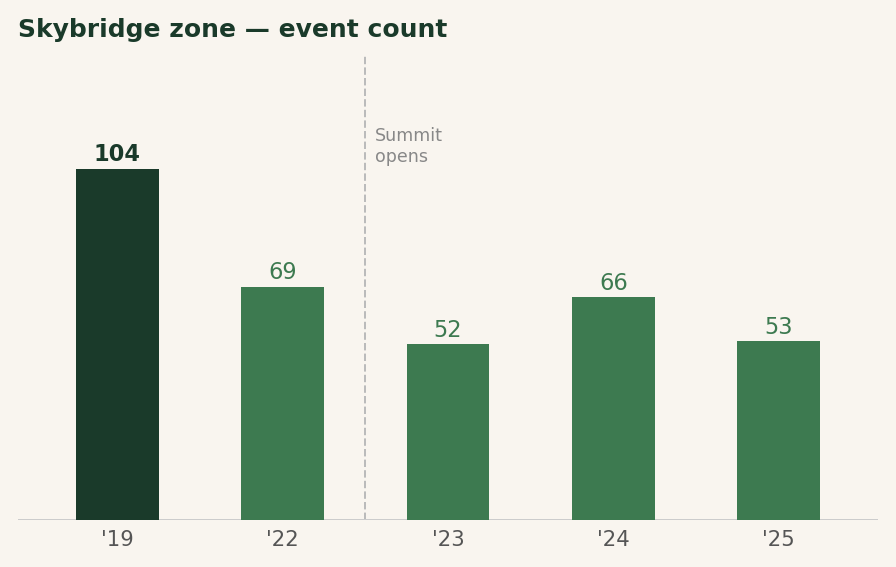
The Skybridge zone — Hall 4EF and the Level 3 breakout rooms — is the building's functional core: high-ceiling, column-free exhibit space that large professional conventions still book. It's the Arch's most resilient zone. The Skybridge itself is also the building's one street-visible signal — colored lights and movement when active, visible from Pike Street below.
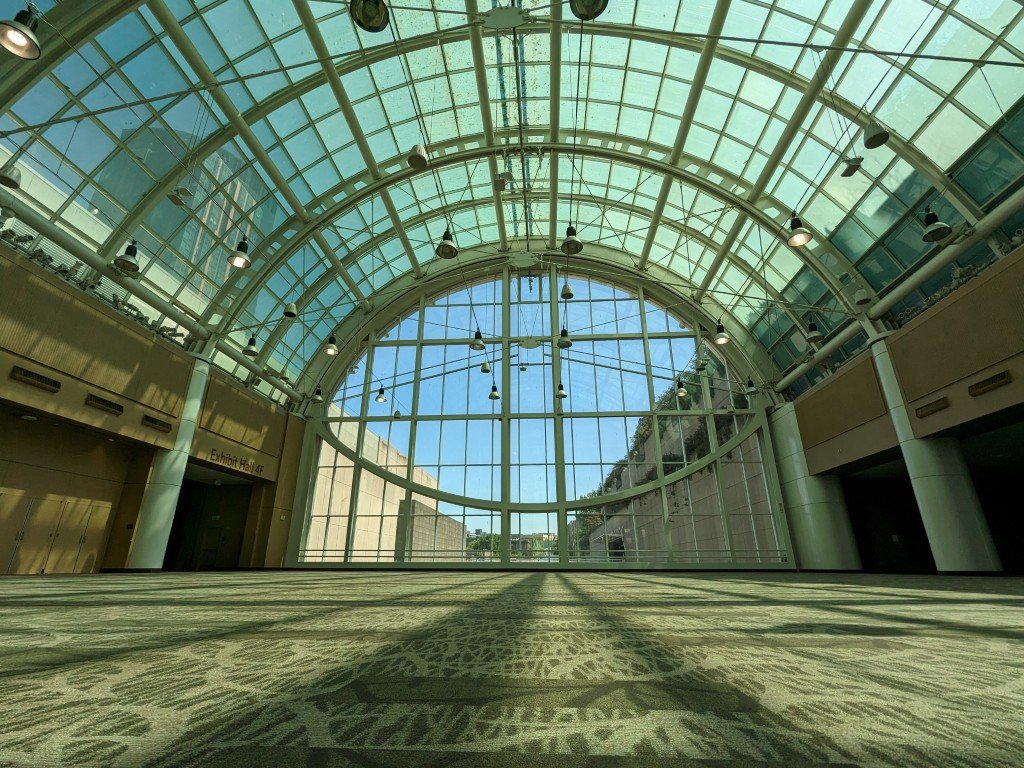
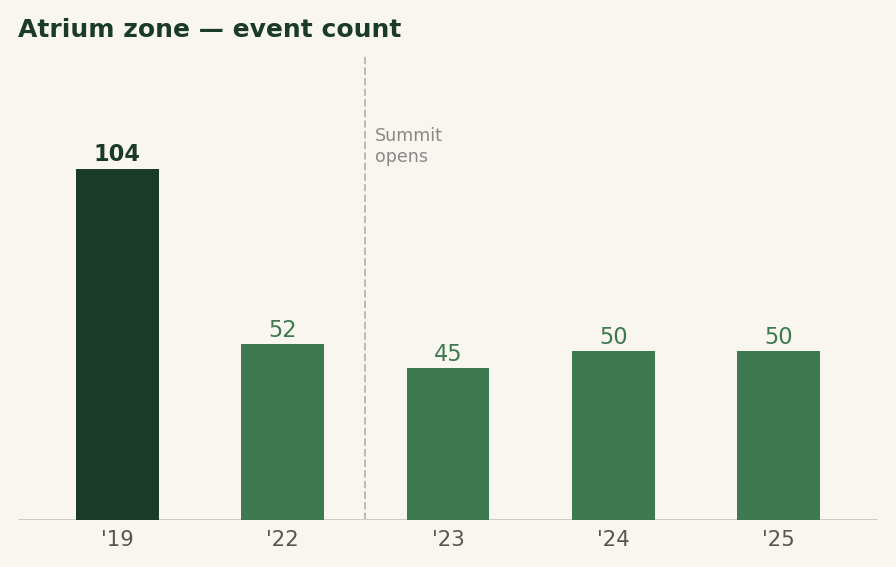
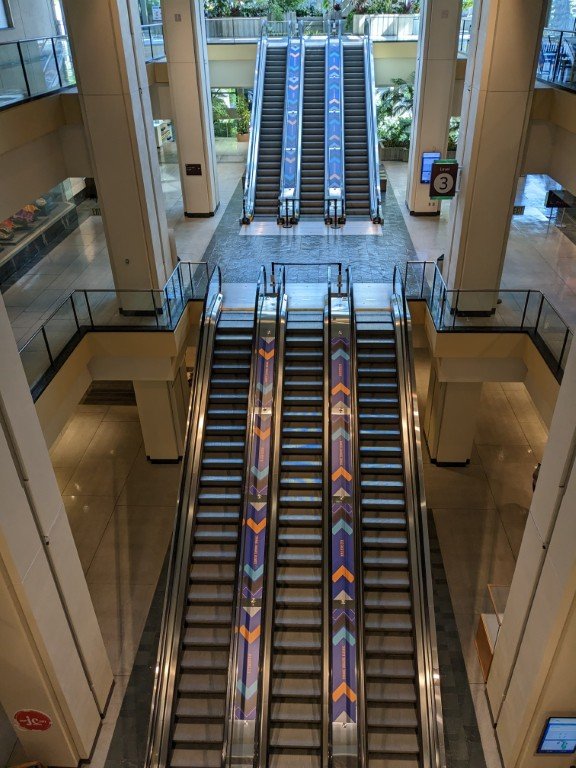
The Atrium Lobby — a soaring interior space adjacent to Freeway Park, at the top of a series of escalators from Pike Street — is the most striking room in the building. But it rarely fills independently. When it does, it's usually as part of an event that books the whole building: the Northwest Flower & Garden Festival runs Hall 4ABCDEF — both zones at once. The most beautiful space in the Arch generates the least demand on its own.
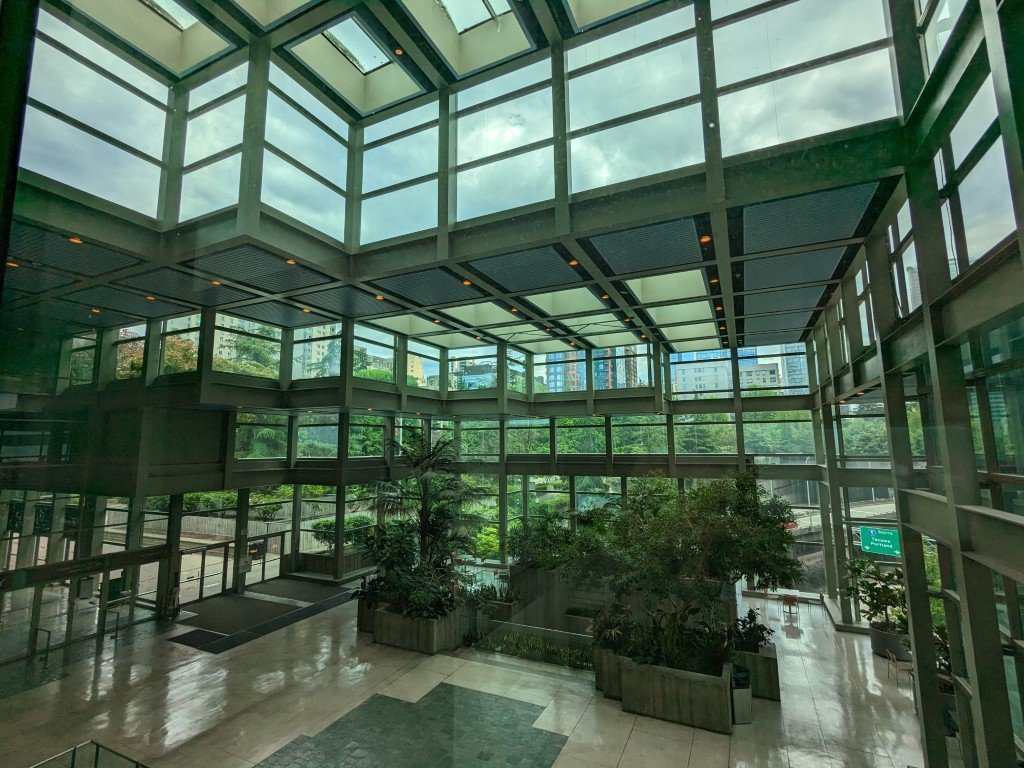
The 6th floor — ballrooms and upper meeting rooms, reached through the Atrium — has windows facing Freeway Park, tinted. Galas, plenary sessions, training events. Nothing registers on Pike Street.
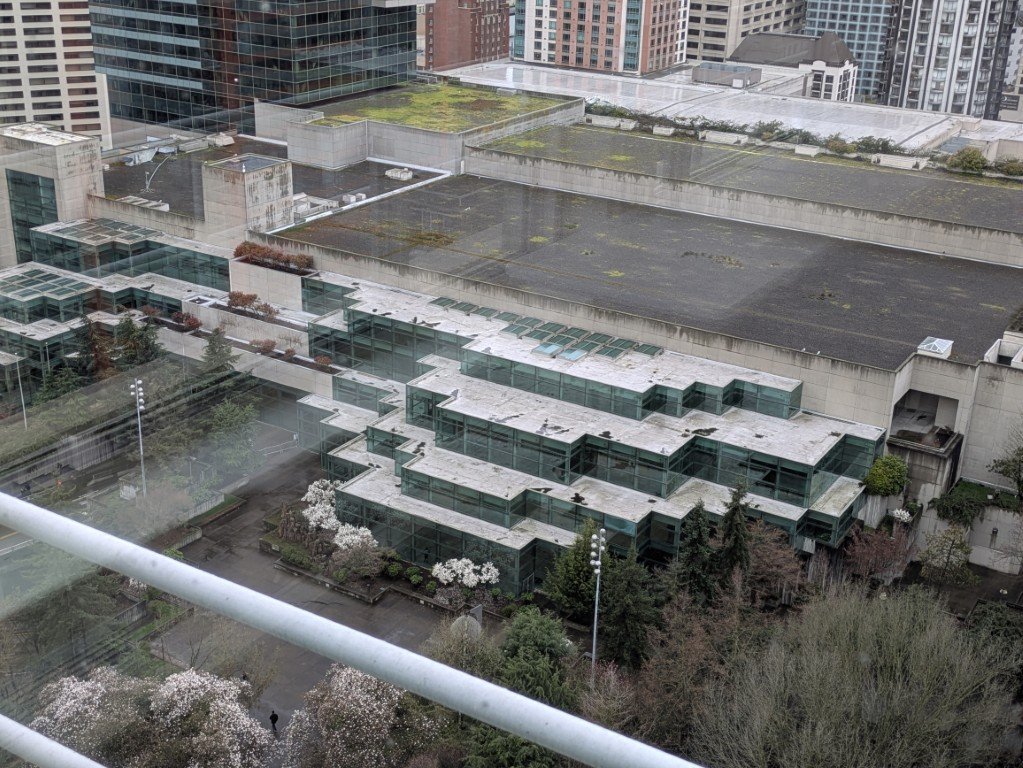
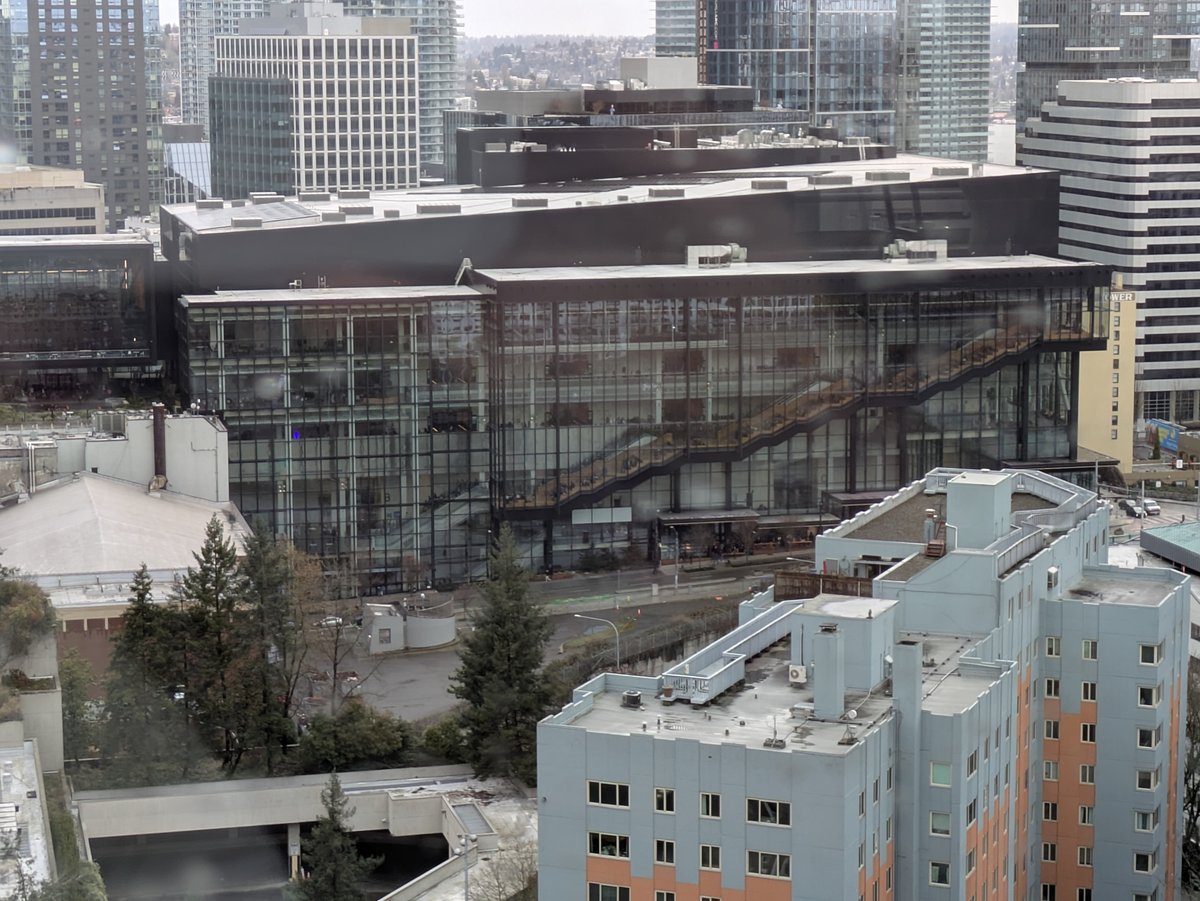
What all four zones have in common: none of them signal their own activity from the street. The Summit's Hillclimb — a glass-enclosed stairway running the full height of the Pine Street facade — shows you people moving inside. The Arch has no equivalent. The Atrium Lobby is at the top of a series of escalators from Pike Street. The 6th floor is two escalators up. The Skybridge zone is reached across a bridge above Pike Street. The one street-visible signal is the Skybridge itself — colored lights and movement, when something is happening.
This is why my original piece called the building dark. A locked door on one side of the street. A trickle of people on the other. Call them black days: not because the building is technically empty, but because you can't feel any warmth radiating out of it.
SCC is looking at these same numbers — the decline in Arch usage isn't news to them. The neighborhood is looking at this same street — the sparse activity isn't news to us. And the architects who built the Summit as an ant farm already know what street-level presence at the Arch looks like.
What will make news is whatever SCC has planned for the Arch in the forthcoming Campus Master Plan (about which I'll have more to say in a future Dispatch).
But for now, it's sufficient to establish that we're looking at the same numbers.
Correction, May 30, 2026: An earlier version gave the 2025 figure for 800 Pike as "60 days for 40 events" in the text. The event count (40) is correct, but the day count was a stale draft number — and it disagreed with this article's own calendar graphic, which was right: 22 days with the street entrance open plus 101 upper-floor (Tahoma) days reached via the Skybridge totals 123 event days, the same measure that gives the 2019 figure of 184. The chart stands as published; only the sentence was wrong. No other figure in this article is affected.
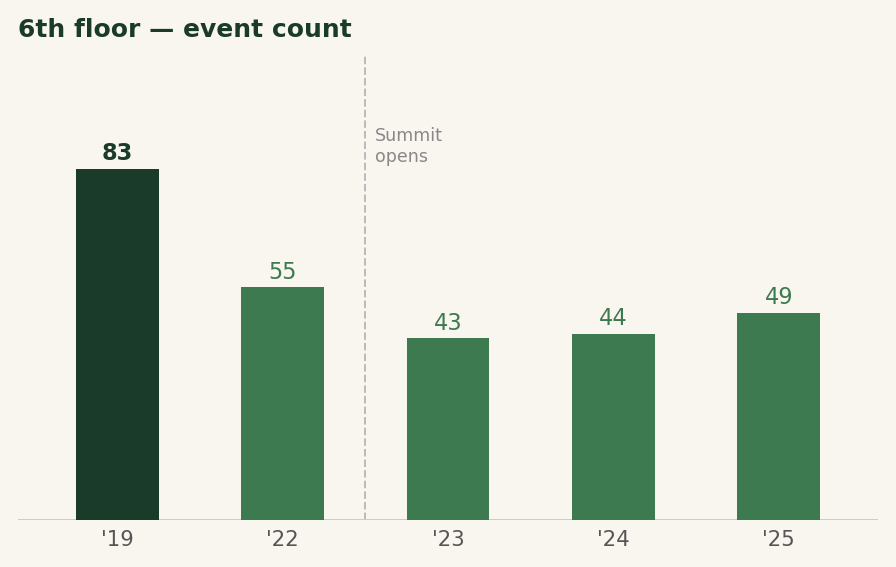
Correction, September 13, 2026: The correction above replaced a right number with a wrong one. 800 Pike logged 131 event days in 2019 and 60 in 2025, not 184 and 123, and the sentence as first published was correct. The higher figures counted Waterfall Suite as part of 800 Pike. The District's own floor-plan booklet puts Waterfall Suite on Level 4 of 705 Pike, beside the Atrium lobby, on the other side of the street; the 800 Pike room on the Tahoma level is Falls Suite. The upper-floor days in the calendar graphic above include Waterfall Suite's days; by the rebuilt count the upper floor alone was in use on 30 days in 2019 and 16 in 2025. The event counts moved the same way: 800 Pike had 53 events in 2019 and 20 in 2025, not 74 and 40, and the May note's "the event count (40) is correct" was wrong; the bar chart of events by year carries the same overcount. The lower-floor figures and the 22 street-entrance days are not affected. The error was found when these figures were rebuilt in a database that cites every figure to the page it was read from; how that happened is at Twice the Space.
On terminology: "dark days" is used loosely in venue discussions but has a specific meaning in the IAVM Convention Center Performance Reporting Framework. Per IAVM, a Dark Day is a contracted day with no functions within a multi-day event — a holiday that falls mid-booking, for example — and is counted as a Use Day, not a measure of building-level emptiness. IAVM's measures for building activity are Event Days (attendees present) and Use Days (any building presence including setup and teardown). The Arch had 194 event days and 274 use days in 2025. The 91 days with no building activity at all (365 − 274) has no IAVM label. ↩︎
Per IAVM, an Event Day is "use of all or part of the venue by one Event Organizer for all or part of one calendar day for the audience of the Event." Move-in and move-out days are not Event Days. A Use Day is any day of occupancy for any purpose under the event contract, including setup and teardown. ↩︎
2019 lower-floor events included: AWS Digital Summit, DevOpsDays Seattle, PASS Summit, Tableau Global Sales Kickoff, BUILD, MozCon, INFORMS Annual Meeting, JADPRO LIVE, ALA Midwinter Meeting, PWX, PAX West, Emerald City Comic Con, Sakura-Con, GeekGirlCon, SEIU 775 Leadership Conference, NCCE, READY, NAIS People of Color Conference, AVID Center Summer Institute, SFB Annual Meeting, General & Special Education Conference, Seattle Interactive Conference, ACMA National Conference, and others. ↩︎
Joint Mathematics Meetings (Jan 8–11), Emerald City Comic Con (Mar 6–9), Sakura-Con (Apr 18–20), BUILD 2025 (May 19–22), Amazon Accelerate (Sep 16–18), SEIU 775 Leadership Conference (Sep 25–26), GeekGirlCon (Nov 8–9). ↩︎
Make a Take / Share a Take▾
Before you pass it on — what's your take?
Sharing a Dispatch piece is taking a position. Take a moment to say what yours is — it travels further, and better, for it.
What do you want to say about this? What struck you — and who needs to hear it?
We don't track clicks. If Make a Take was useful, let us know →
Not sure what to say? Let your own AI help you draft it →
The prompt asks your AI to draft a note in your voice from what the article and its sources actually support — and to push back if you overclaim. Your conversation stays in your AI; nothing is sent to the Dispatch.