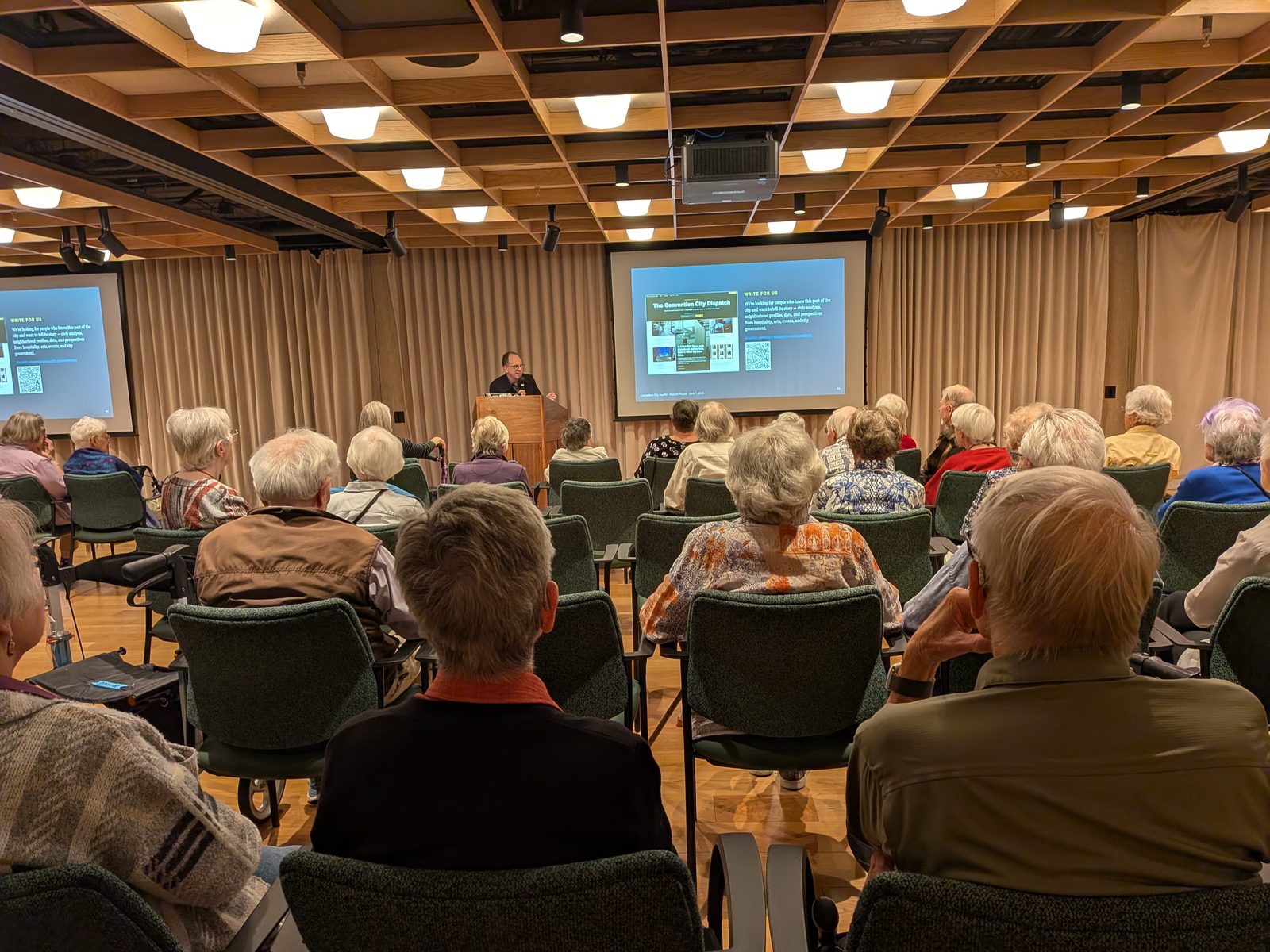
On June 1, a roomful of Horizon House neighbors came out on a Monday evening to talk about the building next door. Thank you — for the turnout, the sharp questions, and the patience for a talk that started with bond covenants and ended with housing.
Thanks especially to the Neighborhoods Committee for hosting and making the room — and to the neighbors from elsewhere on First Hill who came over to listen. That's exactly the kind of neighbor-to-neighbor turnout this work runs on.
Here's the high-level version.
The ask, first: show up. The Washington State Convention Center is a public agency with a public board, and that board meets in public. The schedule is posted at seattlecc.com/governance/meetings-and-minutes. To get on the list, email info@seattlecc.com with your name, company, email address, and mailing address, and ask to be notified of the next meeting. The single most useful thing this neighborhood can do is fill those seats.
Why this room. Horizon House was here before the convention center opened in 1988 — before Freeway Park, before the Summit, before any of it. That long memory is exactly what's missing from the conversation about what comes next. Nobody else nearby has the standing to look at this building with a genuinely civic eye.
The three eras. The first belongs to Jim Ellis. Before he chaired this board, Ellis was the civic lawyer behind Forward Thrust — the package of voter-approved bond measures, passed by King County in the late 1960s, that built a whole generation of public goods at once: Freeway Park, the aquarium, parks and pools across the county, the Kingdome, and, through the regional agency he helped create, the cleanup of a polluted Lake Washington. He was a municipal-bond lawyer who gave away the profits from his own deals so there'd be no whiff of impropriety, and he turned down Nixon's offer to run the brand-new EPA because he thought he could do more good here. That's the civic temperament the convention center was born under.
The second era is the expansion era. Under its longtime chair — a hotelier who knew the business cold and ran a disciplined board — the center pulled off its single biggest project, the Summit building across Pine. It got built, and that is no small thing.
The third era starts at the end of July, when several seats on the board come up for appointment. Who fills them — and whether any of them carry this neighborhood's civic eye rather than only the hospitality industry's — is the open question the whole evening kept circling back to.
Where the money goes. A dedicated 7% lodging tax on every hotel-room night — a separate levy that exists only to fund the building, on top of the ordinary sales tax — flows straight to the convention center, every penny of it, and most of that turns right around to service the debt on the buildings. Food and beverage dwarfs hall rentals — it's not the kind of place you'd rent for a family reunion. And there's a balloon payment waiting at the end of the decade. None of that is hidden, exactly. It's just not anywhere the public would think to look.
The best part was the Q&A. Someone in the audience had, decades ago, sat in Jim Ellis's office as a low-income housing developer and worked with him to build housing as the convention center went up — a story that doesn't get told anymore. That's exactly the story I came to hear. We talked about the Lid I-5 vision, about why Seattle Center feels like a different kind of public space, and about the simple levers a neighborhood actually has: show up, pay attention, write about it, and ask hard questions of the officials who make the appointments.
The invitation. The Dispatch is looking for people who know this part of the city and want to help tell its story — civic analysis, neighborhood history, old photographs, a steady eye on those monthly meetings. I'd be glad to work with you.
Thank you again, Horizon House.
Make a Take / Share a Take▾
Before you pass it on — what's your take?
Sharing a Dispatch piece is taking a position. Take a moment to say what yours is — it travels further, and better, for it.
What do you want to say about this? What struck you — and who needs to hear it?
We don't track clicks. If Make a Take was useful, let us know →
Not sure what to say? Let your own AI help you draft it →
The prompt asks your AI to draft a note in your voice from what the article and its sources actually support — and to push back if you overclaim. Your conversation stays in your AI; nothing is sent to the Dispatch.