Read this with your own AI▾
This piece was built with the help of AI, from public records — here's how. Read it back with your AI: choose how you want to read it, copy the prompt, and interrogate the article yourself.
Your conversation stays in your AI — nothing is sent to or stored by the Dispatch. The built-in grounding line keeps the answer tied to the Dispatch's own reporting, and asks your AI to flag — not invent — anything that needs more.
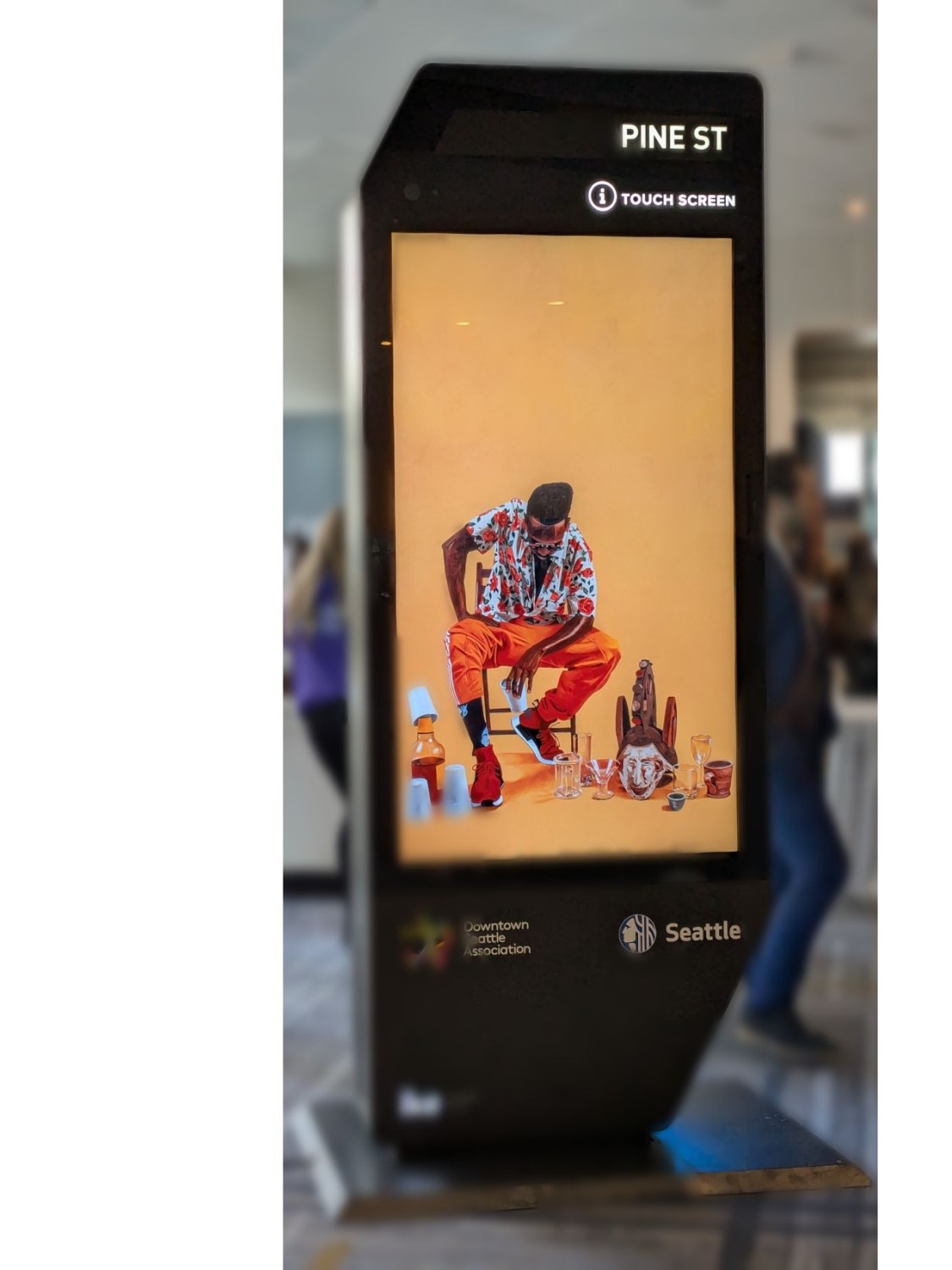
On Tuesday morning, at the corner of First and Pike, Jon Scholes, president and CEO of the Downtown Seattle Association (DSA), picked up a pair of oversized scissors and cut a ribbon. Behind him glowed an eight-foot screen — the first of fifty digital kiosks the DSA plans to install on the city's sidewalks.
"Seattle is a tech town," Scholes said, by GeekWire's account, "and we finally have a 21st-century modern wayfinding system."
Whoa, hold on there a second, Jon.
Sounds to me like the real tech town is Columbus, OH, home of Orange Barrel Media, maker of the IKE Smart Kiosk, which by its own count is deployed in:
Arlington, TX
Atlanta, GA
Aventura, FL
Baltimore, MD
Berkeley, CA
Cleveland, OH
Cincinnati, OH
Columbus, OH
Coral Gables, FL
Denver, CO
Detroit, MI
Houston, TX
Miami, FL
Minneapolis, MN
Oakland, CA
Phoenix, AZ
Raleigh, NC
San Antonio, TX
San Diego, CA
St. Louis, MO
Tampa, FL
Tempe, AZ
West Palm Beach, FL
and now: Seattle, WA
Aren't we special.
It's a digital billboard.
Sure, it has wayfinding and apps. So does everyone's phone. And the idea isn't even new — it's been in the works for years.
The one useful feature, a 911 button, could fit on something the size of an intercom without blocking the sidewalk for 20 years or more.
Who gets what?
The DSA is a private business-improvement association — a BIA, not a public body, and it owes the public no fiduciary duty. And now the public sidewalks will have private digital billboards to fund a private BIA.
The plan is to expand into other neighborhoods — Ballard, the U District, West Seattle, and SoDo. But the permit, and the revenue stream that comes with it, belongs to the Downtown Seattle Association. Whether a kiosk on a Ballard sidewalk sends any of its ad money back to Ballard, or simply upstream to Downtown's BIA, is an open question — and the contract that would answer it isn't public.
Either way, it's a strange bargain for the neighborhood that says yes. The host district gets the twenty-year billboard on its own commercial street. Downtown's association banks the revenue and curates the display. And the paid ads — sold by an out-of-state company — can push a delivery app or a national chain as easily as the local shop three doors down, on a screen the neighborhood didn't design and doesn't control. The sidewalk is Ballard's. The asset is Downtown's.
Now, to be fair, the DSA doesn't pocket all of this as profit. It says the revenue goes back into downtown — the ambassadors in the bright vests who pressure-wash the sidewalks, walk tourists to Pike Place, and check on people sleeping in doorways. But look at the scale. The ambassador program is an $18-million-a-year operation, paid for by an assessment on downtown property owners; it runs with or without these screens. The kiosks, at their rosy $1.1 million projection, would add about six cents to every dollar that program already spends.
So what would it actually take for the public — the people who own the sidewalk — to see a dime? The city's cut is whatever the ads earn above $1.1 million a year. At the 32.5% gross-revenue share the Council's own central-staff memo describes, the kiosks have to gross about $3.4 million a year in advertising before the city collects anything beyond the flat $13,000 it charges for the permit. Ads are sold by the impression, so $3.4 million is roughly 340 million ad views a year — call it 30,000 a day at every one of the thirty downtown kiosks, every day, forever. Pike Place might manage that. Ballard will not. And even Pike Place can't rescue the arithmetic, because there's only one Pike Place: to fill the bucket you'd need something like ten corners that good.
And we don't have to guess, because Berkeley already ran this exact experiment — and Berkeleyside got the numbers. Same company, thirty-one kiosks, a walkable college town. Orange Barrel told Berkeley back in 2018 that the ads would throw off about $830,000 a year — roughly $27,000 a kiosk. The actual haul: $75,000 a year, the contract minimum, and not a dollar more, three years running. In 2024 each kiosk earned less than a fifth of what the company had promised. Berkeley didn't get a windfall. It got the floor.
Orange Barrel runs IKE as a national network — two dozen cities — and it sells the advertising and keeps the books, while each host city takes a contractual share. The screens can run national, regional, or local spots, but what comes back to a city tracks the operator's sales and accounting, not whatever shows on a given screen. Berkeley, wired into that same machine, collected its floor and not a dollar more. Which tells you what Seattle is actually buying. A junior revenue share in a national ad network.
So how many kiosks before any of it reaches the city? On Berkeley's experience, the answer is likely never.
And the money is only part of what the DSA gets. A quarter of every screen is reserved for the "public benefit" — civic notices, public art — curated by the same private BIA that banks the ad revenue. Now, there's nothing wrong with showing downtown in a good light; everyone who lives here wants a clean, safe, thriving downtown. The catch is who gets to narrate it. The organization that pushed these kiosks onto the sidewalk now holds a twenty-year channel to decide which civic messages run on public land — and a private group that gets to author the public realm will tend to cast itself as the one keeping it nice. That's less a public benefit than an image-burnishing machine.
But the self-flattery is the least of it. A sidewalk is public ground — the oldest piece of the public square, open by default to everyone. These screens bolt a permanent communications layer onto it and hand one private organization the keys.
And the DSA is not a neutral notice board. It rates candidates on a public scorecard, it has spent nearly a quarter-million dollars on ballot-measure campaigns, and it exists to advance downtown business interests. So this isn't a transit agency selling content-neutral space on its own platforms — it's an interested party, with a record of taking sides, handed editorial control over a slice of the public square.
Then there's the directory — the part that's actually supposed to point you to a business. Who curates it: the neighborhood that knows the block, the city, IKE's staff back in Columbus, or the DSA? Where does the data come from, who keeps it current, and who answers for it when the screen sends you to a place that closed last year, or quietly ranks a dues-paying member over the shop three doors down? A directory is only as good as its curator — and on a public sidewalk, no one has said who that is.
And look at where they end up. The two places a tourist might actually want help are out: the Market is a warren no kiosk could guide you through, and its historic district wouldn't allow a glowing ad sign anyway; the new waterfront would take one fine, but no one is going to bolt an advertising pillar onto the park the city just spent years and a fortune rebuilding. So the screens settle where they're tolerated — ordinary downtown corners on a street grid, exactly where a visitor is least likely to be lost.
What's the fix?
None of this had to be built this way, and the fix isn't a bigger cut of the money — it's who gets to decide. Start with the easy part: publish the agreement — the revenue split, the threshold, what the city is actually projected to collect — so residents can read the deal before the next batch goes up instead of after.
The city's own Design Commission declined to recommend it. The Council approved it anyway — and in doing so it didn't just permit some kiosks; it delegated the decision to a single downtown business association via citywide permit, and handed each neighborhood's business board an option to get one. Once that delegation happened, there was no door left for the public to weigh in. The people who live on the block get exactly the say they got downtown: they find out when the screen lights up. A neighborhood ought to be able to say no to a twenty-year billboard on its sidewalk, before it's bolted down. There is no mechanism for that, because the prior Council didn't build one.
And the kiosks are only the newest piece. By permit and ordinance, the city keeps handing parts of the public realm — the sidewalks, the cleaning and ambassador crews, now a twenty-year civic-broadcast channel — to a private body no one elected. The public's only assigned role is to watch.
And the ceiling is no comfort. The ordinance authorizes up to eighty kiosks, but the city's share doesn't begin until ad sales clear $3.4 million a year — roughly eight Pike Place Markets' worth, and the city has one. The rest would be ordinary corners that earned about five thousand dollars apiece in Berkeley; to clear the line you'd need hundreds of them, the sidewalks as thick with ad pillars as they are with stop signs. That's the only arithmetic in which the public ever comes out ahead, and it's the trade on offer.
Phase Two isn't built, and it can't move without the Mayor's signature — and Mayor Katie Wilson hasn't signed it. There's no reason to expand this network beyond DSA's own footprint.
A note on the numbers: the 32.5% gross revenue share, the $1.1 million threshold, and the $13,000 permit fee come from the Council's central-staff memo (CB 120992) and PubliCola's reporting; the Berkeley figures ($830,000 projected, $75,000 actual, roughly $4,967 per kiosk in 2024) are Berkeleyside's. The "340 million ad views / 30,000 a day" figure is my own estimate using a typical street-level digital-ad rate (~$10 per thousand impressions) — an order-of-magnitude illustration, not a number the DSA has published. The $18 million is the Metropolitan Improvement District's annual budget; how much kiosk revenue is earmarked for ambassadors specifically, versus DSA programming generally, isn't public.
Sources
- Ribbon-cutting and launch: GeekWire (Kurt Schlosser, June 9 2026)
- The 32.5% gross share and the MOU: Seattle Council central-staff memo, CB 120992
- The $1.1M threshold, the city's overage-only cut, and the $13,000 floor: PubliCola (Erica Barnett, June 25 2025)
- Program scope and the post-vote MOU: The Urbanist (May 12 2025)
- The Design Commission's refusal to recommend: The Urbanist (Sept 2024) and the city's design-commission record
- The 6–2 vote and the amendment earmarking city revenue: Seattle City Council Blog (June 24 2025)
- The Berkeley comparison: Berkeleyside (Oct 10 2025)
- The Miami net-vs-gross fight: Biscayne Times
- The MID and ambassador budget: Real Change and the Mayor's office (2023)
- The DSA's candidate scorecard and ~$238K in ballot-measure spending: DSA advocacy and Washington PDC (contributions dataset)
Make a Take / Share a Take▾
Before you pass it on — what's your take?
Sharing a Dispatch piece is taking a position. Take a moment to say what yours is — it travels further, and better, for it.
What do you want to say about this? What struck you — and who needs to hear it?
We don't track clicks. If Make a Take was useful, let us know →
Not sure what to say? Let your own AI help you draft it →
The prompt asks your AI to draft a note in your voice from what the article and its sources actually support — and to push back if you overclaim. Your conversation stays in your AI; nothing is sent to the Dispatch.