Read this with your own AI▾
This piece was built with the help of AI, from public records — here's how. Read it back with your AI: choose how you want to read it, copy the prompt, and interrogate the article yourself.
Your conversation stays in your AI — nothing is sent to or stored by the Dispatch. The built-in grounding line keeps the answer tied to the Dispatch's own reporting, and asks your AI to flag — not invent — anything that needs more.
On one scoreboard, Seattle already won FIFA.
The Athletic ranked it the number-one host city in the country, tied with Atlanta; Sports Illustrated put it near the top of its own sixteen-city ranking. Lumen Field (aka Seattle Stadium) drew a perfect ten for location and aesthetics. We are, by acclamation, the nicest host city in America to watch a World Cup match.
But by the measure that pays the bills, we came in last. Bloomberg found that online flight bookings for the tournament dates ran twenty-one percent below the same window last year — the only American host city to see a decline, against gains of roughly seven percent in New York and eleven percent in Houston. The most-praised host city in the country was also the only one where flight bookings fell instead of climbing.
Some of it's beyond our control: A strong dollar made the whole country expensive for foreign fans. Federal border friction and a Canadian boycott kept our nearest cross-border neighbors home.
And some of it's geography. The fans flying from London book into Boston, the cheap gateway, and drive from there. Asking them to fly to the far upper-left corner of the country, one of the most expensive places in it, to see the teams we happened to draw, was always going to be a hard sell. We can throw a perfect party and still lose the competition on the schedule and the airfare.
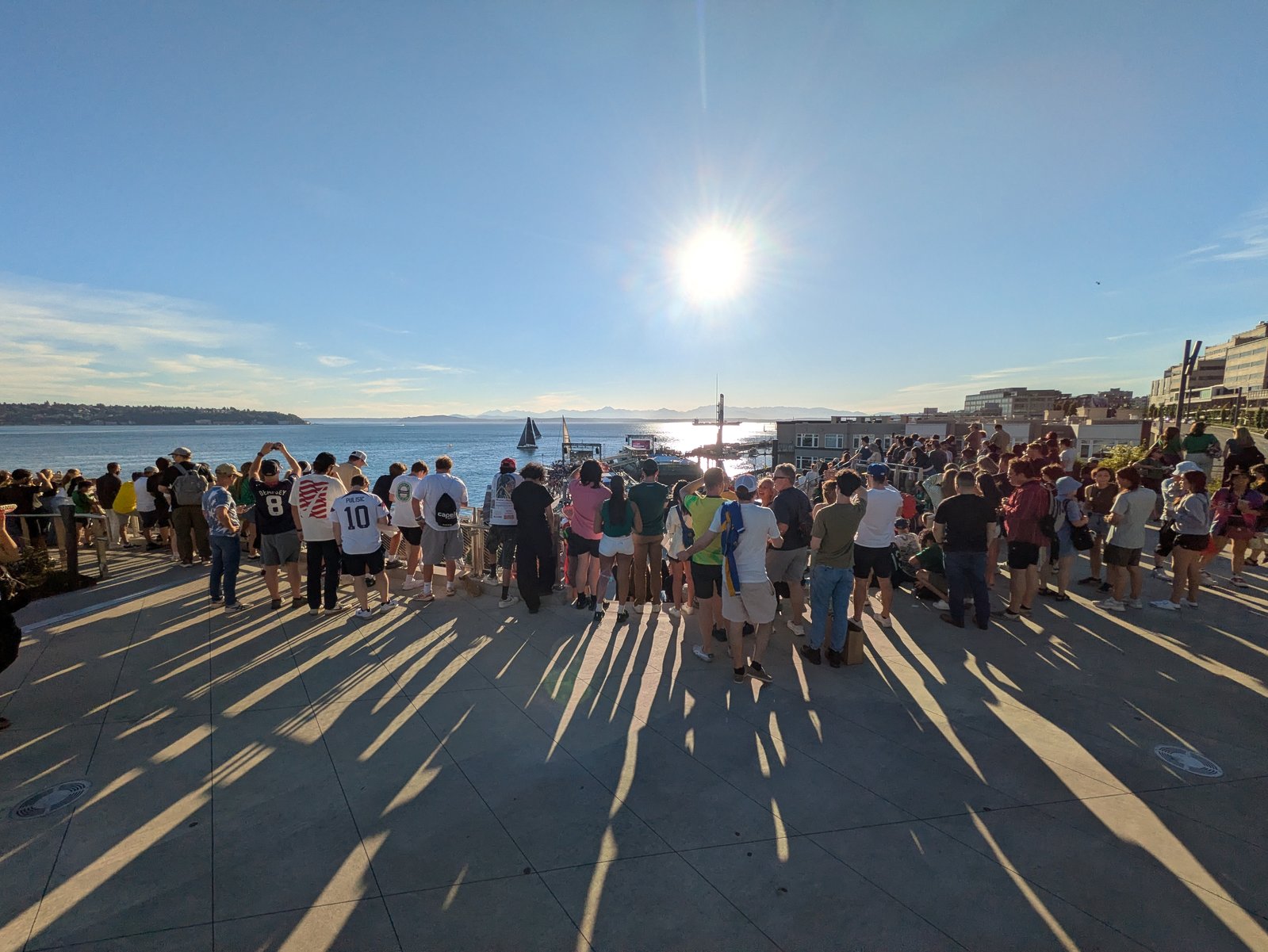
And yet our outdoor parties at the Waterfront, Seattle Center, Occidental Park have been rocking, and the streets are full during match days.
So who's filling them?
It's the locals. The sports economist Victor Matheson told Bloomberg the region's own fans would make up some of the missing international traffic, but not all of it; Anthony Anton of the Washington Hospitality Association watched the hotels fill with people driving in from the rest of Washington and the states next door, not visitors from abroad. The crowd in Occidental Park was, overwhelmingly, a regional crowd.
We threw a party for the world, and they were a whole bunch of long-distance no-shows. But our neighbors showed up, and that made all the difference — it's been wonderful.
Unless you're a hotelier. The hotel-run[1] destination marketing organization Visit Seattle spent its pre-tournament advertising on the United Kingdom and India, with a smattering on Germany and France — none of whom ended up having a team playing here. Its chief business officer, Kelly Saling, told Bloomberg those markets were picked for their travel sentiment, access to Seattle, and income level — before the draw assigned the matches.
Fair enough — but it's always harder to convince international visitors to fly here than it is to entice people to drive or take the train. If we're looking for a crowd to fill the local restaurants, any hungry mouths will do. It's only when we set ambitious targets for "heads in beds" that we end up measuring success by out-of-town visitor counts.
The convention center is graded on the same heads-in-beds scale, and the bookings that plan depends on are already coming loose. At its May board meeting, the PFD's own numbers showed cancellations mounting against future years and the out-year pipeline running soft. And the people who own the hotels aren't betting on a rebound either: Anton told Bloomberg his members are alarmed about their finances, with many of their properties carrying loans that are already underwater.
But there's another way to keep score, another way to keep us in the game, one that plays to our strengths. Seattle is the biggest city in the Pacific Northwest corridor, from Vancouver, BC down to Portland — the hub of a region full of highly technical, highly educated people who benefit from having somewhere to convene. And the same way that we're perfectly capable of throwing a wonderful month-long summer party mostly for the people who live in the Pacific Northwest, we're also well positioned to replicate that pattern with year-round activation for our other public spaces.
That's why I believe that the future of our region's convention centers depends on more than just the competition with other cities for big national and international conventions.
As we're seeing this summer, the foundation for Seattle's success rests on the people who already live in the region.
Picture what we'd see if Seattle Convention Center — one million square feet of publicly owned halls — were run as a three-ring circus, 365 days a year. What if, every day, something's on offer, and if it's not a big conference or a high-revenue catered dinner, it's free community classes, coding one night and knitting the next, with food trucks out back. Allowing the community to use the space to incubate the next thing — whether it's robotics or rock stars.
People used to commute to Seattle for work because their jobs told them to do it, and that's how they got paid. The commuting office worker has become less common: by CBRE's March 2026 count, about a third of our downtown office space now sits vacant.
But what if — hear me out — people from the entire region commuted to Seattle because that's how they get paid? In other words, what if being in downtown Seattle tangibly helped your career? Imagine if Seattle offered the region the best lineup of open venues where you could try new things, exchange ideas, attend lectures, hold meetups, and otherwise do things that spark conversations, connection, and community.
Our region is among the most educated in the country — Seattle itself is the most-educated big city in America — and we have a history of starting world-changing businesses. And the action is happening already. Look at AI House on the waterfront at Pier 70 — a public-private partnership the City of Seattle helped stand up just last year. In its first year, by its own count, nearly 20,000 people came through its events and programming, and its rooms now run full, event after event. That isn't proof a million square feet fills itself. It's proof the demand is real, growing, and already bumping against the size of the room — and we happen to own a much bigger one.
And here we are, with an expanding convention center campus, with large-scale public spaces that can be reconfigured and customized for just about any purpose.
None of this costs us a convention. The marquee shows stay — Comic-Con, PAX, the trade shows booked years out. What I'm after is the rest of the calendar and the rest of the building: the days and the halls not carrying a paying event, opened up on instant bookings to flexible space with a fixed menu of setup options. Some of that fills with paid bookings and catered dinners that help service the debt. Some of it is free — because a building the public owns and the public funds should give the public something back, the way a library does. That isn't a hole in the budget. For a civic building, it's the point.
If we do that, the daily foot traffic will follow. Then the retail. And then you paint the sidewalk and put up fancy lighting.
Not the other way around.
I'm not proposing that we turn our world-class convention center into a rec room.
But I am saying that we don't have to choose between the center and the commons.
Look at Helsinki. It built Oodi — a downtown public commons it calls the city's living room, set at the center of the capital opposite the Finnish Parliament. Helsinki decided public convening was worth building for, and built it. We don't need to build our own Oodi — we have something cheaper and closer to hand: a convention campus we already own, and already pay for, that can take on some of that civic load itself.
Our city showed last Friday that it knows precisely how to make visitors comfortable in our outdoor living spaces. Now we just have to pull off the same trick indoors.
Visit Seattle is a 501(c)6 business association overseen by a board of predominantly hotel executives. It is funded mostly by the STIA — a 2.3 percent fee on Seattle hotel-room nights, projected at $21 to $24 million a year — plus a separate annual marketing payment from the Seattle Convention Center: $11.5 million in 2025, rising to $12 million in 2026. ↩︎
Make a Take / Share a Take▾
Before you pass it on — what's your take?
Sharing a Dispatch piece is taking a position. Take a moment to say what yours is — it travels further, and better, for it.
What do you want to say about this? What struck you — and who needs to hear it?
We don't track clicks. If Make a Take was useful, let us know →
Not sure what to say? Let your own AI help you draft it →
The prompt asks your AI to draft a note in your voice from what the article and its sources actually support — and to push back if you overclaim. Your conversation stays in your AI; nothing is sent to the Dispatch.