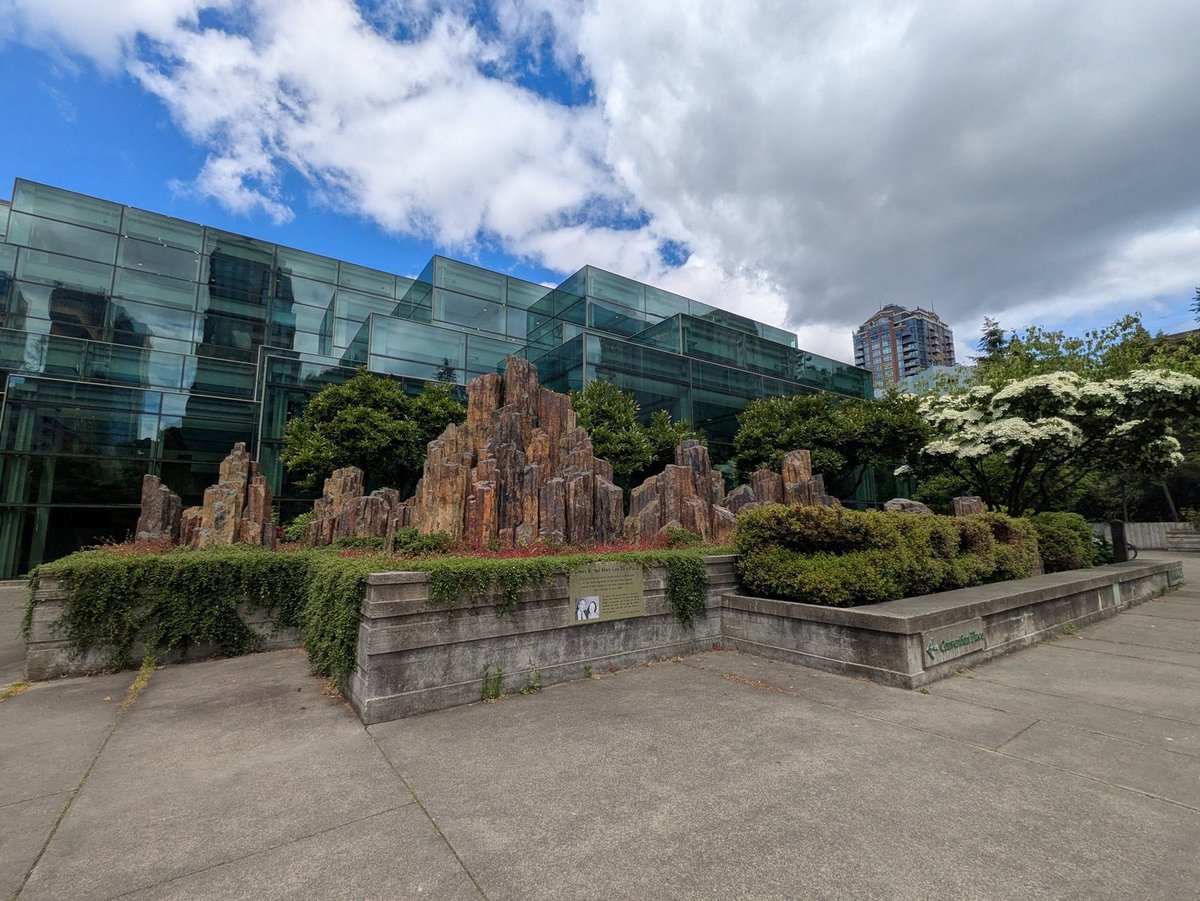
Fifty years ago today, on the Fourth of July, 1976, Seattle built a 5.5-acre-garden park, the first of its kind, on a lid over the Interstate 5 canyon between downtown and First Hill. Today it's called Jim Ellis Freeway Park.
As a boy from a well-off Seattle family during the Depression, Jim noticed the kids who came to school with no lunch. He started carrying an extra sandwich — "my mother always makes too much," he'd say. His father didn't want his sons growing up with silver spoons in their mouths, and so he sent Jim and his younger brother Bob into the woods to build a log cabin by hand; three summers of it made the two of them inseparable. Then, in a German winter in 1945, the war took Bob, and grief nearly took Jim after him — until his wife, Mary Lou, posed a question: "Why not make your life count for his?"[1]
And he did. When Lake Washington was so thick with sewage the beaches were closing, the up-and-coming municipal finance lawyer helped build the public agency — Metro — that cleaned it, and handed the city back a lake it could swim in. He wrote Forward Thrust and carried it to the ballot, and it bought parks and pools and trails. He built Freeway Park as a highway lid. He also wanted to bring light rail to Seattle over fifty years ago, but it fell short of the 60% supermajority it needed.
When the state moved to put a convention center on the next span of that same I-5 lid, an early sketch alarmed him — it seemed to set the hall on the park itself — and he called the governor to tell him to take the concept out of his park. He was assured it would rise beside the park, not on it, and it did. They put Ellis on the board that built the Washington State Convention Center, and he led it for two decades. When the expansion threatened to displace the low-income housing on its footprint, he was the one who insisted the thing be built with housing, enough that by the time it was finished the district had put up or rebuilt three low-income units for every one it tore down.
Last year the convention center hired architects to draw a master plan for its campus, and in a slide shown to the board in February they marked the little courtyard on the north edge — the one with the native basalt rockery and the dedication plaque that reads "James R. and Mary Lou Ellis Plaza" — and called it "UNDER UTILIZED."
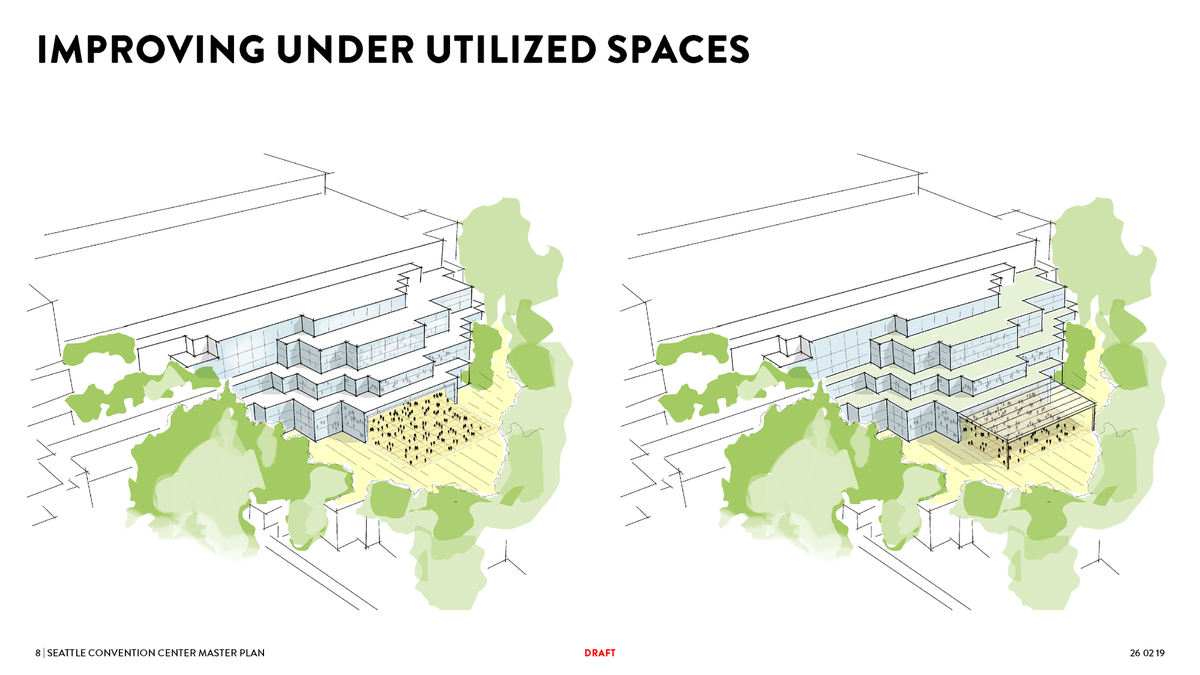 From the convention center's own master-plan deck — marked "DRAFT," February 19, 2026 — under the heading "Improving Under Utilized Spaces." The courtyard shown is the Ellis Plaza: activated at left, roofed as a covered pavilion at right. An early-stage concept, not a final design.
Meanwhile, I look at the convention center itself and call it "UNDER UTILIZED" — not idle, exactly; it books private events. But it's all but closed to the public. Too many large exhibit halls, small meeting rooms, everything in between, open only to whoever can afford to rent them, because these spaces have become the high-cost option for premium catered events rather than a low-cost or no-cost public meeting space like a park or a library.
We should be filling every space, every day, with people and activities and life, turning the geographic center of Seattle into a daily destination for everyone in the city and the region.
On the commemorative plaque, you can read Ellis's own words: "For anyone who may be tempted to chase these dreams, never doubt that your vision can happen."
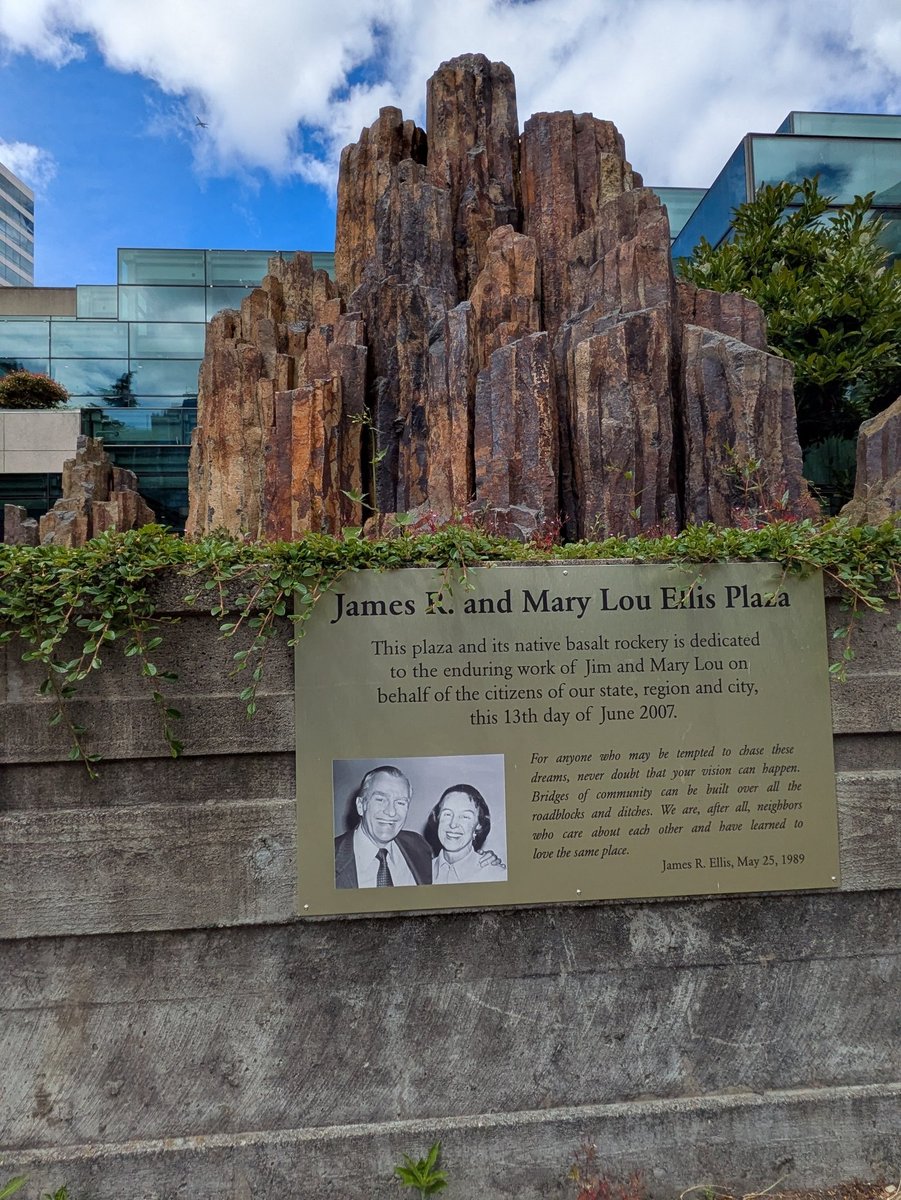 The plaque in the James R. and Mary Lou Ellis Plaza. (Ivan Schneider, June 2026)
No doubt.
And we'll have extra sandwiches.
Ivan Schneider lives on First Hill, near the convention center campus, and writes about its governance for the Convention City Dispatch.
The details of Ellis's early life — the extra sandwich, the log cabin he built with his younger brother Bob, and Mary Lou's question — are drawn from his memoir, A Will to Serve: Stories of Patience, Persistence, and Friends Made Along the Way, by Jim Ellis and Jennifer Ott (Seattle: HistoryLink, 2024) — his account of the civic career that gave Seattle its cleaned-up lake, Forward Thrust, and Freeway Park. ↩︎
Make a Take / Share a Take▾
Before you pass it on — what's your take?
Sharing a Dispatch piece is taking a position. Take a moment to say what yours is — it travels further, and better, for it.
What do you want to say about this? What struck you — and who needs to hear it?
We don't track clicks. If Make a Take was useful, let us know →
Not sure what to say? Let your own AI help you draft it →
The prompt asks your AI to draft a note in your voice from what the article and its sources actually support — and to push back if you overclaim. Your conversation stays in your AI; nothing is sent to the Dispatch.