Read this with your own AI▾
This piece was built with the help of AI, from public records — here's how. Read it back with your AI: choose how you want to read it, copy the prompt, and interrogate the article yourself.
Your conversation stays in your AI — nothing is sent to or stored by the Dispatch. The built-in grounding line keeps the answer tied to the Dispatch's own reporting, and asks your AI to flag — not invent — anything that needs more.
The Office of the Washington State Auditor released the Washington State Convention Center's audited financial statements this morning — report 1040373, covering January 1 through December 31, 2025.
The good news
- Operating revenue rose for the fourth year running — $47.1 million in 2023, $61.3 million in 2025.
- Attendance reached 463,353, on twenty-three fewer events than the year before.
- Hall rental revenue rose 35 percent.
- No new bonds, and every scheduled payment made — though the note to King County grew by $4.6 million, as unpaid interest was added to the principal.
Here are three charts, built by the Dispatch using the district's own schedules.
1. Where the money came from, and where it went
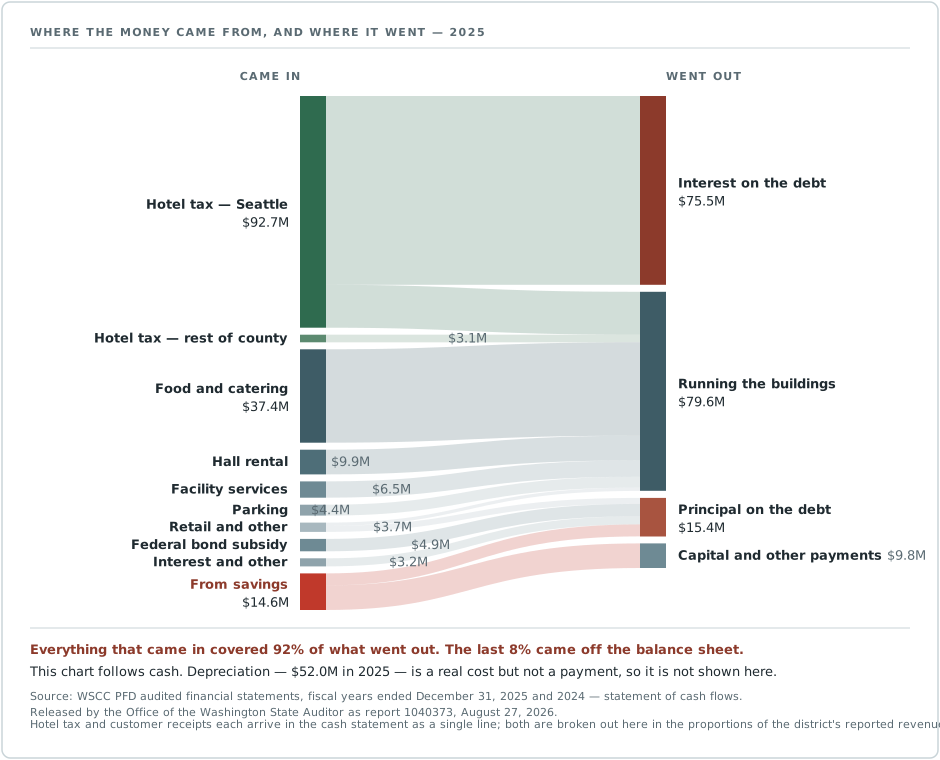
The district ran on two streams. Hotel tax brought in $95.7 million in cash, down from $98.5 million the year before. That is what the district received and kept, net of the lodging tax it collects and passes on to the state, the city and the county. Measured as revenue for the year rather than cash, the figure used later, it is $98.4 million.
Almost all of it is Seattle's seven percent. A second, smaller tax charged across the rest of King County brought in $3.1 million — and that piece fell by half, from $6.4 million the year before. Everything the buildings themselves earned, from hall rentals and catering to parking and storefronts, brought in $61.9 million, which was up.
Most of what the buildings earn is food. Catering and concessions brought in $37.0 million — sixty percent of operating revenue, and more than hall rental, facility services, parking and the storefronts put together.
Against that, interest on the debt alone took $75.5 million, and running the two buildings took $79.6 million. Add principal payments and construction, and the year cost about $180 million against about $166 million that came in.
The difference — $14.6 million — came off the balance sheet. Cash and investments fell from $120.6 million to $106.0 million over the twelve months.
One large cost is missing from that chart, deliberately. It follows cash, and depreciation — the accounting cost of the buildings wearing out, $52.0 million in 2025 — is not a payment to anyone. Count it, as the audited statements do, and the year's operating result becomes a loss of $71.0 million.
2. What it owes each year
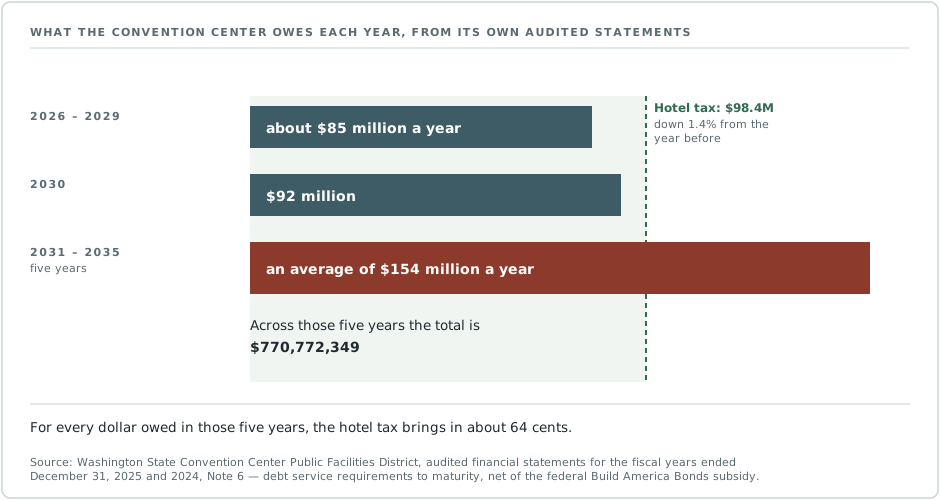
About $85 million a year now, rising to $92 million in 2030. Then, across 2031 to 2035, $770,772,349 — an average of $154 million a year. Measured against last year's hotel tax revenue, that stretch carries about sixty-four cents for every dollar owed.
Most of that block is principal coming due rather than interest, and $341.5 million of it is a single set of notes maturing on July 1, 2035. Public agencies refinance maturities like that as a matter of routine, and doing so would be ordinary rather than alarming. What no published document says is whether that is the plan.
This schedule appears in every one of the district's recent audits. It has gone largely unreported because in each of them it is a pasted picture of a table rather than text — invisible to anyone searching the document.
The tax has moved in both directions: $89.0 million in 2023, $99.9 million in 2024, then $98.4 million last year. This year is the test. Seattle hosted six World Cup matches in June and July, which should lift hotel demand across 2026 — and the district has not published a forecast for what that produces, or for any year after it.
3. What it holds in reserve
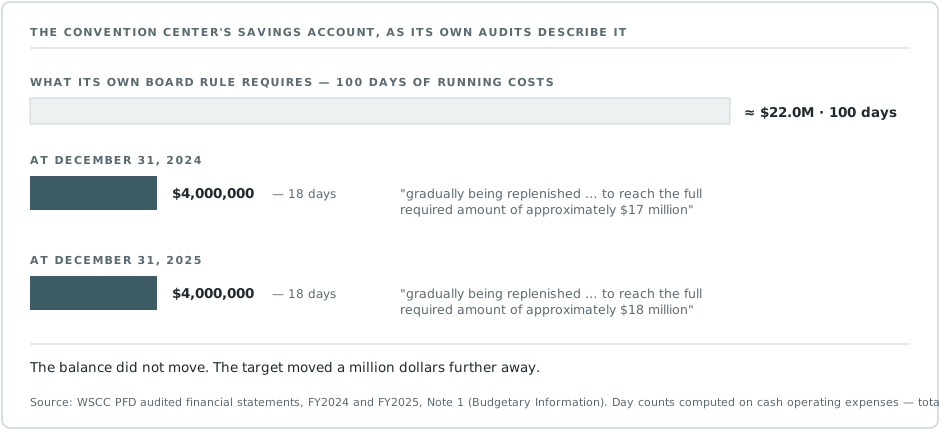
The board's own rule — Resolution 2010-16 — requires an operating reserve of 100 days of budgeted operating expenses. The district says the full required amount is about $18 million. Measured instead against what it actually spent in cash to run the buildings last year, 100 days is about $22 million.
Either way, the reserve holds $4,000,000 — between eighteen and twenty-two days.
This is a designated reserve line, not the district's whole bank balance. It held $47.5 million of unrestricted cash at year end, alongside restricted cash and investments it cannot freely spend. The reserve is the cushion the board told itself to keep, and it is the part that has not moved.
It held exactly $4,000,000 a year ago too. Both audits use the same sentence: the reserves "are gradually being replenished after the pandemic." The figure they are working toward moved from about $17 million to about $18 million.
What comes next
A full reading of the document — what the numbers mean for the neighborhood, a fair evaluation of the district's strategy, and the questions a long-range plan would have to answer — publishes over the next two weeks.
The audit was performed by a contracted firm, Baker Tilly US, LLP, which signed its opinion on May 15. The opinion is unmodified — the statements present the district's position fairly. In a separate report the firm said it identified no material weaknesses in internal control and no instances of noncompliance, while noting that weaknesses may exist which its testing would not have found.
Source: Washington State Convention Center Public Facilities District, Independent Auditor's Report and Annual Financial Report for the fiscal years ended December 31, 2025 and 2024, released by the Office of the Washington State Auditor as report 1040373 on August 27, 2026. Cash figures — receipts, payments, the drawdown and the year-end balances — are from the statement of cash flows. Revenue and expense lines, including the two lodging taxes, food service, hall rental, interest and depreciation, are from the statement of revenues, expenses and changes in net position. Unrestricted cash is from the statement of net position. Debt service to maturity and the King County note are from Note 6, with the note's capitalized interest from the supplemental schedule of noncash financing activities and from Note 10. The operating reserve and its stated target are from Note 1. Event and attendance figures are from management's discussion and analysis. Earlier years in the revenue and lodging-tax series come from the district's audited statements for the fiscal years ended December 31, 2024 and 2023, December 31, 2023 and 2022, and December 31, 2022 and 2021. All are public records, and every calculation here can be redone from them.
Disclosure: Ivan Schneider lives in the neighborhood and holds several interests that touch this subject. They are listed in full on the About page.
Make a Take / Share a Take▾
Before you pass it on — what's your take?
Sharing a Dispatch piece is taking a position. Take a moment to say what yours is — it travels further, and better, for it.
What do you want to say about this? What struck you — and who needs to hear it?
We don't track clicks. If Make a Take was useful, let us know →
Not sure what to say? Let your own AI help you draft it →
The prompt asks your AI to draft a note in your voice from what the article and its sources actually support — and to push back if you overclaim. Your conversation stays in your AI; nothing is sent to the Dispatch.