Read this with your own AI▾
This piece was built with the help of AI, from public records — here's how. Read it back with your AI: choose how you want to read it, copy the prompt, and interrogate the article yourself.
Your conversation stays in your AI — nothing is sent to or stored by the Dispatch. The built-in grounding line keeps the answer tied to the Dispatch's own reporting, and asks your AI to flag — not invent — anything that needs more.
Over ten days in September I built the convention center's books and its floor plans into a database, on top of the audits I had been collecting since February and the responses to my public records requests since May, with the same AI assistance the rest of the Dispatch is made with. It sits behind a new door, Insights, on the rebuilt conventioncityseattle.com. Every figure in it cites the page it was read from, and all but 93 open it.
Why
First, because I can. And because after seven months I have gotten to know these books very well, and all of that was inside my own AI chats. These are complicated stories. I wanted a way to show that I have done my homework, and that the reporting stands on a base of actual figures.
The front door now says what the whole Convention City Seattle domain is for: bridging a GAP, and that is Governance, Awareness and Participation. On governance I have said about all I can, and the Punch List holds the asks and the tests that would close them. Awareness is the next question: how a city, county or state office, a neighborhood association, a media outlet or an academic researcher can engage with this topic without having to build all of this for themselves.
How
The schema was generated. I came up with what I call Schema Evolution Automation, the method my own Model Citizen Developer practice runs on, which lets me do this kind of thing in about the time it takes you to set up your columns in Excel: describe the tables once, and the database, the pages and the queries come out of the description. What a figure is, what a period is, what counts as the same line under two names, and what a check has to prove are my decisions, in that description.
The audit figures are not read by an agent and taken on trust. A program reads each audit PDF and files every figure with the document and the page it came from, and every cited page is rendered as an image. Then a test, one per number, opens the cited page and looks for that amount printed there. There are 2,976 of those checks, one per figure, inside a suite of 6,034. Both year columns of every audit are captured, so each fiscal year is read twice, from its own audit and from the next one's comparison column, and the two readings are compared. One audit with a broken font map was recovered by optical character recognition, and the database records that its figures were read from an OCR copy. Where a line changes its name between audits and no rule could settle the join, I read the statements, and the decision sits in the database with its reason.
The prose is where the agents argue. The six findings, and every piece on the Dispatch since July, go through a multi-agent adversarial process before it publishes: one agent reads it as an industry rebutter, one as a media critic, one as an ordinary reader with no background, and a fourth checks each claim against the sources, so that readability, conceptual accuracy and fairness are tested by something other than my own re-reading.
Nothing in it was typed in once and left. The database is rebuilt from the documents every time, by the same steps in the same order, so when I fix a figure by hand the fix becomes one of the steps and is applied again on every rebuild. All of the code is part of my toolkit, and it is an example of the kind of thing you are going to see a lot more of. Starting now.
What it holds
Fifteen audited statements, one for each year ending 2011 through 2025, and fifteen other documents: two records responses, two management reports, three board and committee decks, a contract excerpt, a King County memorandum and a reply from one of its authors, a statute, a bond official statement, a utilization dataset computed from the event log, and the two floor-plan booklets. Across them, 2,976 figures on 254 accounts, 2,880 of them from the audits, each citing the page it was read from. A line that changes its name becomes two accounts tied by a recorded alias; a figure that changes for a year already reported becomes a registered movement, and there are 185 of those. From the buildings, 952 events and 13,946 bookings, one event in one space over its dates, on their own page.
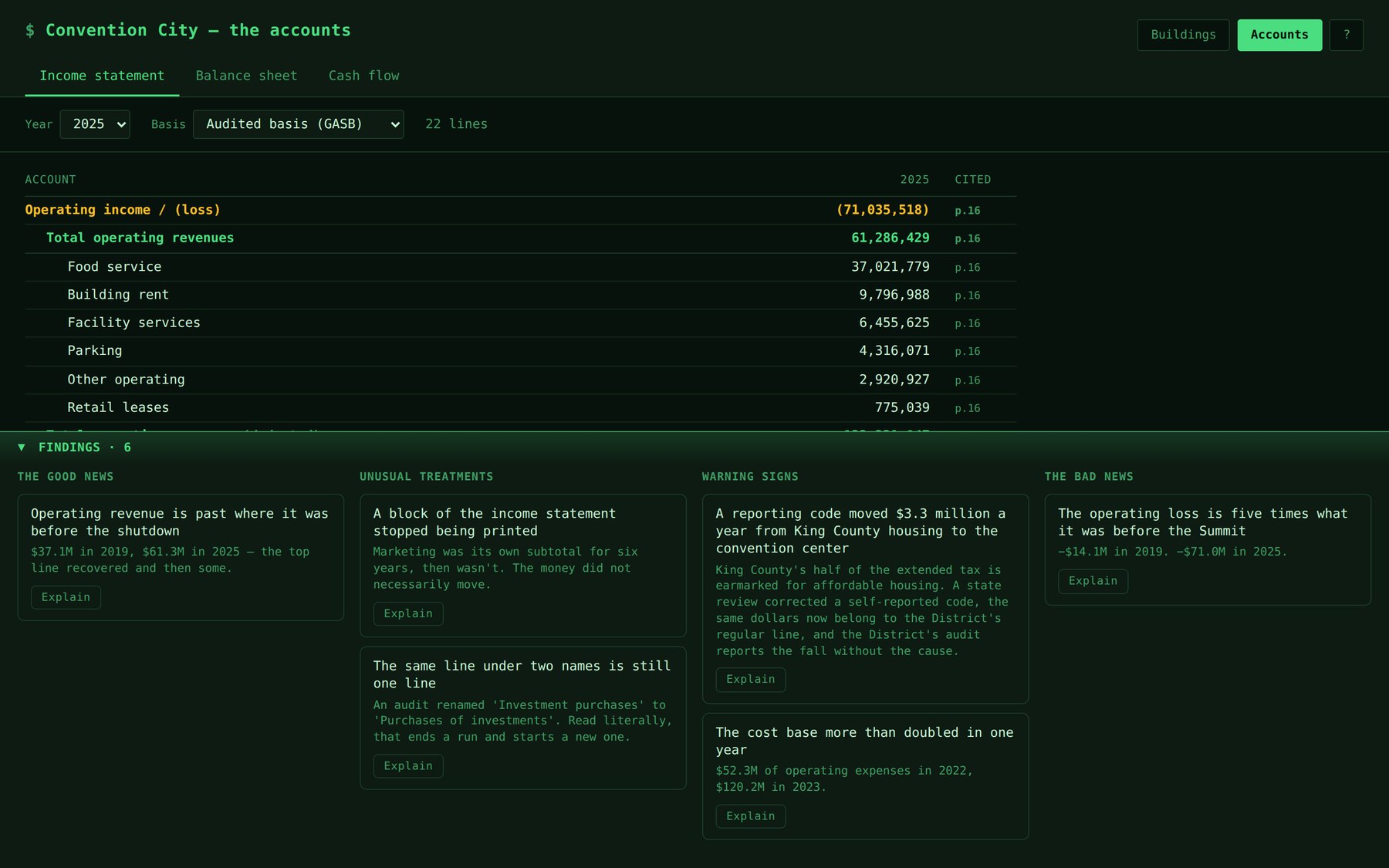
And six findings, each a route through the books that names a reason to look at one line and then walks you to it with the page on the screen. They run from the good news to the bad: operating revenue is past 2019; a block of the income statement stopped being printed; the same line under two names is still one line; a reporting code moved $3.3 million a year from King County housing to the convention center; the cost base more than doubled in a year; the operating loss is five times what it was before the Summit, the second building, opened in 2023.
How it checks itself
A suite of 6,034 checks runs against the database. The central one is the simplest: for every figure, open the document at the cited page and look for the amount printed there, in any of the ways an accountant might print it. On the last full run, 2,889 of 2,976 figures were found on the page they cite; the other 87 come from five sources with no page a reader can open and are skipped and named, not counted as passed. Other suites check that each statement foots, that its lines add up to its printed totals, and that every disagreement between two audits is a registered movement.
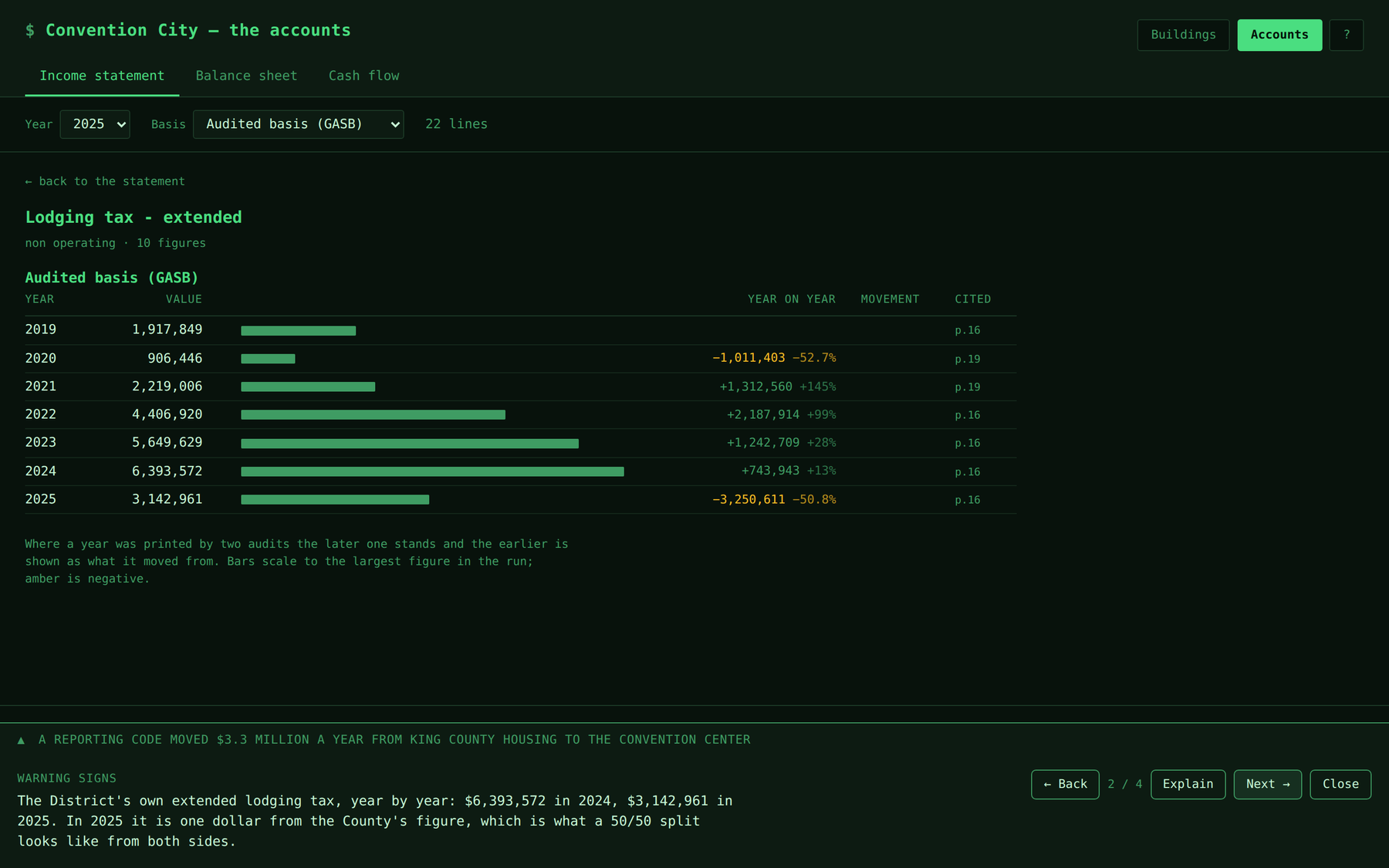
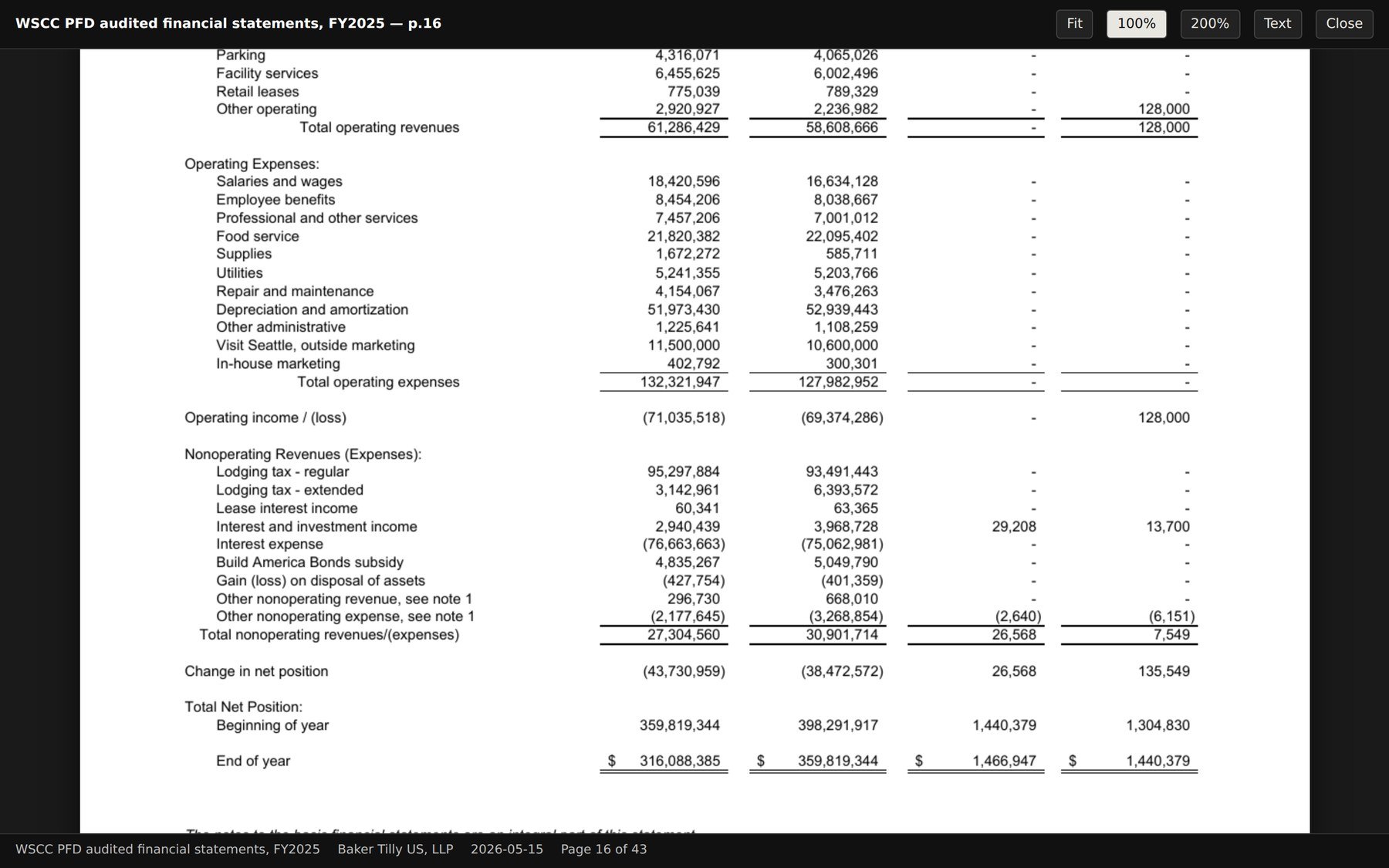
What a passing check proves is narrow. It establishes that a figure is where the database says it is. It does not establish that the figure is right. A number transcribed accurately from a page that is itself wrong passes every provenance test in the suite.
What it does not claim
This is one person's rendering of public records. It is not the District's, the Washington State Convention Center Public Facilities District that owns the center, nor the State Auditor's, nor an accounting firm's, and accuracy is not guaranteed. The booklets and the event log are the District's records, not hosted here; each citation tells you which one to ask for. The rows are readable one table at a time, the schema and the queries are shown, and the generator that produced the pages is not published.
And some of what it holds will stay open for a while. There are numbers in these books that will not settle until the 2026 audit is out, a year from now, and others that will not settle unless I spend more time than I would like chasing figures the District has not published.
Open Accounts, pick a finding, and follow it to the page. If a number is wrong, the page will show you, and the form is where to say so.
Sources. The counts are the ones printed on the two method pages of the Insights door as of September 13, 2026; the last full run of the checks was September 13. The figures named in the six findings are each cited, in the database, to the statement and page they were read from, and every calculation can be redone from them.
Make a Take / Share a Take▾
Before you pass it on — what's your take?
Sharing a Dispatch piece is taking a position. Take a moment to say what yours is — it travels further, and better, for it.
What do you want to say about this? What struck you — and who needs to hear it?
We don't track clicks. If Make a Take was useful, let us know →
Not sure what to say? Let your own AI help you draft it →
The prompt asks your AI to draft a note in your voice from what the article and its sources actually support — and to push back if you overclaim. Your conversation stays in your AI; nothing is sent to the Dispatch.