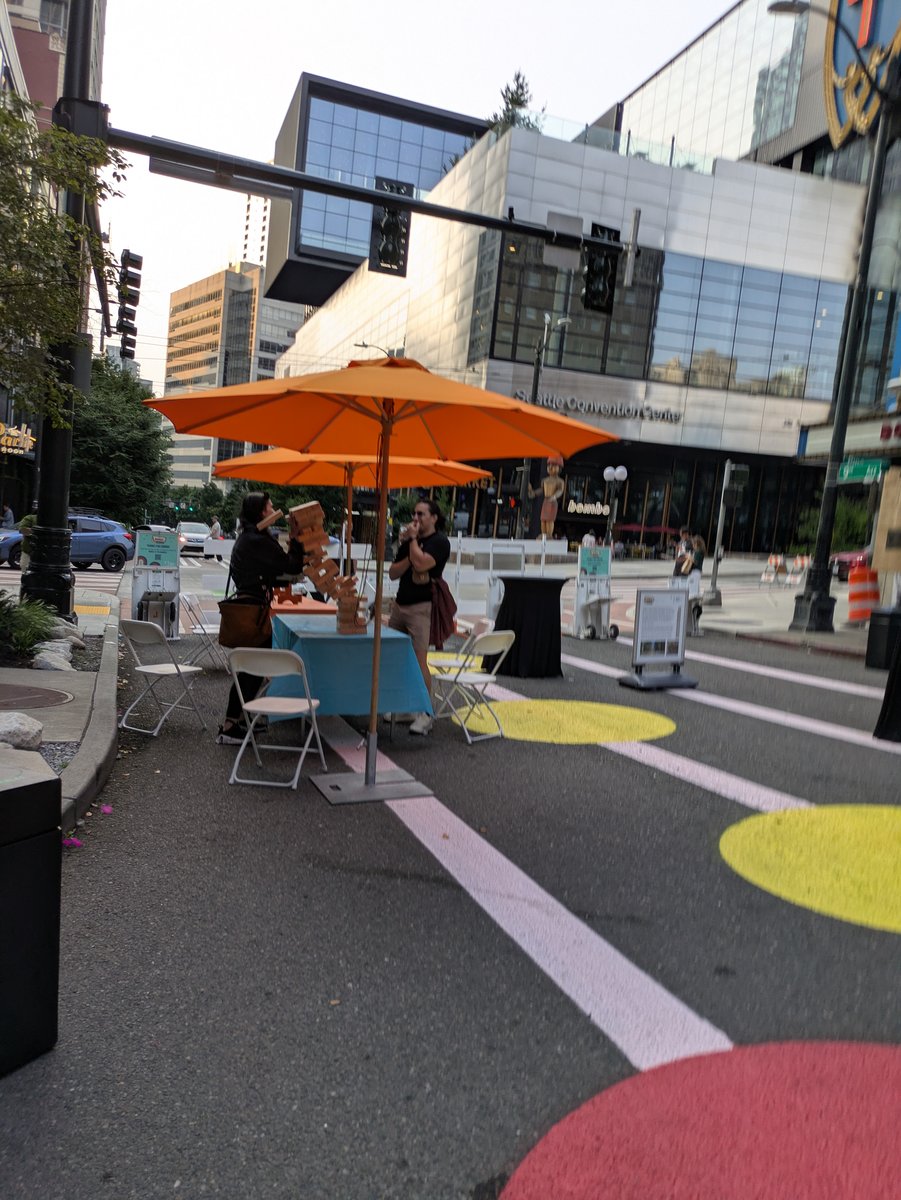
Don't blame the SCC operations team for this.
It was a three-week rush job, and they'd never really done this before. They've closed this block for a crowd already — a beer garden and food trucks for PAX and Nintendo Live back in 2023, and it went well enough that organizers were asked back the next year[1] — but usually what happens on the convention center's own turf stays there. This time SCC had Big Plans for the neighborhood, courtesy of its Campus Master Plan and the plan's exclusive house architect, LMN — the same firm that built the Summit, the Arch, and some of the neighboring hotels.[2] Part of that plan is "activating" the block, and the version of activating that showed up in August included painting the street itself.
Starting July 28, 2026, that block — 9th Avenue between Pike and Pine — became the plan's showcase: closed to cars, strung with lights, home to Market at the Marquee's Thursday night crowds through August.[3] Three weeks after the last Thursday market, the street's still shut. KIRO broke the story and the Seattle Times followed it up: the short version is that the pavement paint won't wash off. Graffiti remover and heated pressure washers couldn't touch it, the white lines read as lane markings from behind a wheel, and SDOT won't hand a Minor Arterial that feeds an I-5 express-lane onramp back to traffic until it looks like a street again. The near-term fix is paint over paint, in black or gray; the real fix is grinding the surface off.[4][5]
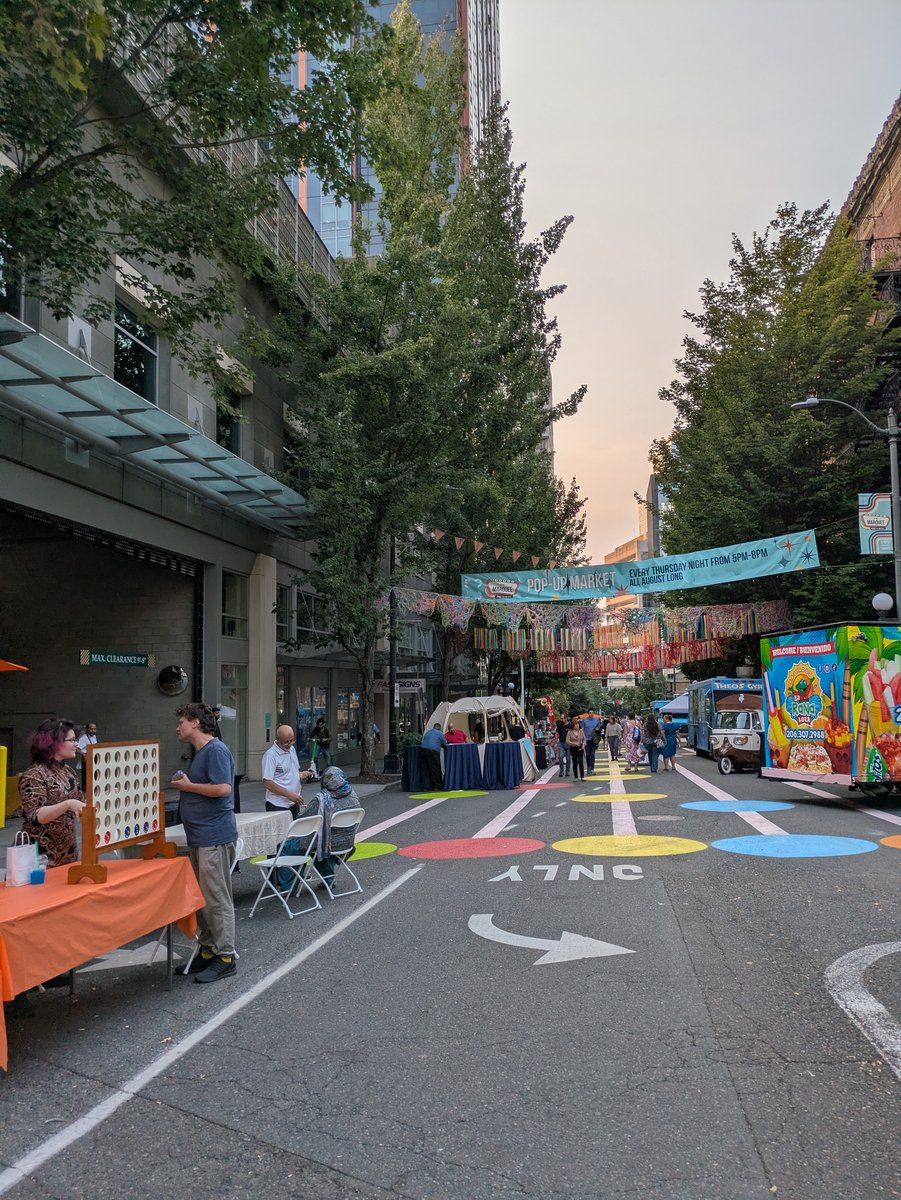
Neither story says who drew the pattern, or when.
An interpretive sign the Center posted on the block during the market credits the design in its own words: "The street painting designed on the surface of 9th Avenue, designed by LMN architects, is part of a larger vision for urban activation in downtown Seattle celebrating the connection between the Arch and Summit buildings of the Seattle Convention Center." The sign explains the pattern as a nod to the Paramount next door — "the note progression of a 90s song by a famous Seattle band"[6] — with the circles echoing "large colorful circular panels stuck to the façade of the Arch building" up the block.
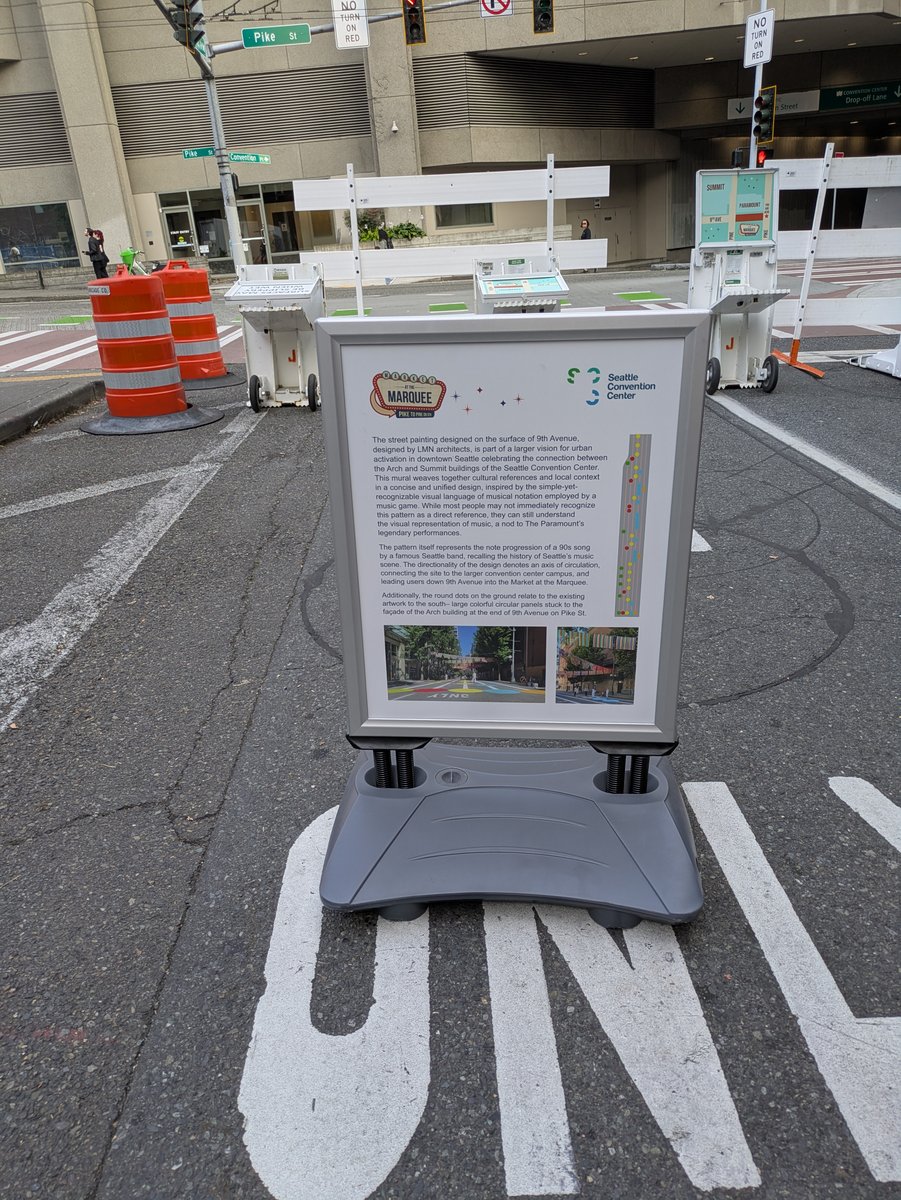
LMN isn't a muralist the Center hired for the summer. It's the firm holding the exclusive, multi-year contract to write the Convention Center's entire Campus Master Plan — the ten-year blueprint for the Arch, the Summit, and the land around them.[2:1] It's also the firm that designed the Arch and the Summit in the first place: LMN designed the convention center's original Addition and the Elliott Grand Hyatt beside it back in 2001, in the same project, with the same codeveloper — R.C. Hedreen Co. — that's still part of the network around the campus today. And a street-surface treatment on 9th Avenue isn't a new idea LMN had this summer. It's on the record from February.
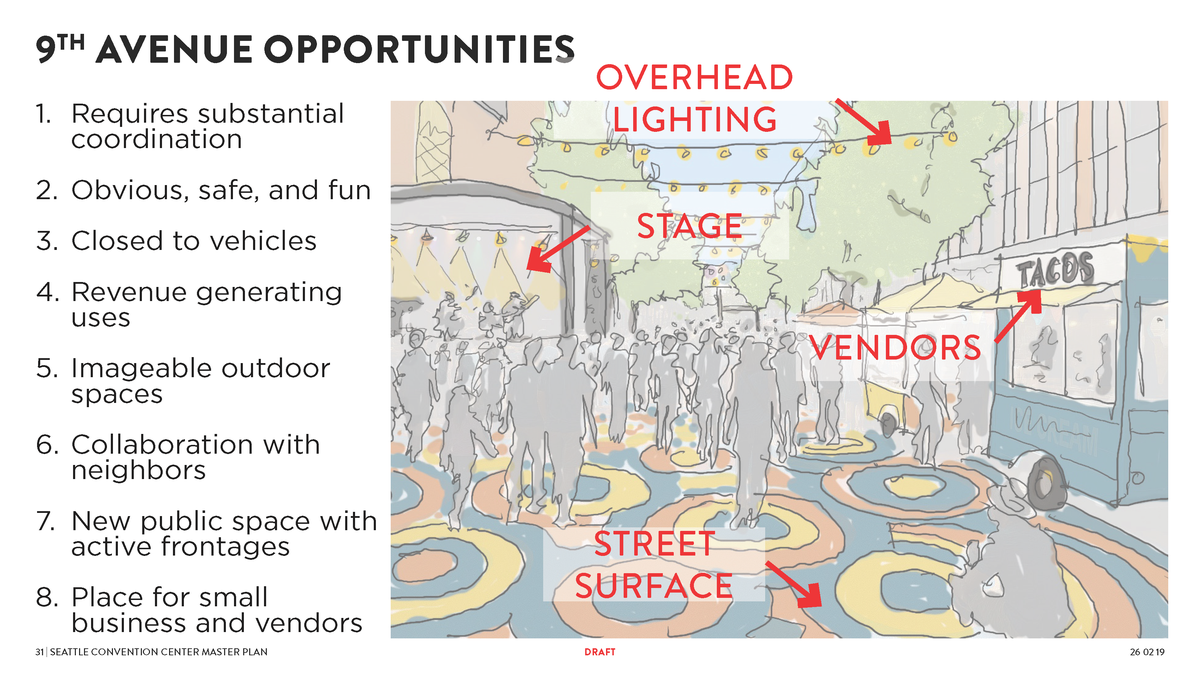
LMN presented that deck to the board on February 24, 2026, under the Facility Committee's "Projects Updates" — the agenda lists COO Jon Houg, Capital Projects director Lester Brown, and LMN's Mark Reddington (the firm's principal on the contract) and Brian Tennyson among the presenters.[7] The slide sketches a packed night market on 9th Avenue, its own arrows labeling the overhead lighting, a stage, vendor tents, and the street surface itself — the same shape Market at the Marquee actually took in August. Its numbered list of eight "opportunities," alongside the sketch, includes "revenue generating uses" and "obvious, safe, and fun." Item one on that list, ahead of all of them: "Requires substantial coordination." The idea reads, on paper, as harmless placemaking, with its own warning label already attached. It is also, six months later, the reason SDOT can't get traffic back onto a block that feeds a freeway onramp.
The turnaround between deck and pavement was fast. By the Center's own account to its board in August, the whole arc ran three weeks start to finish: a first task force meeting between SCC and Seattle Theatre Group on July 7, the street closed to cars on July 28, and the first Market at the Marquee on August 6.[8] The street-use permit for the closure — issued to Houg personally, as the Center's COO — wasn't approved until July 31, three days after the closure had already begun.[9] Three weeks is fast work for logistics. It's not much runway for the "substantial coordination" LMN's own slide said this would need.
CEO Jennifer LeMaster has now used the same line about the closure three times in two months, in a sponsored trade newsletter, a sponsored magazine placement, and now the Seattle Times: "During the World Cup, we witnessed the power of shared experiences to bring people together and energize downtown Seattle... This activation is an opportunity to continue creating those moments."[10] And so in a rush to capitalize on the post-FIFA glow, the Center scored an own-goal.
If your architect tells you to cut down a tree for a better view, and your landscaper does it, and it turns out to be against code — who's on the hook? In most places, all three: the architect, for advice inside their own expertise that didn't come with a warning label; the homeowner, because a code violation attaches to the property no matter whose idea it was; and the landscaper, for doing regulated work without checking first.
Ninth Avenue has the same three parties. LMN drew the pattern and told the board, in writing, that it "requires substantial coordination" — its own words, item one on the list, months before anyone touched a paintbrush. SCC's leadership signed off on a three-week sprint from first meeting to first market, permit and all, with the permit itself arriving three days after the street was already closed. And some unfortunate scapegoat picked the specific paint that turned out not to come off a public street. That's three different failures, and right now the news coverage is only talking about the paint.
WSCC-PFD board minutes, Sept. 26, 2023. ↩︎
The Campus Master Plan: What's Been Decided, this desk, July 11, 2026. ↩︎ ↩︎
A Car-Free Ninth Avenue, this desk, July 21, 2026. ↩︎
KIRO Newsradio first reported the story; David Gutman, "Seattle Convention Center painted the street. The paint won't come off," The Seattle Times, Sept. 17, 2026. ↩︎
David Gutman, "Colorful art won't come off a Seattle street, so dull paint will cover it," The Seattle Times, Sept. 19, 2026. ↩︎
The sign doesn't say which song. Sign up for the newsletter and we'll tell you. ↩︎
WSCC-PFD board meeting agenda, Feb. 24, 2026; Campus Master Plan draft deck presented to the board, dated 26 02 19, obtained through a public-records request. ↩︎
"Market at the Marquee: from concept to fruition," SCC board presentation, August 2026, obtained through a public-records request. ↩︎
SDOT Street Use Permit SUFUN0006504, Seattle Services Portal, obtained through a public-records request. ↩︎
Connect NW, July 30, 2026 (sponsored issue); Seattle Magazine "Elite Partners," Aug. 14, 2026 (sponsored post); The Seattle Times, Sept. 17, 2026. ↩︎
Make a Take / Share a Take▾
Before you pass it on — what's your take?
Sharing a Dispatch piece is taking a position. Take a moment to say what yours is — it travels further, and better, for it.
What do you want to say about this? What struck you — and who needs to hear it?
We don't track clicks. If Make a Take was useful, let us know →
Not sure what to say? Let your own AI help you draft it →
The prompt asks your AI to draft a note in your voice from what the article and its sources actually support — and to push back if you overclaim. Your conversation stays in your AI; nothing is sent to the Dispatch.