At Avia Apartments, 1011 Pike Street, a 672-square-foot one-bedroom called "The Rainier" rents for $2,444 a month. You can see the Summit building from your window — it rises directly across the I-5 express lanes.
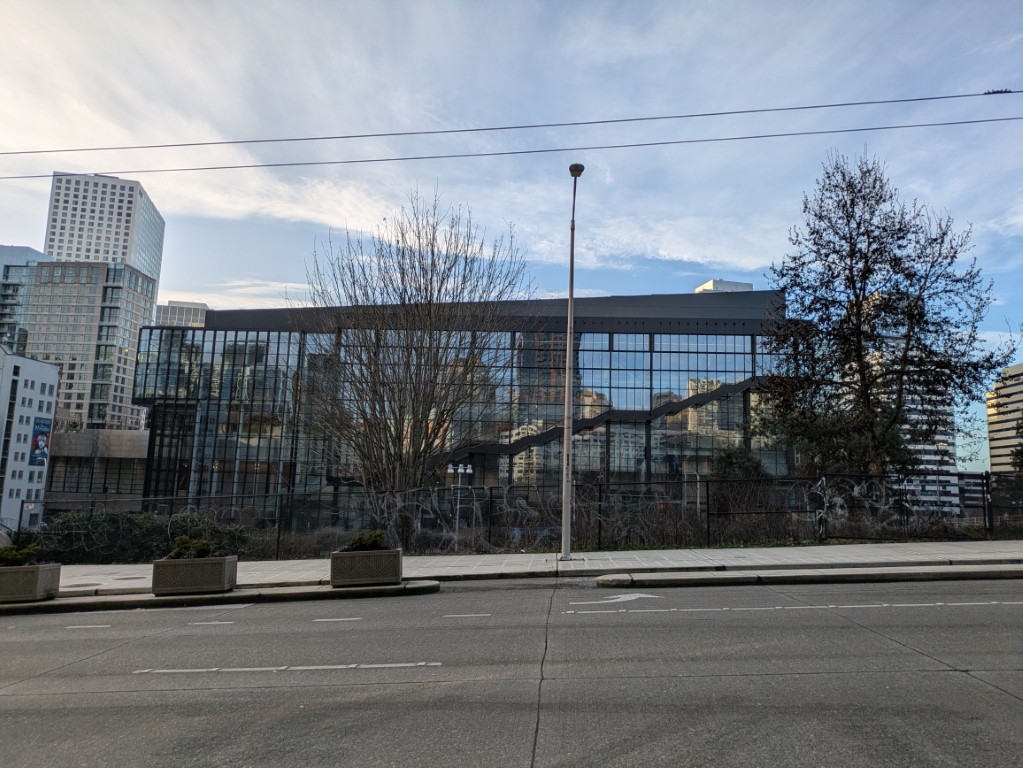
On the far side of the Summit, on Olive Way between 9th Avenue and Terry Avenue, with Howell Street beyond, is a parcel at 920 Olive Way. It's owned by the Washington State Convention Center Public Facilities District, the public agency that runs the convention center. Throughout this article: the PFD. It's fully entitled for a residential tower. Construction drawings are 75–80% complete. It's been fenced and empty for years.
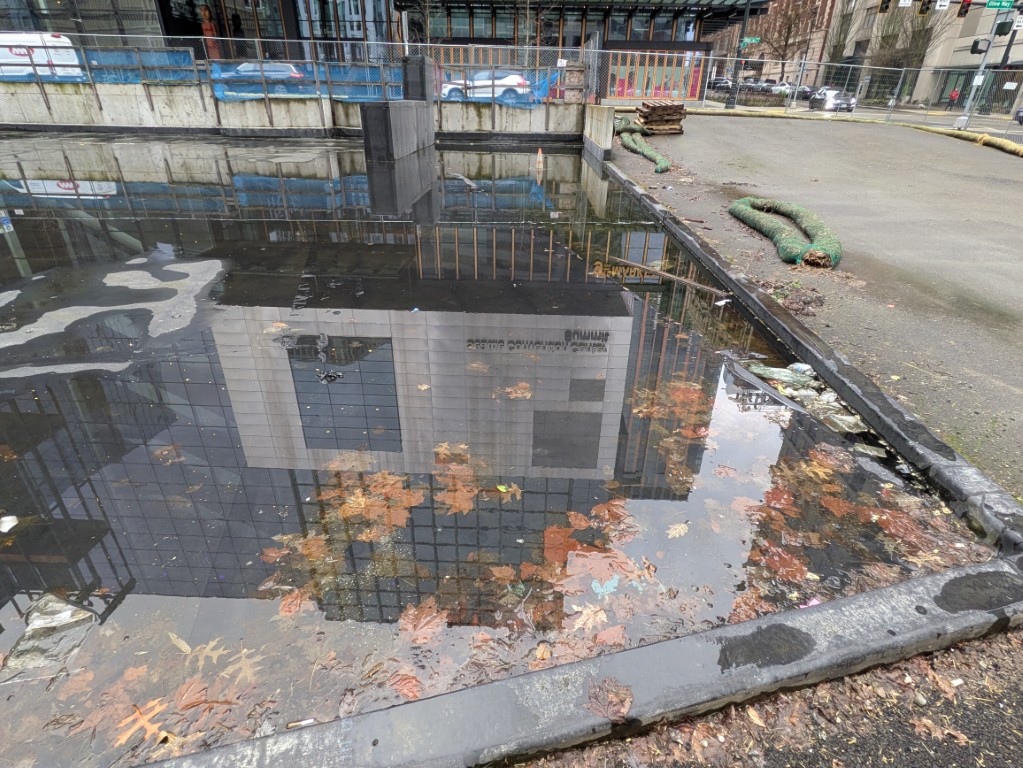
The PFD paid $56.4 million for this parcel in 2013. Today the King County Assessor values it at $0 — the PFD is tax-exempt. Its annual bill is $2,426. Surface water drainage and noxious weed fees. Present use, per the assessor: Parking (Commercial Lot).
What Happened at 920 Olive Way
When the PFD built the Summit — the $1.9 billion addition that opened in January 2023 — the project included two co-development sites designed for private developers to build on. The PFD needed the land below grade for Summit infrastructure. The plan was to sell the above-grade development rights and apply the proceeds to construction costs.
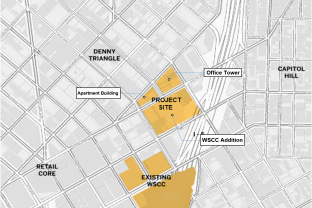
The two sites were designed to feed each other. The office site would attract a major employer — the expectation was a tech anchor on the scale of Amazon or Google. Those office workers would create demand for the residential site — a 29-story, approximately 400-unit tower with ground-floor retail at 920 Olive Way. Workers want to live near work. The residential tower fills because the office tower fills.
The office site sold to Hudson Pacific Properties (NYSE: HPP) for $86 million in 2019.
The residential option went to a separate group of local investors for $15.75 million, approved by the PFD board in September 2019. Expected closing: July 2021.
Hudson built the office tower. It's called Washington 1000 — 16 stories, 546,000 square feet. It opened in 2023 into a downtown office market with 35.6% vacancy, second highest in the nation. Three years later, no signed leases have been announced. The building won a 2025 CoStar Impact Award. The architecture is not the problem.
When Washington 1000 opened empty, it didn't just kill Hudson's investment — it killed the demand thesis for the residential site. No office tenants means no residential demand.
The PFD's development manager, Pine Street Group, had designed the residential site to "about 75 to 80 percent construction documents, entitled and ready for final refinements by the purchaser" (from the SCC's project website, now archived). Years of work. Millions in soft costs. A shovel-ready site, entitled and designed at public expense.
The closing never happened. COVID hit. The option lapsed. By the 2022 audit, the PFD reported the office pad sold but noted only that "the second pad will be sold later." By 2024, the language had shifted to: "The residential pad disposition is planned when commercial real estate conditions improve."
Something else appears to have happened in between. PFD board minutes from December 2024 through January 2026 show executive sessions on "possible litigation" related to the residential parcel at every meeting, with external counsel present. In January 2026, the board passed Resolution #2026-3, formally terminating the residential option. The details were discussed behind closed doors.
What the termination means: the PFD now holds the above-grade development rights with no buyer and no obligation to anyone. The entitlements — zoning approvals, design review, 75-80% construction documents — are specific to the 400-unit residential tower. To build something different would mean new entitlements, new design review, new environmental review. Years and millions. So the PFD is untethered but constrained: it can sell the residential rights to a new developer, sit on the parcel, or pursue temporary activation. What it can't easily do is start over.
The PFD paid $56.4 million for this parcel. The underground infrastructure they needed is built and in use — that part worked. What's above ground is a site that was supposed to sell for $15.75 million, and didn't.
Why No One Is Buying
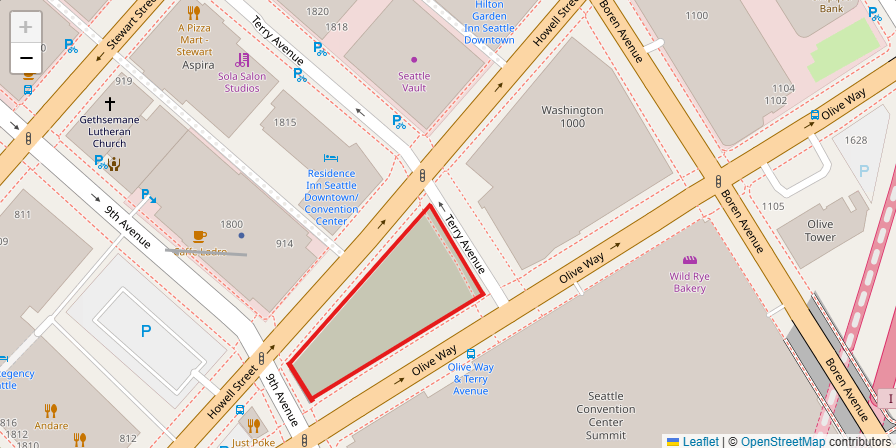
Walk the block. The parcel is a wedge with four sides.
Start at 9th Avenue, the narrow end of the wedge. A poké restaurant on a small triangular plot with a few parking spots — the only retail that could fit here. Across Olive Way, a doggie daycare. Across Howell, the Hyatt Regency. Looking toward Washington 1000 — nothing blocking the view — you have two choices: Howell on your left, Olive on your right. Take Howell.
Howell Street. Axis 9, an office building that used to have a Caffe Ladro in the lobby. No more. Next to it, a Residence Inn by Marriott. On the parcel fence, a "CONDITIONS OF ENTRY" sign reads: reserved for the use of our patrons and customers only. There are no patrons. There are no customers.
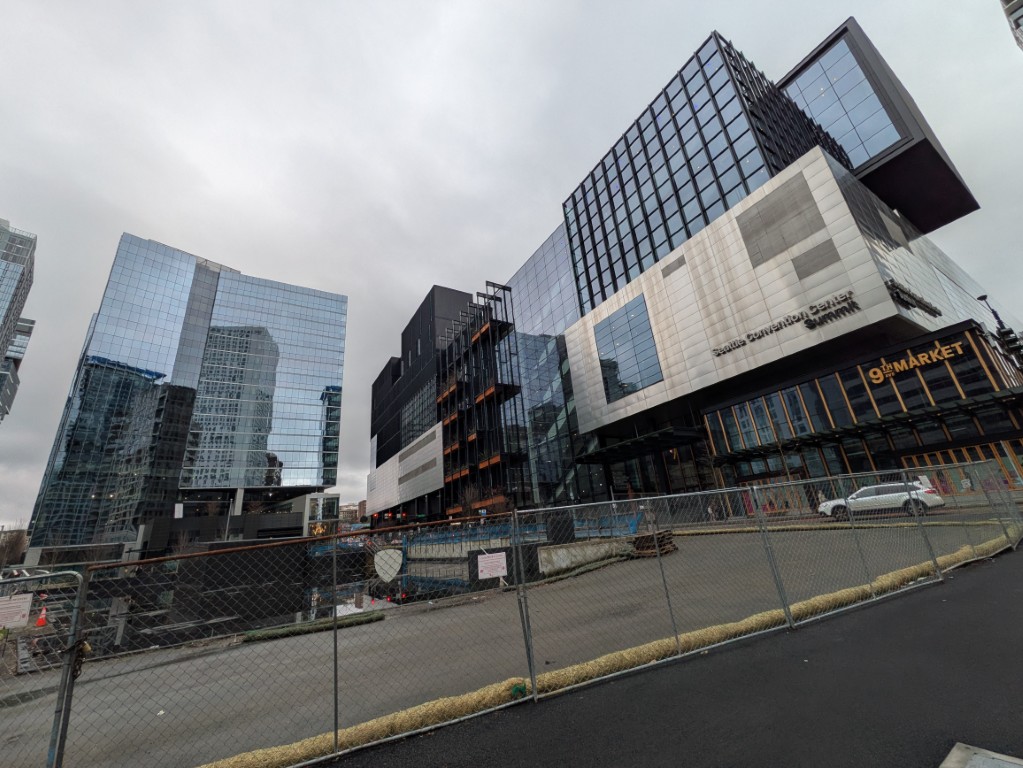
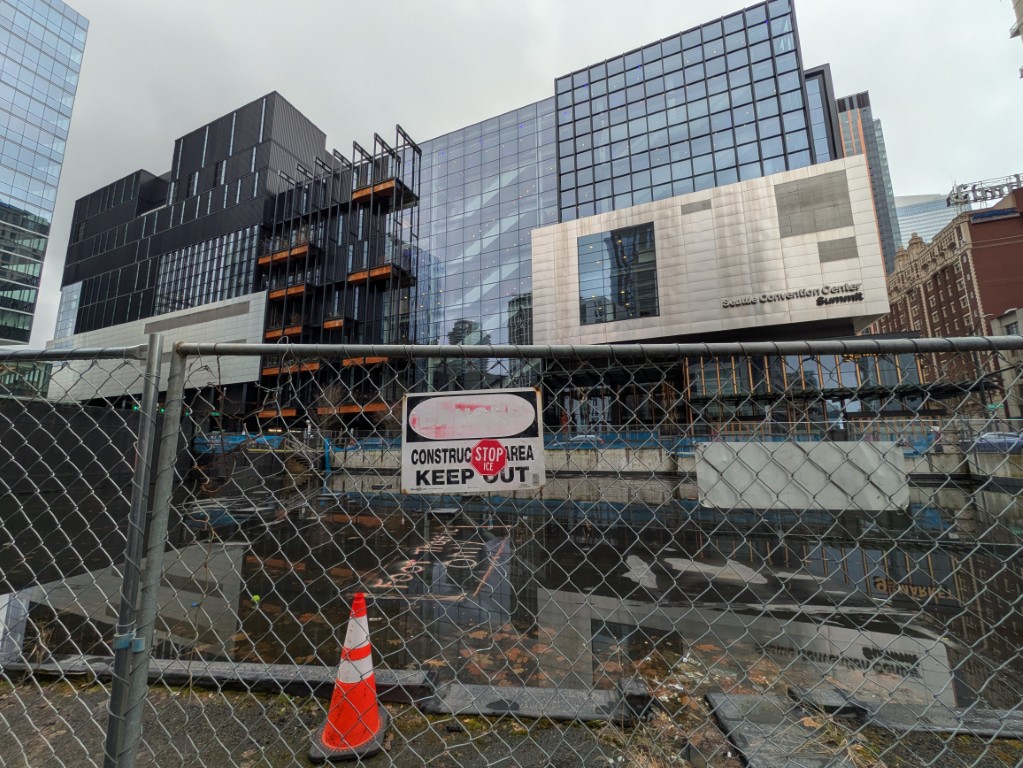
Turn right on Terry Avenue. On your left, Washington 1000 and the truck exit from the Summit's parking helix. As of Hudson's Q4 2025 earnings call, management described "early discussions" with four large-block tenants and one letter of intent. That was three months ago. No signed leases have been announced. On your right, the parcel itself — standing water collects on the pavement when it rains.
Turn right on Olive Way. The Summit itself — angular glass and steel, stepping back in dark volumes. A $1.9 billion building with no street-level reason to stop.
Who builds a 400-unit residential tower here? Who underwrites a construction loan for a site where the anchor buildings — the Arch and the Summit — earn $58.6 million but spend $75 million running (fiscal year 2024), with lodging tax plugging the gap, and the office tower next door can't find tenants?
And it's not just the vacancy next door. Starting in 2030, the PFD's bond payments nearly double — from $85 million to $156 million a year — on revenue that can't cover it. If you're a developer underwriting a residential tower, or a tenant considering a lease at Washington 1000, you're not just evaluating the block. You're evaluating the solvency of the public agency next door.
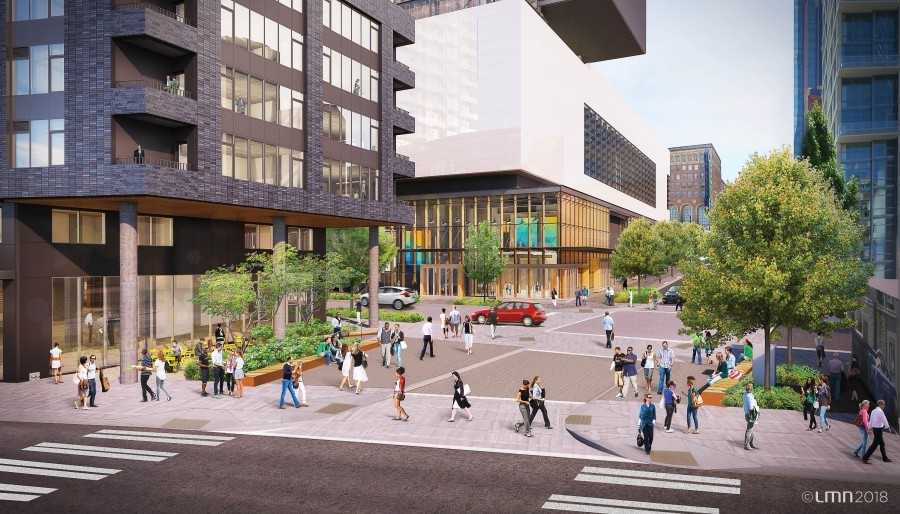
In 2018, the Summit's architect, LMN, rendered this same block with pedestrians, outdoor seating, ground-floor retail, and a 29-story residential tower rising above it. The project website that hosted these renderings is no longer online. (It was indexed by search engines as recently as last week. Hmm.) The Wayback Machine has it.
The Real Carrying Cost
The $2,426 annual bill is what the county charges. It's not what the parcel costs.
The PFD bought 920 Olive Way for $56.4 million in 2013, financed with bond proceeds. The underground infrastructure is built and in use — that money isn't wasted. But the above-grade development rights, which were optioned at $15.75 million, are sitting idle. Those bonds accrue interest whether the parcel produces revenue or not. The above-grade portion's share of the PFD's annual debt service runs in the hundreds of thousands per year — and rises when the 2030–2034 balloon hits.
The plan wasn't bad. The PFD needed the underground portion of these parcels for Summit infrastructure — utilities, parking, the loading helix. They bought the land, built below grade, and planned to sell the above-grade development rights to recoup the cost. Cities do this all the time. The urban planning was sound. The architecture was real — LMN designed a 400-unit residential tower with ground-floor retail, 75-80% construction documents, a building that would have made this block a neighborhood. That work was competent.
The financing is where it broke. The 2018 bond official statement is explicit: the District "anticipates selling the parcels and applying the proceeds from the sale to pay a portion of the costs of the Addition." The co-development sales were supposed to offset the cost: sell the parcels, reduce the amount borrowed, shrink the balloon payments. The bond document even names the fallback: "In the event that the parcels cannot be sold at the anticipated time or price, the District may incur additional borrowing."
The office sale brought in $86 million for the PFD. The residential deals fell through.
And the parcel that was supposed to be a 400-unit residential tower sits empty. A built tower would generate millions a year in property tax for Seattle schools, parks, transit, and city services. Right now it generates zero.
The above-grade residential rights were optioned at $15.75 million before the pandemic — that's the last comp. In a dead corridor, even that price may be optimistic. And the question of who eventually buys a distressed public asset at a discount, and whether they have any connection to the people advising the board on what to do with it, is worth asking before it happens, not after.
Three Scenarios for 920 Olive Way
Scenario 1: Status quo. The PFD holds the parcel. Pays $2,426/year. Waits for the market to recover. The campus master plan produces a rendering. No developer bites because nothing has changed on the street. The 2030 balloon arrives. The parcel becomes a bargaining chip in a bond restructuring negotiated from weakness.
Scenario 2: Campus master plan delivers. LMN designs something compelling. A developer materializes — perhaps when downtown office vacancy drops below 20%, perhaps when interest rates fall enough to pencil residential construction again. The tower gets built in 2031 or 2032. The PFD captures the sale proceeds. This is the optimistic case, and it depends on macro conditions the PFD cannot control.
Scenario 3: The parcel becomes part of the Commons. The Arch activates as a 365-day public space. But 920 Olive Way is a few blocks north of the Arch — too far to ride that wave passively. What if it doesn't have to? The parcel is publicly owned, above-grade, and sitting empty. Before anyone builds a tower, the site itself could be the Olive Branch of the Commons. An "Olive Garden," if you like — outdoor market, event staging, the north campus. Not waiting for the corridor to reach it, but extending the Commons onto Olive Way.
A food truck lot that gives Washington 1000's future tenants a reason to come outside. Lunchtime concerts for convention attendees who want a break from the ballroom. A weekend farmers market. Community services — food pantry, job fairs, the kind of programming that proves a block is alive before a developer has to bet on it.
What would it cost? Permitting, insurance, power, portable facilities, programming staff — someone whose job it is to activate public spaces should be scoping this. The full PFD holding at 920 Olive Way is roughly 1.49 acres across two parcels (Terry Avenue bisects them), already paved, already fenced, already producing zero revenue. Whatever the number is, compare it to what the PFD is paying in debt service on above-grade rights that generate nothing.
The Olive Branch
920 Olive Way is paved, fenced, and producing nothing. The full Commons — activating the Arch as a 365-day public space — requires negotiation, governance, a nonprofit partner, and political will. That takes time. The Olive Branch doesn't.
Take down the fences. Sign the parcel over to a Friends of the Commons organization. Start programming. Food trucks. Lunchtime concerts. A weekend market. The kind of activation that costs almost nothing on a site that's already paved and already accruing debt service.
The Olive Branch proves the concept. It shows the PFD, the neighborhood, and the developers watching from the sidelines that this block can support life. It gives Washington 1000's leasing team something to point to besides a puddle. It gives convention attendees a reason to step outside. And it does all of this without waiting for the full Commons to negotiate its way through a governance structure.
When the bigger Commons activates — when the Arch itself becomes a year-round public space — the fences go back up at 920 Olive Way and the residential tower gets built. By then, the developer isn't betting on a dead block. The neighborhood is already working. The leasing brochure writes itself: Walk to work in two minutes. Walk to the Commons in ten.
The campus master plan is underway. The residential parcel is untethered for the first time since the co-development was conceived. The Olive Branch is the thing they can do right now, with what they already have, that changes everything that comes after.
The carrying cost of inaction is $2,426 a year plus bond interest.
The cost of inaction is everything else.
All figures from public records: King County Assessor (APN 0660001114) · King County Recorder · WSCC PFD 2024 Audited Financial Statements · PFD Board Meeting Minutes · WSCC Addition project website (archived; site taken down): office co-development, residential co-development · Hudson Pacific Properties SEC Filings · Downtown Seattle Office Vacancy Q4 2025 (The Registry, via Cushman & Wakefield) · Avia Apartments (1011 Pike Street; accessed March 24, 2026) · Apartment rental comparison for illustration; Avia faces the Summit building across the I-5 express lanes, with the 920 Olive Way parcel on the far side of the campus.
Ivan Schneider is the founding editor of the Convention City Dispatch. He lives on the Pike/Pine corridor.
Updated June 13, 2026: An earlier version gave the activation site as 0.24 acres — the recorded area of a single assessor parcel (APN 0660001114), the one cited above for the $56.4 million purchase and the $2,426 annual bill. The full PFD holding at 920 Olive Way is roughly 1.49 acres across two PFD-owned parcels, with Terry Avenue running between them. The activation argument is unchanged.
Make a Take / Share a Take▾
Before you pass it on — what's your take?
Sharing a Dispatch piece is taking a position. Take a moment to say what yours is — it travels further, and better, for it.
What do you want to say about this? What struck you — and who needs to hear it?
We don't track clicks. If Make a Take was useful, let us know →
Not sure what to say? Let your own AI help you draft it →
The prompt asks your AI to draft a note in your voice from what the article and its sources actually support — and to push back if you overclaim. Your conversation stays in your AI; nothing is sent to the Dispatch.