Catching up on C-STAR? Start with the latest.
In early May, the Dispatch found out about C-STAR — and there was no public information about what it was. The only details available were what could be pulled off the state bidding portal: a scope of work, a floor plan, a construction schedule. The Seattle Convention Center does not publish its detailed board packets or presentation materials online.
So when the Dispatch asked — in print, in a piece headlined Please Tell Me There's Nothing to Worry About — what C-STAR actually was, the answer wasn't anywhere the public could look it up. It took a public-records request to get it. Now the Dispatch has it.
Here is what Pike Street will look like in the weeks and months to come.
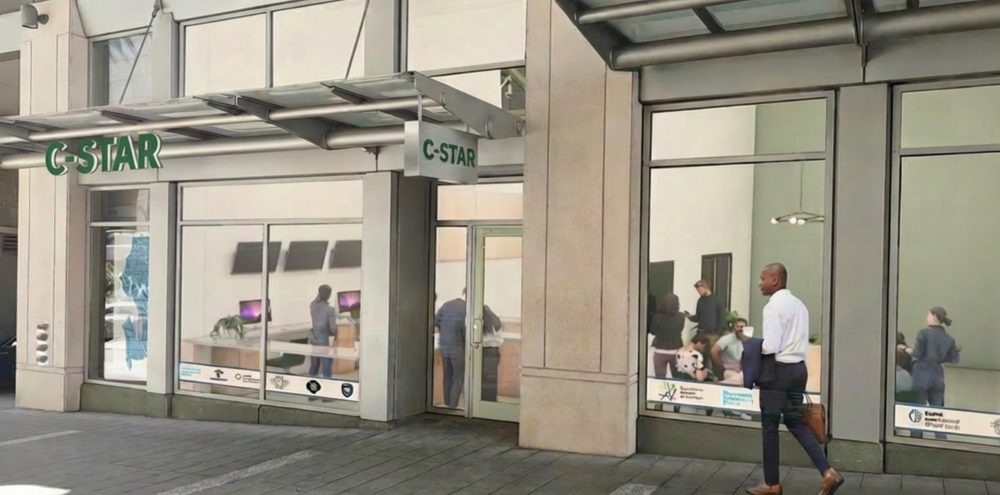 The C-STAR storefront on Pike Street. Rendering: Graham Baba Architects, from SCC board materials presented February 24, 2026, obtained through a public-records request.
The board's own authorizing resolution describes "a new, integrated, visitor-centered approach to public safety," built on "the coordinated presence of ambassadors, care teams, and public agency partners," and meant to serve "not only visitors but also local residents, seniors, and surrounding neighborhoods." A project slide states the design was "coordinated with SPD, MID, DSA, CARE Team and SCC" — the Seattle Police Department, the Metropolitan Improvement District, the Downtown Seattle Association, and the city's civilian Community Assisted Response and Engagement team. The named partners are local and civic.
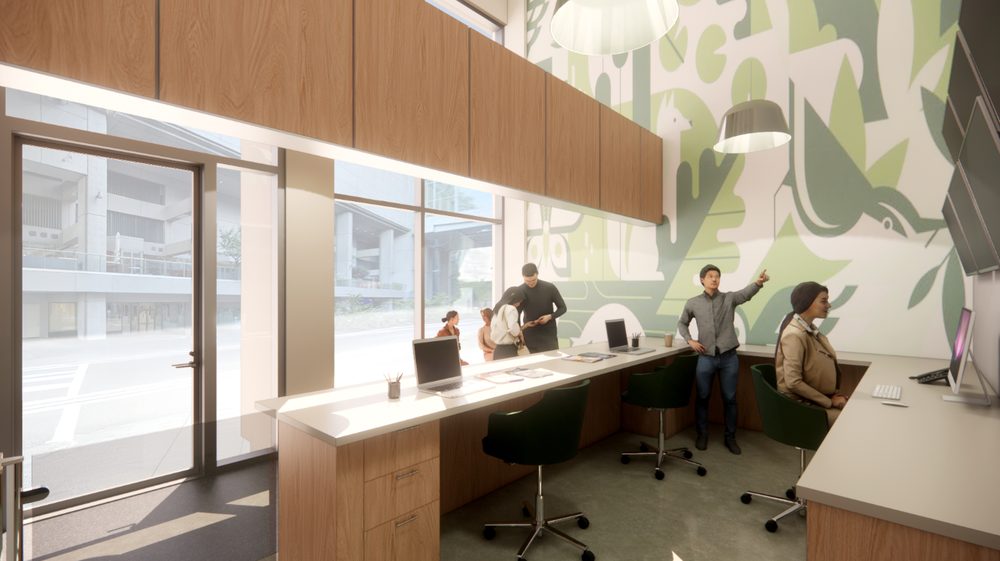 Inside: an open office in hospitality-design vocabulary. Rendering: Graham Baba Architects, via SCC board materials obtained through a public-records request.
The same slide says the space is also designed to accommodate "precinct-type work for SPD and other government agencies," without naming the other agencies — language that echoes the "external project stakeholders and end users" phrasing in the procurement scope. And behind the reception counter, the renderings show the working half of the room.
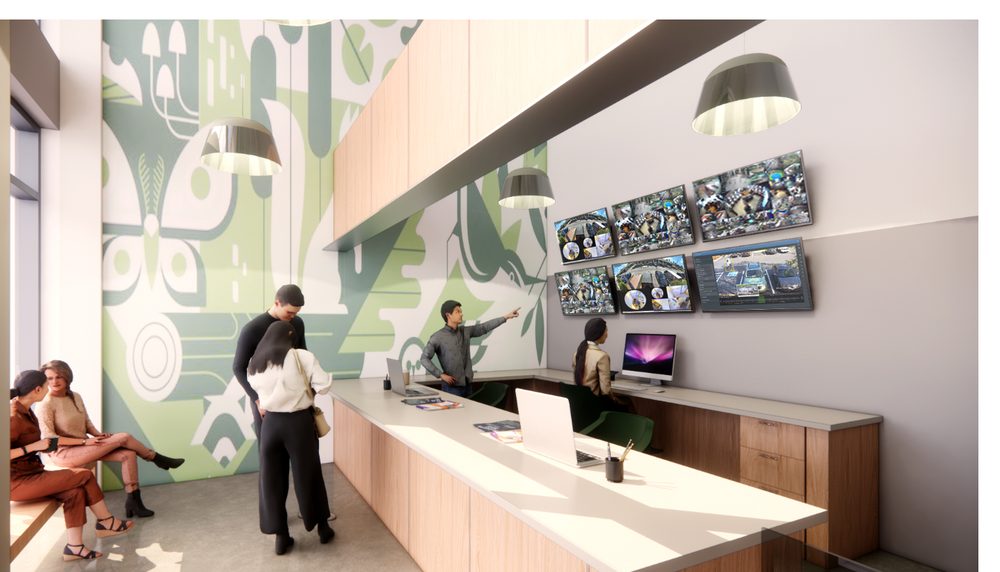 A reception counter sits beside a wall of camera-feed monitors. Rendering: Graham Baba Architects, via SCC board materials obtained through a public-records request.
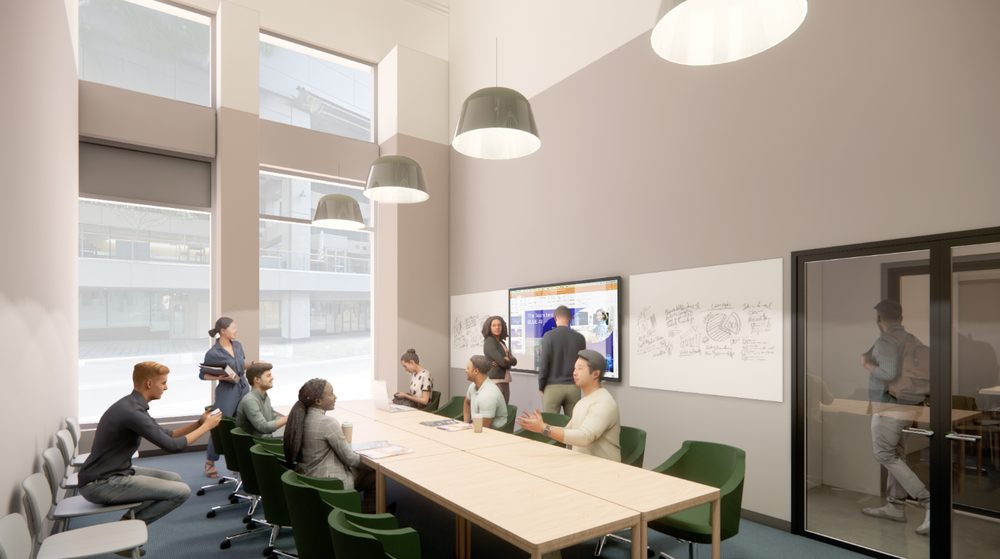 A glass-walled briefing and conference room. Rendering: Graham Baba Architects, via SCC board materials obtained through a public-records request.
No federal partner on the contracts. Earlier Dispatch reporting asked whether C-STAR could be used for federal immigration enforcement, and noted that nothing on the record ruled it out. A public-records request filed May 22, 2026 (delivered May 29) for all of the convention center's agreements with any federal agency since January 1, 2025 came back with a single contract: a $4,620 "Wildlife Damage Management" agreement with the U.S. Department of Agriculture's Animal and Plant Health Inspection Service (APHIS), now inactive. There was no agreement with the Department of Homeland Security, Immigration and Customs Enforcement, Customs and Border Protection, the FBI, the Secret Service, or FEMA. The named C-STAR partners are local and civic. A contracts register would not capture an informal coordination arrangement, so this does not "prove" the building closed to federal use — but the federal-enforcement-hub reading is not borne out by the records. What the documents still do not settle is who may use the space later: the design accommodates the unnamed "other government agencies," and the district has set no policy on who those can be.
How it was authorized. The board approved Resolution 2026-05 on January 27, authorizing the CEO to expedite procurement and execute the general contractor agreement, citing the need to open "in advance of increased activity associated with the 2026 World Cup."
Where it came from. The project began with a kickoff in August 2025 and ran a full design cycle — a design workshop with the police department, the CARE team, and the Downtown Seattle Association, and an October meeting with the prior Mayor's office — five months before the board authorized the construction contract in January. C-STAR does not appear in any of the board's posted 2025 minutes — not in August, when the project kicked off, nor in December, when the board adopted its 2026 budget; its name first surfaces in the public record on January 27, 2026. The minutes for the board's October regular meeting could not be checked: as of publication, the link on the convention center's website returns a "not found" error.
What's still unresolved. The documents answer what C-STAR is. They do not resolve policy. Asked whether any rule bars federal immigration enforcement from convention center property, the district responded in writing that "no such policy has been adopted by the PFD Board," describing itself as a narrowly defined event venue rather than a "full-service city government." Both the City of Seattle and King County have adopted sanctuary orders for their own properties; the Port of Seattle, also an independent agency, has its own. The convention center has none.
When exactly C-STAR opens isn't public. Construction documents targeted substantial completion by June 1, and the board's materials say only "summer 2026"; the authorizing resolution tied the timing to the FIFA World Cup, whose Seattle matches begin June 15. It will most likely open in the coming weeks — but the convention center has announced no date.
— The name "C-STAR" is not spelled out in the resolution, the board deck, or the procurement documents.
Ivan Schneider is the founding editor of the Convention City Dispatch.
Updated June 13, 2026: The "no federal partner" section has been tightened to match the cited records. The federal-agreements public-records request was filed May 22, 2026 and delivered May 29; it returned a single $4,620 USDA APHIS "Wildlife Damage Management" contract, now inactive, and no agreement with DHS, ICE, CBP, the FBI, the Secret Service, or FEMA. The wording now notes that a contracts register would not capture an informal coordination arrangement, so the records do not "prove" the building closed to federal use — but the federal-enforcement-hub reading is not borne out by them. What the records establish — unnamed external "other government agencies" written into the project scope, and no sanctuary policy — is unchanged, and so is the accountability question it raises.
Make a Take / Share a Take▾
Before you pass it on — what's your take?
Sharing a Dispatch piece is taking a position. Take a moment to say what yours is — it travels further, and better, for it.
What do you want to say about this? What struck you — and who needs to hear it?
We don't track clicks. If Make a Take was useful, let us know →
Not sure what to say? Let your own AI help you draft it →
The prompt asks your AI to draft a note in your voice from what the article and its sources actually support — and to push back if you overclaim. Your conversation stays in your AI; nothing is sent to the Dispatch.