Read this with your own AI▾
This piece was built with the help of AI, from public records — here's how. Read it back with your AI: choose how you want to read it, copy the prompt, and interrogate the article yourself.
Your conversation stays in your AI — nothing is sent to or stored by the Dispatch. The built-in grounding line keeps the answer tied to the Dispatch's own reporting, and asks your AI to flag — not invent — anything that needs more.
A hands-on board, and the oversight it's missing
Nine people govern the Seattle Convention Center, and not one does public finance for a living. That's just one of three fixable gaps, and five of the nine board terms expire July 30 — the appointing authorities' to fill.
A convention-center board has one core job, and it is not running the place — there is a CEO and a staff for that. The board's job is oversight: watching the books, and holding the institution accountable for the public's money and its public mission. So the fair question about the nine people who govern the Seattle Convention Center — the board of the Washington State Convention Center Public Facilities District (WSCC PFD) — is not whether they know the hospitality business. It is whether the board is built to oversee a public asset.
Consider what this board takes up. It renovates a meeting room into a wine-tasting room by resolution, curates a multimillion-dollar art collection, and signs off on the design of its own celebratory signage. It approves the weightier things too: the $1.8 billion in bonds, the Visit Seattle marketing contract it renews without competitive bid, the Aramark concession, every annual budget. The difference isn't how it votes on each — appointed boards like this one rarely split, and unanimity is no sin. It's that the second list — the money — is the real work of oversight, and the board has no financial professional to do it. It is at home with the building's fixtures; the risk in its debt is beyond it. For a body whose one job is watching the money, that is exactly backwards.
None of that makes the board unusual in its makeup. Set against a survey of eighteen convention boards nationwide, Seattle sits squarely in the middle on composition: its size is ordinary, its hotel plurality is common, and it carries a statutory labor seat that many of these peers lack. Even its distance from the ballot is normal — most of these boards are appointed, not elected, and the ones that seat sitting officials run the gamut from none to a majority. Where Seattle falls behind is narrower and sharper: on three things that let a public actually hold a board like this to account. And each of the three is settled by the five appointments coming as soon as July 30.
At a glance
| What real oversight needs | Does Seattle have it? | The peer picture | The fix |
|---|---|---|---|
| A public-finance pro watching a $1.8B debt | No | Only 4 of 18 seat one — but they're the best-governed (Boston, Nashville, Philadelphia, Washington DC) | Appoint one to an open seat |
| A public that can watch the meeting | No — no livestream or recording | Alone in the field: every other board offers a remote way in — even Detroit, which posts no minutes online, runs its meetings on Teams | Livestream the meetings and post recordings — a board policy, near-zero cost |
| Leadership that turns over | No — same chair 23 years, no term limits, holdover | No peer caps chair tenure, but reform boards (Portland, Detroit, Indianapolis) force turnover by annual election | Fresh appointees; the board elects its own chair |
On board size, the hotel plurality, whether elected officials hold seats, Seattle is middle-of-the-pack; it even carries a labor seat. These three are where it actually falls behind — and all three are the Governor's, the County Executive's, and the Mayor's to fix, if they act on the five terms coming due July 30 (and, for access, a policy the board could adopt tomorrow).
A finance officer to watch the debt
Start with the money, because that is the board's first duty. In Boston, the state's finance chief and the City of Boston's chief financial officer both sit on the convention authority's board, ex officio. In Philadelphia, the state budget secretary and the city CFO sit on the board — with the power, written into statute, to approve or reject the capital budget line by line. In Nashville, three state fiscal officers — the comptroller, the state treasurer, and the secretary of state — are seated by statute. These are the people whose day job is public money, placed on the board precisely to watch it.
Seattle seats none of the above. This is a board carrying $1.8 billion in bond debt — payments set to balloon toward $156 million a year around 2030, against a lodging-tax stream of about $100 million a year that barely covers them today. Not one of its nine members does public finance for a living. Seating a finance officer is not universal — only about a quarter of the boards in our 18-city national survey do it — but the ones that do are the best-governed of the group, and on a debt this size Seattle is not among them. The template isn't exotic, either: Massachusetts wrote Boston's balanced board into statute. No one here has to invent it — only appoint to it.
The objection writes itself: the center already employs a chief financial officer on staff, so why does the board need finance expertise too? Because the two jobs are opposites. The staff CFO works for the institution and reports to the board — his job is to run the money and present the numbers. The board's job is to watch him do it: to bring an independent, expert eye to the questions the staff won't ask of its own work — whether the district is living within the debt it already carries, whether its spending and expansion plans strengthen its creditworthiness or strain it, and who is left holding the risk if it strains. Asking the staff to supply its own oversight is not oversight. That is exactly why the peers that seat a finance officer seat one who answers to the public rather than to the CEO — so the person watching the money has no stake in the answer.
Being able to watch
There is a plainer failure underneath all of this: you cannot watch this board without going to it. No livestream, no recording posted afterward, no call-in, no remote comment — and on that count Seattle is alone in this comparison; even boards that post no minutes online still let the public watch remotely. Think about who a weekday-afternoon meeting the public must attend in person shuts out. Not the retirees a few blocks away at Horizon House — they have the afternoon free, and any who want to can walk over. It's the neighbors with jobs: the hospital workers of First Hill, the downtown and South Lake Union workforce, anyone who can't spend a Tuesday afternoon in a meeting room. A livestream or a posted recording is exactly what would let them watch. And this is not a limit of the technology — the board depends on it. At the June 30 meeting, the public came to a room whose only convention-center official was the communications director; the board ran the proceedings from elsewhere, by video, its chair and chief executive appearing to the room on a screen. The board, in other words, attends remotely. It simply declines to let the public do the same. The neighbors with the most reason to watch are the ones the board makes it hardest for.
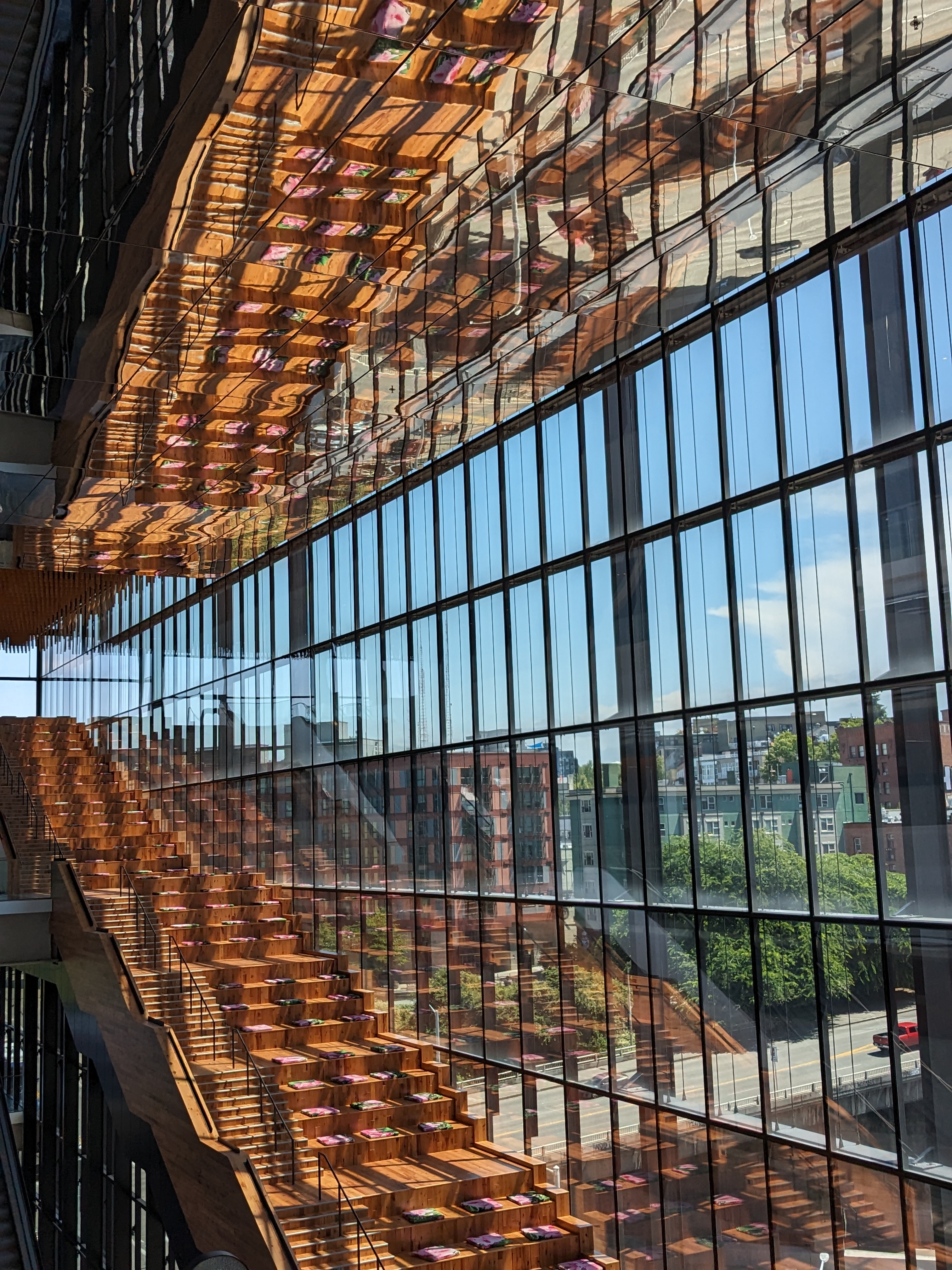
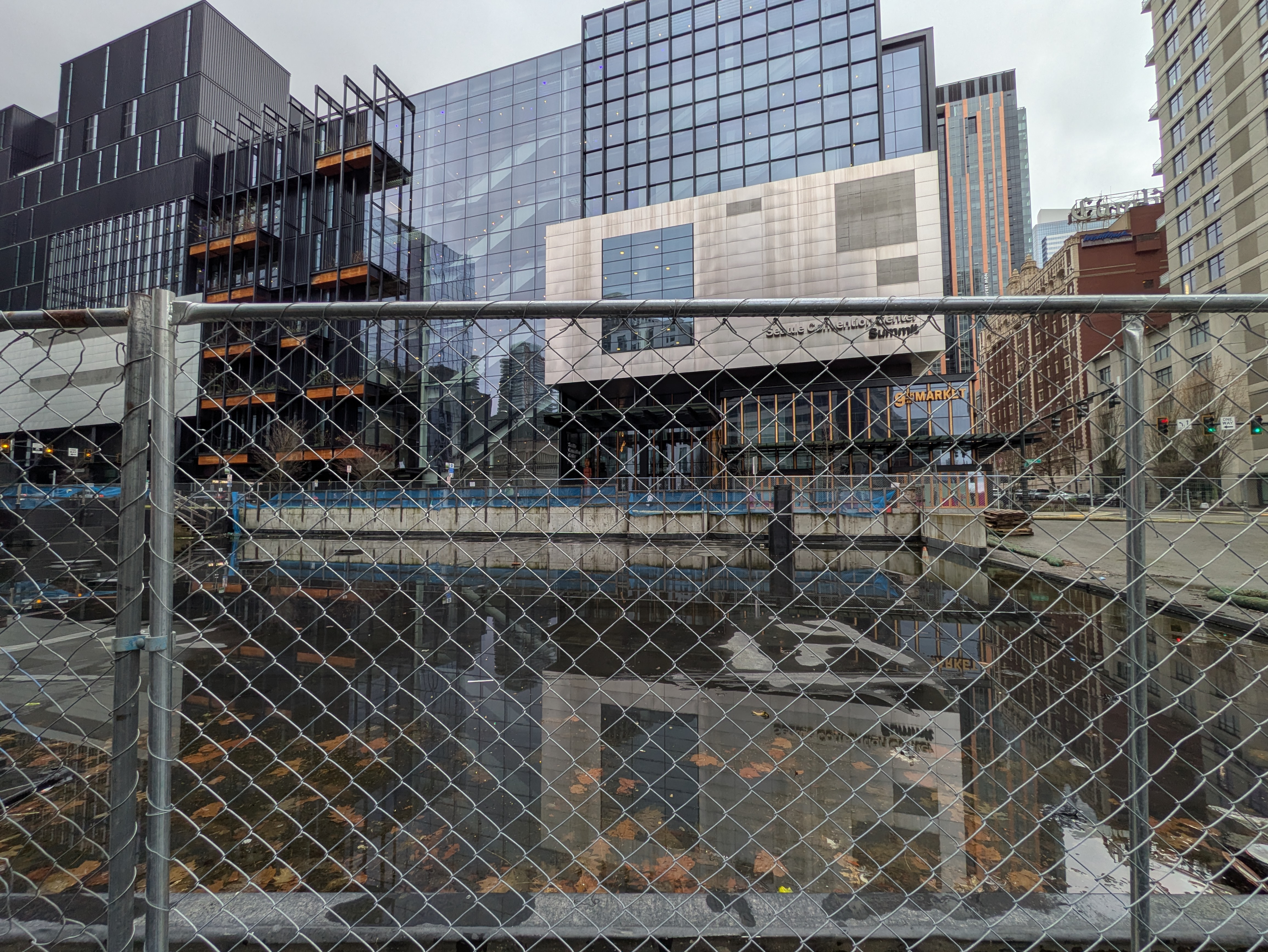
This is a board with attention to spare for the look of the place. It runs a multimillion-dollar public-art program through its own committee and settles individual works, namings, and signage by formal resolution — the "picking the art" end of the job gets careful, minuted care. On June 30, that produced a motion from its Marketing Committee to approve a sign: the "Summit Signage Project Celebrating Board Governance & Stewardship for Outreach, Diversity and Inclusion." Read the slogan against the meeting. Its location was buried in a PDF posted a week out, and the online minutes reach back barely eighteen months. The board's website even spells out how to keep track: under the Open Public Meetings Act, it says, anyone who wants notice of its meetings should email info@seattlecc.com with their name and address. People who have done exactly that report no reply — the one notice channel the board points them to does not answer.
Leadership that never turns over
The board proposed to celebrate its diversity and inclusion under a chairman in his twenty-third year at the gavel — which points to the real question about this board: who runs the room, and for how long. Frank Finneran has chaired it since 2003, and, by the center's own account, held a seat reaching back to the 1988 opening — while every convention board in this comparison rotates its chair, most of them by an annual vote. The longest-serving chairs at any of these peers stepped down after twelve or thirteen years. Seattle's is past twenty. No board caps how long a chair can serve, so this is not against the rules — it is what the rules permit when nothing forces a turn. The reform-minded peers build the turn in anyway: Portland, Detroit, and Indianapolis re-elect their officers every year. Seattle's two-year officer terms, stacked twenty-three deep, do not.
And the calendar will not force the turnover on its own. Those five terms expire July 30 — but a board member whose term is up keeps the seat until a successor is appointed. Expiration is not replacement. If the Governor, the King County Executive, and the Mayor don't move, the incumbents hold over, and the board that was supposed to turn over stays exactly as it is. Portland closed this trapdoor in 2001, ending holdover outright; Seattle never has. So July 30 is not a deadline that changes anything by itself — it is an opportunity that materializes only if the appointing authorities make it a priority.
The fix is an appointment
None of this needs a new law, a new tax, or a fight. Washington is a leader on accountability — open government, one of the strongest public-records laws in the country, an attorney general's office that made its name holding institutions to account. The five people who fill these seats can solidify that reputation for one of the state's prize assets. Put someone who does public finance in the room, seat a neighbor, and turn the lights on so the public can watch.
Companion piece: "Help Wanted: Seeking PFD Board Members" — who to put in those five seats, and how to apply.
Sources
- Statute & board roster: RCW 36.100.020; WSCC PFD board roster (seattlecc.com/governance).
- Debt & lodging tax: the district's FY2024 audited financials (Moss Adams) and bond disclosures.- Chair tenure: chair since 2003, confirmed across those minutes.
- Meeting access, minutes archive, signage: the WSCC PFD June 30, 2026 board agenda (seattlecc.com) and an eight-site governance-website review (July 1, 2026); the June 30 meeting conducted with the board attending by video — the chair and CEO appearing on a screen, the communications director the only convention-center official in the room — from direct observation of that meeting.
- OPMA notice channel: the board's meeting-notice instruction (email info@seattlecc.com) from seattlecc.com; the unanswered-request experience from that review and from members of the public who have tried the address.
- Public-art program & namings: district board resolutions and minutes (e.g., Res. #2026-07).
- Visit Seattle & Aramark: the Visit Seattle marketing contract's no-bid basis in the district's Board Policy 7 (Exemptions from Competitive Procurement), and Aramark as food-and-beverage concessionaire, from board policy and minutes.
- Peer comparison: composition, meeting-access, and chair-rotation from an eighteen-board convention-governance almanac (July 1, 2026) — Boston (Mass.gov, Overview of the MCCA, boards.mass.gov); Philadelphia (64 Pa.C.S. § 6005); Nashville (Tenn. Code § 7-89-108); Washington DC (D.C. Code § 10-1202); Chicago (MPEA roster, mpea.com); Portland (Metro / MERC, oregonmetro.gov); Detroit (MCL 141.1359–1361); Indianapolis (IC 36-10-9). Peer rosters current as of July 1, 2026.
Make a Take / Share a Take▾
Before you pass it on — what's your take?
Sharing a Dispatch piece is taking a position. Take a moment to say what yours is — it travels further, and better, for it.
What do you want to say about this? What struck you — and who needs to hear it?
We don't track clicks. If Make a Take was useful, let us know →
Not sure what to say? Let your own AI help you draft it →
The prompt asks your AI to draft a note in your voice from what the article and its sources actually support — and to push back if you overclaim. Your conversation stays in your AI; nothing is sent to the Dispatch.