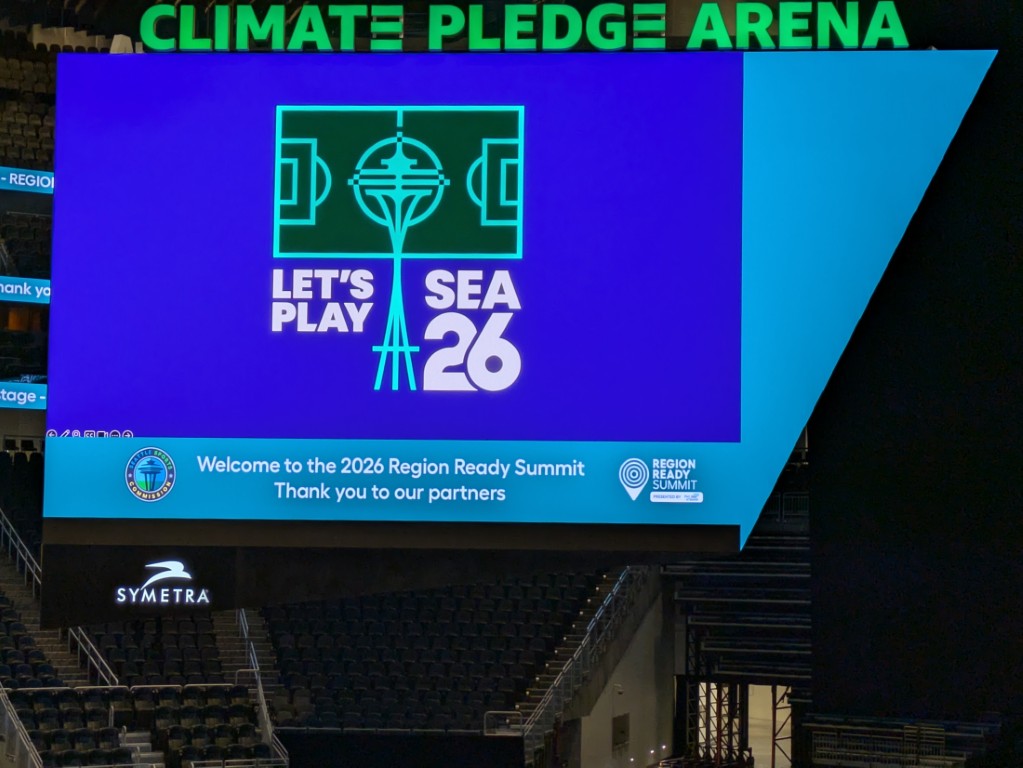
The original plan for FIFA in Seattle was simple: one official Fan Celebration, at Seattle Center. Then it became four. Pacific Place stepped up, activated its five-story atrium as Seattle Soccer House, and gave Convention City Seattle its closest public fan zone — two blocks from Westlake Link Station. The city found ways to open space to the public.
Seattle Convention Center made a different choice.
During the FIFA window — June 14 through July 7, six matches at Lumen Field, a projected $929 million in economic impact for King County — the SCC campus is available for private corporate watch parties, branded galas for 800 to 4,000 guests, and sponsorship activations in its exhibit halls. "If a corporate sponsor wants to host an evening gala in a ballroom," Assistant Director of Sales Aaron Davis told the Connect NW newsletter today, "we can bring that to life." Senior Advisor Michael McQuade added: "A FIFA watch party, where a corporate entity or organization wants to put on their own invitee party would be perfect." The buildings are open. The guest list is closed. The question is where the money lands: inside the building with Aramark, or across the city with the businesses that need it.
That's the sound of an institution working off ~$1.83 billion in bonds still outstanding from a $1.9 billion build. The critique isn't that the SCC is making money during FIFA. It's about competing visions for what the Arch should become — and what that costs the blocks around it.
The New Direction
In January, the SCC announced that McQuade, the longtime Director of Sales — at the organization since it opened in 1988 — was moving into a newly created Senior Advisor role with a mandate to evaluate "tradeshows, sports and special event opportunities for the city." Sports and special events: new language, new direction.
The strategic logic is coherent. Map out the professional sports calendars for Seattle — Kraken, Mariners, Reign, Seahawks, Sounders, Storm, Torrent, Rat City Roller Derby — and you have a dense inventory of away-game windows, each one a potential private watch party at the Arch. On Wednesday, the NBA's board of governors voted unanimously to begin formal expansion talks with Seattle, with a SuperSonics franchise possibly joining the league as soon as 2028-29. If that happens, the calendar gets richer still.
Stack NCAA tournament rounds, Premier Lacrosse, Major League Rugby, Olympic qualifiers, and the bids the Sports Commission is pursuing through 2033, and you have something approaching year-round premium programming.
SCC's new CEO, Jennifer LeMaster, spent seventeen years at the Georgia World Congress Center Authority in Atlanta, rising to Chief Administrative Officer. The GWCCA runs a convention center adjacent to Mercedes-Benz Stadium on the same public campus. But even in Atlanta, the convention center doesn't double as a sports-bar-for-hire — the stadium handles the games, the convention center handles conventions, and they complement each other as neighbors. What's emerging — repurposing exhibit halls as regular corporate watch party venues — has essentially no precedent. It's an experiment being codified into a Campus Master Plan without anyone calling it an experiment.
What Spillover Means
Urban economists have a precise term for what convention centers are supposed to produce: spillover. Delegates who stay three to four nights, eat out twice a day, explore Pike Place, extend their trips, discover things. The hotel room is the economic engine. Restaurants, retail, and attractions run on that fuel. That spillover is the theoretical justification for public financing of convention infrastructure — the idea that a publicly owned venue generates citywide economic activity that exceeds what the venue itself captures.
A corporate watch party in an exhibit hall inverts every variable in that model.
Attendees are local — no hotel nights. Food and beverage is captive inside the venue, operated by Aramark under the building's exclusive food-service contract — no restaurant spend on the surrounding blocks. The event runs three to four hours — no time to explore. Groups arrive together and leave together — no individual wandering, no discovery behavior.
Jane Jacobs spent a career documenting what happens to the blocks around buildings that generate foot traffic without distributing it: the street goes quiet, ground-floor retail struggles, the neighborhood loses the "eyes on the street" that make it safe and economically coherent. The surrounding blocks get the externalities — traffic, crowds on the sidewalk, pressure on transit. They get none of the upside.
The Growth Machine
This isn't a new problem. Growth Machine Theory — developed by sociologist Harvey Molotch in 1976 — describes exactly this dynamic: public authorities that prioritize exchange value over use value, where revenue flows to debt service and the surrounding community absorbs the costs without capturing the benefits. The theory was built to describe cities. It describes this building.
What makes the SCC version particularly stark is the institutional structure. A sports bar — if one could survive on this corridor — would employ local staff, pay local rent, keep the margins local. SCC is a public authority. The revenue goes to debt service on a $1.9 billion expansion. The food service is Aramark. The loop closes inside the building, and the neighborhood around it gets nothing. The sports-bar-for-hire solves a fiscal problem for the SCC — a fiscal problem of their own making.
What the City Should Offer Instead
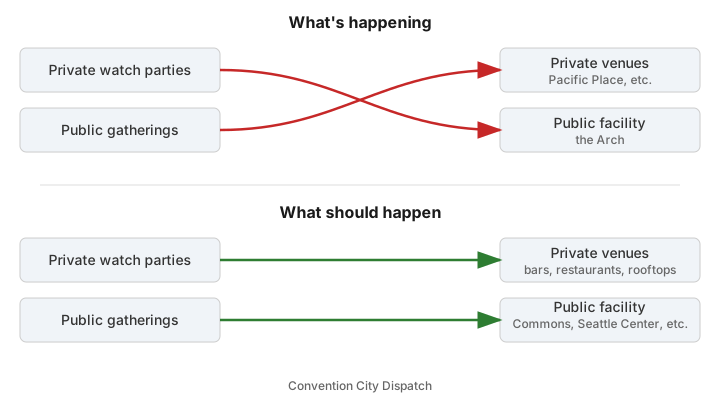
Here's the thing: a company that wants to host a FIFA watch party for its employees is a good thing. People gathering to watch a match together, going out with colleagues, enjoying the city — that's what makes a place worth living in. The question is where it happens.
The Seattle Sports Commission already exists. It runs Region Ready. It published the FIFA Watch Party Playbook. It has a calendar that stretches through 2033 — FIFA, NCAA, Premier Lacrosse, Major League Rugby, Olympic qualifiers. The events are coming. What if the Sports Commission operated as a concierge for corporate event planners — a Visit Seattle for companies trying to get their teams out into the city?
Your company wants a watch party for 40 people? Here's a sports bar in Pioneer Square that would love to have you. A rooftop in Capitol Hill. A brewery in Ballard. A hundred people? Here's a restaurant with a private room and a 12-foot screen. The Sports Commission helps you pick the right venue, the way Visit Seattle helps convention planners pick the right hotel.
The spending goes to small businesses. The employees actually explore Seattle — they discover neighborhoods, eat at local restaurants, maybe think I could live here. This isn't idealism. Urban planning theory — from Hillier's work on how movement distributes through city networks to Smart Growth principles on distributed economic activity — consistently shows that spreading activation across connected venues produces better neighborhood-level outcomes than concentrating it in a single facility. The company gets a team-building experience that's better than a ballroom. The city gets distributed economic activity across dozens of venues in every neighborhood, not captive spending inside one publicly owned building.
And the Arch? In this model, the Arch hosts what only the Arch can host — the public fan zone, the open screen, the civic gathering that draws people to the corridor and sends them into the neighborhoods around it. Private parties use private venues. The public building serves the public.
That's not what's happening this summer. But the Seattle Sports Commission has the calendar, the relationships, and the playbook. They could be the engine of growth for small businesses across the city, turning every game day into a citywide spectacle. Or they can watch Seattle Convention Center turn it into an antiseptic catered yawn.
The Seattle Commons proposal, including the financial case for the Arch as a public amenity, is at commons.conventioncityseattle.com.
Sources: Connect NW Newsletter (March 26, 2026) · Seattle Times: NBA expansion vote (March 25, 2026) · Visit Seattle: FIFA economic impact study (Tourism Economics, December 2024) · Jennifer LeMaster biography (ALSD) · Jacobs, J. (1961). The Death and Life of Great American Cities. · Molotch, H. (1976). The City as a Growth Machine. American Journal of Sociology, 82(2), 309-332.
Ivan Schneider is the founding editor of the Convention City Dispatch. He lives on the Pike/Pine corridor.
Corrected June 13, 2026: Two figures have been brought into line with the underlying records. An earlier version described the SCC as "working off $1.9 billion in bond debt." The $1.9 billion is the Summit build cost; roughly $1.83 billion in bonds remain outstanding (FY2024 audited Statement of Net Position), against that $1.9 billion build. The later reference to a "$1.9 billion expansion" is correct — it names the build, not the current balance — and is unchanged. The piece also described Aramark's food service as operating "under a national contract." Aramark is the convention center's own exclusive food-and-beverage contractor (exclusive since 1988; current contract began January 1, 2025, with extensions running to a potential 2033) — not a national master contract. The captive-spend point the line carries is unchanged.
Make a Take / Share a Take▾
Before you pass it on — what's your take?
Sharing a Dispatch piece is taking a position. Take a moment to say what yours is — it travels further, and better, for it.
What do you want to say about this? What struck you — and who needs to hear it?
We don't track clicks. If Make a Take was useful, let us know →
Not sure what to say? Let your own AI help you draft it →
The prompt asks your AI to draft a note in your voice from what the article and its sources actually support — and to push back if you overclaim. Your conversation stays in your AI; nothing is sent to the Dispatch.