Seattle Convention Center would like to host your graduation.
"Every commencement deserves a venue as memorable as the achievement," its summer pitch says — the Arch and Summit, your stage next year. Wonderful idea, and a good use of space. This is exactly what we need Convention City Seattle to become — not just a place for business visitors, but a resource for the entire community.
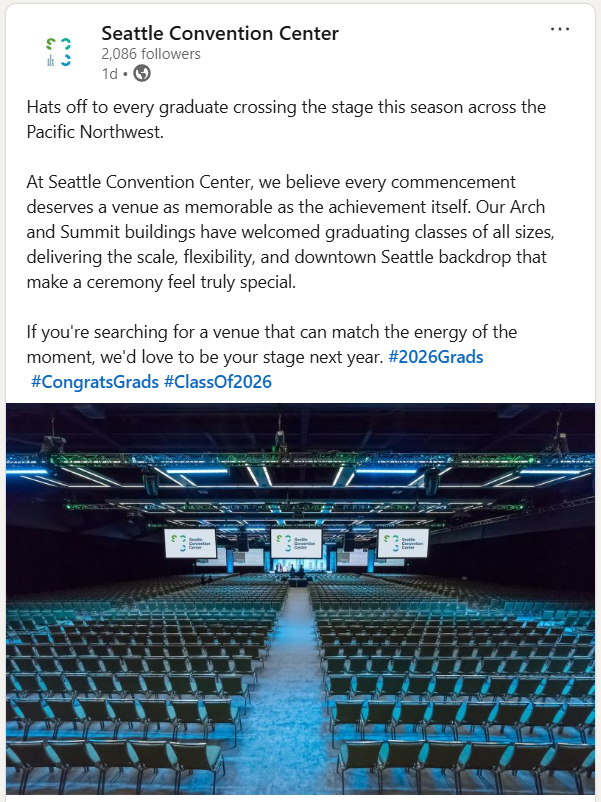
Graduations are relatively simple events: everyone shows up all at once to listen to the valedictorian and the commencement address, and then the graduates line up to collect their degrees and flip their tassels. Then everyone poses for pictures, and that's it.
The best part is the timing. A graduation lands right as the convention calendar empties out for the summer — the center's own booking records show, by my own month-by-month count, the building at its quietest in July and August, barely five percent of the year's bookings in each month against October's fifteen. The reason is simple: if you're booking a convention in Seattle, you pick a shoulder season, when you're not competing for hotel rooms with summer tourists. The building's own calendar empties out in midsummer, precisely when school lets out and residents are most free. The space is there; the season is there; the only missing piece is the invitation.
The problem is the cost structure. The food and beverage is captive and priced for corporate budgets; booking the hall for an ordinary public purpose is like chartering luxury motor coaches for a school field trip in a year the district can't afford field trips at all. But a graduation is the exception. A commencement is two hours of folding chairs and a podium — no banquet. Take the catering out of the equation and you are simply renting a room, and the cost wall comes down. That's why the pitch actually works, and why it's smart.
A graduation is the first rung. A summer of public events, and the citywide celebrations a great public room could hold the rest of the year, is the potential.
Here at the Dispatch, we're all about bringing people into the Convention City neighborhood, and it would be wonderful to see graduates and their families making full use of the campus and the adjacent spaces in Freeway Park.
And here's some more exciting news: Seattle Convention Center has been named Best Managed.
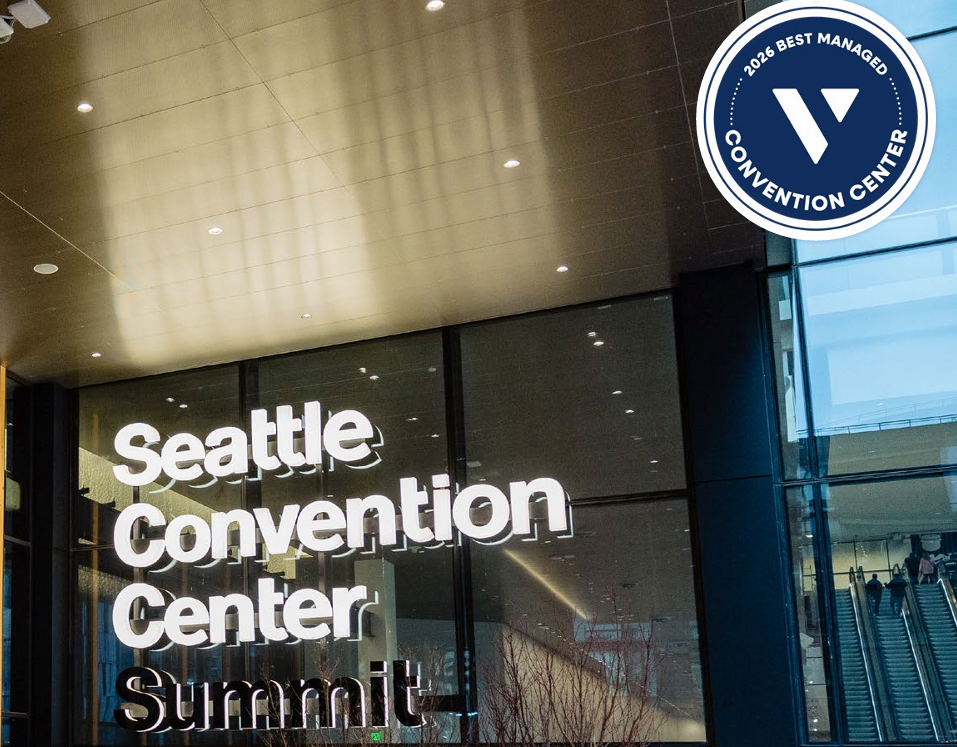
The distinction arrives on the cover of the May issue of Business View Magazine, in a glossy fourteen-page profile under the headline "The Epicenter of a City That Has It All." In form, it's a commencement address, and the CEO delivers the valedictory. Seattle, Jennifer LeMaster explains, is "uniquely positioned… a million square feet of meeting space sitting right in the heart of downtown." Her team offers not mere satisfaction but "radical hospitality and a world-class experience." "Leadership," she says, "exists at every level and in every department." The building is "inviting customers into the journey of reinvestment." Pomp, circumstance, and a tassel for management.
It's a fine speech. It's also an advertisement. The profile that pronounces SCC "Best Managed" is custom publishing: the feature is wrapped in full-page ads from the center's own vendors — Aramark the caterer, Encore the producer, Edlen the electrician, Smart City the network — and it closes with a directory of the same names. Every quote is the CEO's. The publisher says as much, in the fine print beneath its table of contents: the content was "provided by" the subject, "without verification by us." Who cut the check — SCC, or the vendors crowding its margins — it doesn't say. Either way, the genre is advertising, not business journalism — Bloomberg Businessweek and The Economist profile companies they don't bill, and don't hand their subjects a "Best Managed" ribbon on the way out. A real read on management lives in the books, not a magazine — and we'd want a passing grade on the final before anyone hands out a diploma.
The real value of the Business View article is that it shows you what an organization says about itself when it gets to tell its own story. And in the May issue, two public convention authorities did exactly that, in identical formats — Seattle, and the Massachusetts Convention Center Authority, which runs Boston's halls. Both, for the record, wear the same "Best Managed" badge on their opening spread. Read side by side, the two self-portraits are about completely different things.
Seattle's is about the customer. Its section heads sell "seamless execution" and a "citywide experience"; its promise is "radical hospitality"; its numbers are thin. Boston's is about the public. Its section heads are "Driving Community and Commerce" and "Anchored in Community." It quotes not only its executives but a member of its governing board, on stewardship. And it backs that up with an accounting — jobs supported, attendees, hotel-room nights, a dollar figure for economic impact, all tied to the state's own oversight report. You can argue with the numbers, but at least they're part of the story they tell. Handed a blank page, Seattle described a good vendor; Boston described a public steward.
Seattle has two buildings, and a Public Facilities District that — by its own audited numbers — ran a $69.4 million operating loss in 2024 (more recent numbers are not yet published). Boston loses money too. Its halls cover only about seventy percent of their operating costs; like nearly every convention center in the country, the rest comes from dedicated hotel and tourism taxes. Moreover, Boston's convention authority just ousted its own CEO amid a travel-spending scandal, and carries audit findings of its own.
Maybe it's not the time for a valedictory speech from either convention center.
Good news: the staff at the Seattle Convention Center did make the honor roll. SCC won a Smart Star from Smart Meetings — Best Convention Center, for the second year in a row. The Smart Star is a readers' choice award: meeting professionals vote for the venues they actually use. About a dozen convention centers make the cut each year — and it measures execution. That duck on the water LeMaster described, calm on top and working furiously beneath, is the operations and events staff — long-tenured pros who know the building cold, running flawless events while the people who hire them vote to say so. That award is theirs, and they earned it.
And so, in this graduation season, let's celebrate what SCC does right — the execution quality from its seasoned staff, and the growing awareness among its management that the convention center must provide space for the broader community.
We look forward to a bright future where the public uses the convention center buildings for civic events.
A note on the numbers: the seasonality figures — the building at its quietest in July and August, against an October peak — are my own count of bookings by start-month in the Seattle Convention Center's own event log (a frequency of bookings, not a count of event-days). Those records are public; they're available from SCC by records request.
Convention City Seattle maintains profiles of convention cities around the world — 32 so far, scored across 16 dimensions, from food-hall activation to transit to public programming — at almanac.conventioncityseattle.com.
Make a Take / Share a Take▾
Before you pass it on — what's your take?
Sharing a Dispatch piece is taking a position. Take a moment to say what yours is — it travels further, and better, for it.
What do you want to say about this? What struck you — and who needs to hear it?
We don't track clicks. If Make a Take was useful, let us know →
Not sure what to say? Let your own AI help you draft it →
The prompt asks your AI to draft a note in your voice from what the article and its sources actually support — and to push back if you overclaim. Your conversation stays in your AI; nothing is sent to the Dispatch.