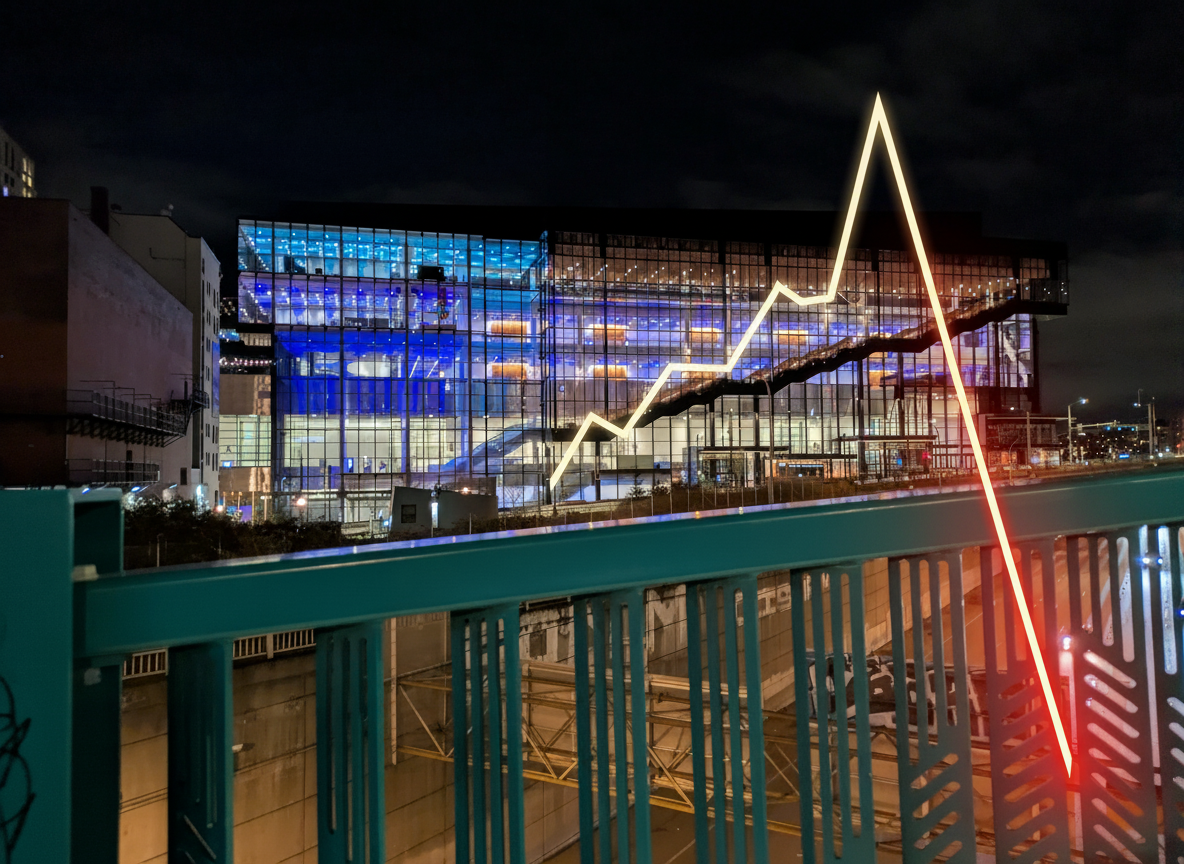
I worked at the Seattle Convention Center in 2023 as an admission attendant — union, on-call. While I was there, I began to refresh the finance and accounting skills I'd learned in my MBA 25 years earlier. They posted a Capital Accountant position, $70-110K, three years experience required. I didn't feel qualified. I never applied. That August I moved to full-time as an AA lead, still union, through the end of the year.
And I kept reading the textbooks.
It turns out the best way to learn financial statements is to pick one organization and get really familiar with it. Read the audits. Pull the bond documents off EMMA. Trace where the money comes from and where it goes. Understand one set of books deeply, and the concepts — operating income, debt service, depreciation, return on investment — stop being abstract. They become the story of a building you've worked in.
This is what I found this month when I looked into the books of Washington State Convention Center Public Facilities District, the legal entity behind Seattle Convention Center. What follows is a primer: economic impact, lodging tax, debt service, return on invested capital, breakeven analysis, and fiscal impact — all illustrated with real numbers from one organization's public records. Read it straight through or come to it when you need to understand something specific.
This was prompted by the Puget Sound Business Journal reporting that the Seattle Convention Center "edges back to profitability" with $1.4 million in net operating income for 2025.
Let's get some intuition for that number, shall we?
What's in this primer
- The Multiplier Effect — What IMPLAN is and why economic impact numbers are larger than reality
- The Public Pitch and the Bond Pitch — The $1.5B "turned away" pitch and the CBRE forecast that sold the bonds
- Return on $1.9 Billion — Operating income, ROIC, cost of capital, and breakeven — step by step
- "$1.4 Million in Profit" — What the PSBJ number includes, excludes, and likely reclassifies
- Apples to Apples — The real trajectory when you apply the same definition to every year
- Turn Around — Three questions to ask about any economic impact claim
The Multiplier Effect
IMPLAN (Impact Analysis for Planning) is an input-output model used by virtually every convention bureau, sports authority, and tourism board in the country. It works by tracing spending through ripple effects:
- A convention attendee pays $225 for a hotel room
- The hotel pays staff, buys linens, pays utilities
- Those workers buy groceries, pay rent, get haircuts
- Those businesses pay their workers, who spend again
Each dollar gets counted multiple times as it cascades through ~550 industry sectors. A $225 hotel room becomes $450 in "total economic impact" at a 2.0x multiplier. The original $225 is "direct." The additional $225 is "indirect" (the hotel's supplier purchases) and "induced" (workers spending wages).
The ripple effects are real. But three things inflate the number:
Leakage. In Seattle, a large share of spending leaves the region immediately. The hotel chain's profit goes to corporate headquarters. The linens come from overseas. The food distributor sources from California. IMPLAN has regional adjustment factors. They are generous.
Substitution. If the convention attendee's hotel room would have been booked by a tourist anyway — Seattle in summer, say — the "new" spending is zero. IMPLAN counts all spending as incremental. It does not model counterfactuals.
Displacement. Locals avoid downtown during a major convention. Their spending doesn't disappear; it moves to other neighborhoods or weekends. IMPLAN doesn't subtract this.
The academic literature on this is large and one-directional. Heywood Sanders at the Brookings Institution documented that consultant demand forecasts overestimate by 30-60% (he has a new book on convention-center economics underway). Baade and Matheson found that ex-ante economic impact studies overstate actual impact by 3-10x. John Crompton's paper in the Journal of Travel Research was titled, plainly, "Economic Impact Studies: Instruments for Political Shenanigans?"
The Government Finance Officers Association explicitly warns municipalities: economic impact is not cost-benefit analysis. An economic impact study asks "how much spending does this generate?" A cost-benefit analysis asks "does the spending justify the public cost?" Convention authorities almost never commission the second study.
The Public Pitch and the Bond Pitch
The Seattle Convention Center's expansion was justified by two numbers, aimed at two audiences.
The public pitch: "$1.5 billion in turned-away conventions." The center argued it was forced to turn away more than 300 conventions worth $1.5 billion over five years because it lacked space. That's $300 million per year — an enormous number. It was an economic impact projection: hotel rooms, restaurants, taxis, retail, all run through the IMPLAN machine.
The entire convention center — both buildings, every event — generated $66.5 million in operating revenue in 2025. The "$1.5 billion turned away" claim was nearly five times the center's total revenue from all activity. That $300 million wasn't venue economics. It was the IMPLAN multiplier applied to visitor spending far beyond the convention center's walls — hotels, restaurants, taxis, retail.
That's not an error. It's how the chain works. Economic impact is a shadow on the wall — a real shape, cast by a real object, but larger than the thing that cast it:
| Step | Amount |
|---|---|
| What flows through the convention center | $66.5M (total, all events) |
| Direct visitor spending (hotels, meals, transport) | $150-200M |
| IMPLAN multiplier (1.7-2.0x) | $300-400M |
| Ratio: shadow to object | ~5-6x |
A 5-6x ratio between economic impact and total venue revenue is typical for the convention industry. The multiplier on direct visitor spending (1.7-2.0x) is within industry norms — the gap grows because most visitor spending happens outside the convention center. The problem isn't the math. The problem is that $300 million in economic impact was used to justify a capital investment that had to be repaid from a completely different revenue source — and even at face value, the economic impact doesn't generate enough tax revenue to cover the cost.
What $300 million in economic impact actually yields in taxes:
Accept the $300 million. Assume it all lands locally. Not all of it is taxable — wages earned aren't point-of-sale transactions. Maybe $200 million flows through taxable spending: hotel rooms, restaurants, retail, services. Apply the actual tax rates:
| Jurisdiction | What they collect | Bond exposure |
|---|---|---|
| SCC/PFD (lodging + convention tax) | ~$18M | Owes $85M/yr in debt service |
| State of Washington (sales tax) | ~$13M | Backstop expires 2029; then zero |
| County/Metro/RTA (sales tax) | ~$5M | None |
| City of Seattle (sales tax) | ~$2M | None, but 7% lodging tax is locked |
| Total | ~$38M |
The state makes out best. Washington collects $13 million in general fund revenue, free and clear. Their contingent backstop on the bonds expires in 2029 — but the state's real exposure doesn't end there. A SCC default would reprice every municipal bond in Washington. Schools, roads, utilities — all would carry a higher risk premium if the state let a special-purpose district fail on bonds that carried an implicit state guarantee. The state's incentive to keep the convention center solvent has less to do with the convention center than with protecting its own borrowing costs.
The city's fiscal picture is more complicated. Seattle collects roughly $2 million in general fund sales tax — but the convention center also supports restaurant jobs, hotel employment, and a downtown service economy that wouldn't exist at the same scale without it. Those benefits are real. They're just not fiscal. Meanwhile, the city's 7% lodging tax — $93.5 million in 2024, collected from every hotel guest in the city, not just convention attendees — is permanently allocated to SCC debt service. That revenue could fund housing, transit, or public safety. Instead it services bonds on a facility the state benefits from most directly.
King County collects about $5 million in sales tax from convention-related activity — but its hotels contribute $6.4 million in the 2.8% extended lodging tax that goes straight to SCC debt service. The county sends more to the convention center than it gets back.
The facility was called the Washington State Convention Center for decades. Last year it rebranded as the Seattle Convention Center. But the economics haven't changed. The state captures the most revenue with the least risk. Seattle bears the cost. The name change was branding. This really is Washington State's convention center.
And here is the upper bound: if $300 million in economic impact generates $38 million in total tax revenue for all jurisdictions combined, then $38 million is the absolute maximum that all levels of government should rationally agree to spend attracting that activity. The annual debt service alone is $85 million — more than double the tax capture, even if you accept every dollar of the economic impact at face value.
The bond pitch: "$171 million in lodging tax by 2024." The bonds were sold on a CBRE Hotels Advisory forecast projecting lodging tax growing from $104 million (2017) to $171 million by 2024, providing 2.0x debt service coverage. This made $1.9 billion in bonds sellable.
The actual 2025 lodging tax: $98.4 million — 42% below projection (EMMA continuing disclosure, February 2026). Growth from 2024 to 2025: less than 1%.
The projected debt service coverage ratio: 2.0x. The actual: 1.18x.
Both the District and its consultant disclaimed the forecast in the bond documents:
"The District makes no representation or warranty as to the correctness of the Report or the conclusions set forth therein."
"Any projection is subject to uncertainties... there are likely to be differences between projections and actual results, and those differences may be material."
Return on $1.9 Billion
Here is a question worth asking: what return does the Summit Building generate on the $1.9 billion invested?
To answer it, we need three concepts.
Operating income is what a business earns from its core activity — revenue minus operating expenses. If a convention center takes in $66.5 million from renting halls, selling food, and charging for parking, and spends $65.1 million running the buildings, the operating income is $1.4 million. That's the number SCC reported for 2025.
Return on invested capital (ROIC) measures how much profit an investment generates relative to what was spent. If you invest $1,000 in a rental property and it earns $40 per year in net income, your ROIC is $40 / $1,000 = 4%. It tells you whether the investment was worth making.
Cost of capital is what you pay to borrow the money. The Summit was financed with $1.9 billion in bonds at a weighted average interest rate of about 3.9%. That means the center pays roughly $75 million per year in interest. For the investment to create value rather than destroy it, the ROIC must exceed the cost of capital. If you're paying 4% to borrow and earning 2%, you're losing money on every dollar invested.
Now the numbers.
Step 1: What did the Arch building earn before the expansion?
In 2019, the Arch building — operating alone, before the Summit existed — generated about $37 million in revenue and spent about $28 million on cash operations (excluding depreciation and the Visit Seattle transfer). Operating income: +$9 million. The Arch had minimal debt. It was a modest building making a modest profit.
Step 2: What do both buildings earn after the expansion?
In 2025, SCC reports $66.5 million in revenue and $1.4 million in operating income. This is the combined performance of the Arch and the Summit — the whole campus, on SCC's most favorable accounting basis.
Step 3: What is the incremental return from the Summit?
The question is not "is the campus profitable?" It's "did the Summit investment make things better or worse?" To answer that, subtract what the Arch was already earning:
$1.4 million (both buildings, 2025) minus $9 million (Arch alone, 2019) = -$7.6 million
The Summit didn't add $1.4 million in profit. It reduced the campus's operating income by $7.6 million compared to what the Arch earned on its own. The expansion made the financial picture worse, not better.
Step 4: Calculate the return on invested capital.
ROIC = incremental income / invested capital = -$7.6 million / $1,900 million = -0.4%
To be clear: the campus is profitable. The investment is not. The convention center earns $1.4 million. But it earned $9 million before the Summit was built. The $1.9 billion expansion didn't create the profit — it shrank it.
The bonds carry an average interest rate of about 3.9%, or $75 million per year. That debt service is paid by lodging tax, not by operating revenue — the two flow through different cash registers. But the comparison still matters: the public spent $1.9 billion and the operating result got worse. If a listed company spent $1.9 billion to go from $9 million in income to $1.4 million, the shareholders would expect things to change. Asset divestitures. Management changes. A new slate of directors. Not a blank check for more.
Even in a generous scenario — say revenue eventually reaches $80 million (a 20% increase) and operating income climbs to $15 million — the incremental return would be $6 million on $1.9 billion, or 0.3%. The investment thesis doesn't improve with time.
Step 5: What would it take to break even?
For the ROIC to match the cost of capital, the Summit would need to generate $76 million per year more in operating income than the Arch was generating alone. Working through the math with the center's current cost structure (about 60 cents of variable cost per dollar of revenue), that implies $275 million in annual operating revenue — 4.1 times the current $66.5 million.
For context: McCormick Place in Chicago, the largest convention center in North America, generates roughly $250 million. The Javits Center in New York does about $200 million. Seattle would need to out-earn both — in a metro one-third the size of Chicago.
There is no plausible revenue scenario that earns 4% on $1.9 billion. It was a civic infrastructure project sold as a revenue investment.
A booster will say the Summit is still filling: convention bookings are placed years out, and 2025 is only its third season against the Arch's best year ever. But time doesn't close a gap this size. Even fully booked at the scale of the largest halls in the country, the Summit falls short of the $275 million breakeven; and because money has time value, a return pushed to some distant fully-ramped year is worth less today, not more. Waiting doesn't rescue the math — it discounts it. No convention center, arena, or transit hub earns a market return on its construction cost; that's the point. The Summit may be worth having, but the case is civic, not financial — and the cost-benefit study that would test it has never been commissioned.
"$1.4 Million in Profit"
Now back to the PSBJ headline. SCC reports $1.4 million in net operating income for 2025 — "the first positive year since 2019."
Three things to understand about this number:
It is unaudited. The FY2025 audit (Moss Adams) won't be available until approximately October 2026 — the State Auditor's Office issued the FY2024 audit on October 30, 2025, and the FY2023 audit on October 21, 2024. The $1.4 million is self-reported by SCC management. As a Public Facilities District — a special-purpose government entity — SCC's audited financials must follow GASB (Governmental Accounting Standards Board) standards. Its self-reported numbers follow no standard. There is no rule requiring the figure told to PSBJ to match the audited definition.
It almost certainly excludes ~$53 million in depreciation. The audited FY2024 operating loss was -$69.4 million (GAAP). Excluding depreciation, the cash operating loss was -$16.4 million. Depreciation is the annual cost of the building wearing out. You can argue it's "non-cash" — but the building is three years old. That wear is real, and the replacement cost will be real.
The math requires ~$10 million in expense reduction. Revenue of $66.5 million minus $1.4 million income = $65.1 million in expenses. But audited FY2024 cash operating expenses were $75 million. Where did $10 million go?
The leading candidate: Visit Seattle reclassification. SCC pays approximately $12 million per year to Visit Seattle, the city's tourism marketing agency. In FY2024, this appeared as an operating expense. If reclassified as a non-operating transfer in FY2025, operating expenses drop by $12 million — mechanically producing the $1.4 million "profit" with no operational change.
Unlike depreciation, the Visit Seattle payment is real cash. It comes from lodging tax revenue and flows to an external agency. Moving it from one line in the income statement to another does not change the center's cash position by one dollar.
Apples to Apples
If SCC changed its definition of operating income in 2025, the honest comparison requires the same definition applied to prior years. Here is the trajectory, restated:
| FY2019 | FY2023 | FY2024 | FY2025 | |
|---|---|---|---|---|
| Revenue | ~$37M | $47.1M | $58.6M | $66.5M |
| Cash expenses (reclassified) | ~$28M | $58.9M | $62.7M | ~$65.1M |
| Operating income | +$9M | -$11.8M | -$4.1M | +$1.4M |
Under consistent accounting, the "turnaround" is $5.5 million (from -$4.1M to +$1.4M) — not the $17.8 million implied by comparing the 2025 self-reported number to the 2024 audited number.
And the trajectory tells a different story than the headline. The center went from +$9 million on one building with no debt to +$1.4 million on two buildings with $1.9 billion in debt. That is not turning a financial corner. That is a decline dressed as a recovery.
Turn Around
For any economic impact claim — convention center, World Cup, sports stadium, tech campus — ask three questions:
1. What is the fiscal impact? Not "how much spending does this generate?" but "how much tax revenue does the government collect, net of the public cost?" For the convention center: ~$98 million in lodging tax minus ~$85 million in debt service minus ~$10 million in operating shortfall = roughly $3 million net.
2. What is the return on invested capital? If public money was spent, did the investment improve the financial picture or make it worse? The convention center spent $1.9 billion and went from $9 million in operating income to $1.4 million. The campus is profitable. The investment is not.
3. Who commissioned the study? Every major economic impact study for a convention center or sports venue is commissioned by the entity that benefits from the finding. The same small group of consulting firms produces nearly all of them. Independent academic studies consistently produce lower numbers — often 3-10x lower.
The prisoners in Plato's cave didn't need better shadows. They needed to turn around.
The Convention Center's audited financials, bond documents, debt service schedules, and CBRE forecast are analyzed in detail at commons.conventioncityseattle.com/financials. The 2030 debt service cliff is covered in Big Balloon Bailout. The Arch building's role in downtown is discussed in The Big Tent. All source data is public record.
Correction, May 30, 2026: An earlier version said the FY2025 audit "won't be available until approximately May 2026." The State Auditor's Office issues the District's contracted-CPA financial audit in late October (the FY2024 audit was issued October 30, 2025; FY2023 on October 21, 2024), so the FY2025 audit is expected around October 2026. May is when the District has traditionally released its own unaudited figures — which, as of May 30, it had not done.
Correction, August 27, 2026: This piece treated $66.5 million as the convention center's 2025 operating revenue. That was the district's own unaudited figure, given to the Puget Sound Business Journal; the audited statements published August 21, 2026 report operating revenue of $61,286,429 for 2025. The "Apples to Apples" table therefore set an unaudited 2025 figure beside audited prior years, and the return-on-capital section's revenue base is overstated by $5.2 million. Two further corrections: the FY2025 audit was published in August, not "approximately October 2026," and it was signed by Baker Tilly US, LLP — Moss Adams audited fiscal years 2020 through 2024. And the closing arithmetic in "Turn Around" used an operating shortfall of about $10 million; the audited figure is $17,750,118, which turns "roughly $3 million net" into a deficit of about $4 million against scheduled debt service, or about $10 million against 2025's actual cash debt service.
The audit also answers the question this piece asked. Audited 2025 cash operating expenses were $80,348,517 against the management basis's implied $65.1 million — $15.2 million excluded rather than the $10 million estimated here, of which $11.5 million is the audited Visit Seattle payment. Cash operating expenses rose in 2025. On a consistent cash basis the 2025 operating result was −$19.1 million, against 2024's −$16.4 million.
Make a Take / Share a Take▾
Before you pass it on — what's your take?
Sharing a Dispatch piece is taking a position. Take a moment to say what yours is — it travels further, and better, for it.
What do you want to say about this? What struck you — and who needs to hear it?
We don't track clicks. If Make a Take was useful, let us know →
Not sure what to say? Let your own AI help you draft it →
The prompt asks your AI to draft a note in your voice from what the article and its sources actually support — and to push back if you overclaim. Your conversation stays in your AI; nothing is sent to the Dispatch.