Read this with your own AI▾
This piece was built with the help of AI, from public records — here's how. Read it back with your AI: choose how you want to read it, copy the prompt, and interrogate the article yourself.
Your conversation stays in your AI — nothing is sent to or stored by the Dispatch. The built-in grounding line keeps the answer tied to the Dispatch's own reporting, and asks your AI to flag — not invent — anything that needs more.
The visitor population of Convention City Seattle, from the convention center's own calendar — and why its swing, not its size, is what a business on the corner can't survive.
Daily visitor draw, Feb 2026–Feb 2027 — each event counted at its full crowd on every day it runs (a weekend-badge con is there all weekend); rotating day-shows like the Flower & Garden Festival are spread across their run. The dashed line is the average; almost no day sits on it. Gold bars are the 4,000+/day spikes; the biggest are labeled.
A factory runs on a stable daily number — a whistle, a shift, a crowd arriving at a regular pace. Convention City doesn't have one. The day-to-day swing here — the standard deviation, ~4,800 — runs about twice the average itself (~2,200). Most days the public calendar shows nothing to plan around; then a comic con puts twenty-five thousand on the block.
And this is only the calendar you can see. The private galas and buyouts that never get listed are real — but they're sporadic bookings too, so they add to the swing, not to a stable floor. The events we can't see make the corner harder to staff, not easier.
- Take each public event's expected attendance from the SCC calendar.
- Count that crowd on every day the event runs — a badge con's attendees are present all weekend, so a 25,000-a-day show counts 25,000 each day. (A rotating day-show like the Flower & Garden Festival, whose 60,000 is a 5-day total, is the exception — that one spreads across its run.)
- Sum every event active on each calendar day → that day's draw.
- Take the mean (~2,200) and population standard deviation (~4,800) across all 365 days.
Source: Seattle Convention Center public events calendar. Which building an event books (Arch / Summit / both) is a second-order detail — the population counts all of it. Attendance figures are venue/organizer estimates.
In an article about the Pike St. site of the former Cheesecake Factory, I did some arithmetic on a napkin and published it rather quickly because I wanted to make a hot-dog reference on National Hot Dog Day, which tells you what kind of operation this is. The claim was that the SCC Arch doesn't draw a steady enough crowd to make the corner across the street a viable site for a large-scale restaurant. I still believe it. But this Dispatch runs on an invitation — read it with your own AI, check my work — and the artificial intelligentsia pushed back that I had asserted a standard deviation and never shown where it came from. So I redid the math and found I'd been too easy on the convention center.
I missed it the first time because of confirmation bias: I walk that block, and Pike Street by the convention center is a commercial dead zone most days of the year — empty sidewalk, for-lease signs, a hot-dog stand that's closed most days and not much else. So when the numbers came back saying the corner draws almost nobody most days, they matched what my own eyes had already told me, and I filed them and moved on.
The problem was in a single word: attendance. The convention center's calendar lists an "expected attendance" for every event, and that number means two different things depending on the show — sometimes the crowd on a given day, sometimes the total who pass through across the whole run — and nobody tells you which. For a medical conference it barely matters: four thousand doctors register, the same four thousand are in town all four days, so four thousand is both the total and the daily crowd. The Northwest Flower & Garden Festival lists sixty thousand, but that's a five-day figure for a crowd that mostly turns over from one afternoon to the next — maybe twelve to fifteen thousand on the floor at once, not sixty thousand. Same word, wildly different meaning.
My first pass divided every number by the days it ran, as if every crowd rotated like the garden show's. That badly shortchanges a convention — a lot of Comic Con's badge-holders hold weekend passes and are on the block Thursday and still there Sunday. Count the full crowd every day and you make the opposite mistake, since plenty do buy a single day. The truth sits somewhere in the middle. And here's what matters: it doesn't change the answer. Count the crowds the stingiest way — everyone comes once — and the day-to-day swing is still 2.4 times the average; count them the most generous way, everyone every day, and it's 2.1. Wherever the real number falls, the swing runs past twice the mean. So I used the generous count — the most favorable reading the convention center could ask for — and the corner still can't hold a Cheesecake Factory.
The visitor draw averages about twenty-two hundred people a day. The standard deviation — the size of the daily swing — is about forty-eight hundred, more than twice the average itself. More than half the year, the public calendar gives a restaurant nothing to plan around. Then a comic con drops twenty-five thousand people onto one block. That is not a number you staff a factory against. It's a number you meet with a hot-dog cart. Shout out to DEEZ DOGZ, which can move five thousand dogs on a Comic Con day.
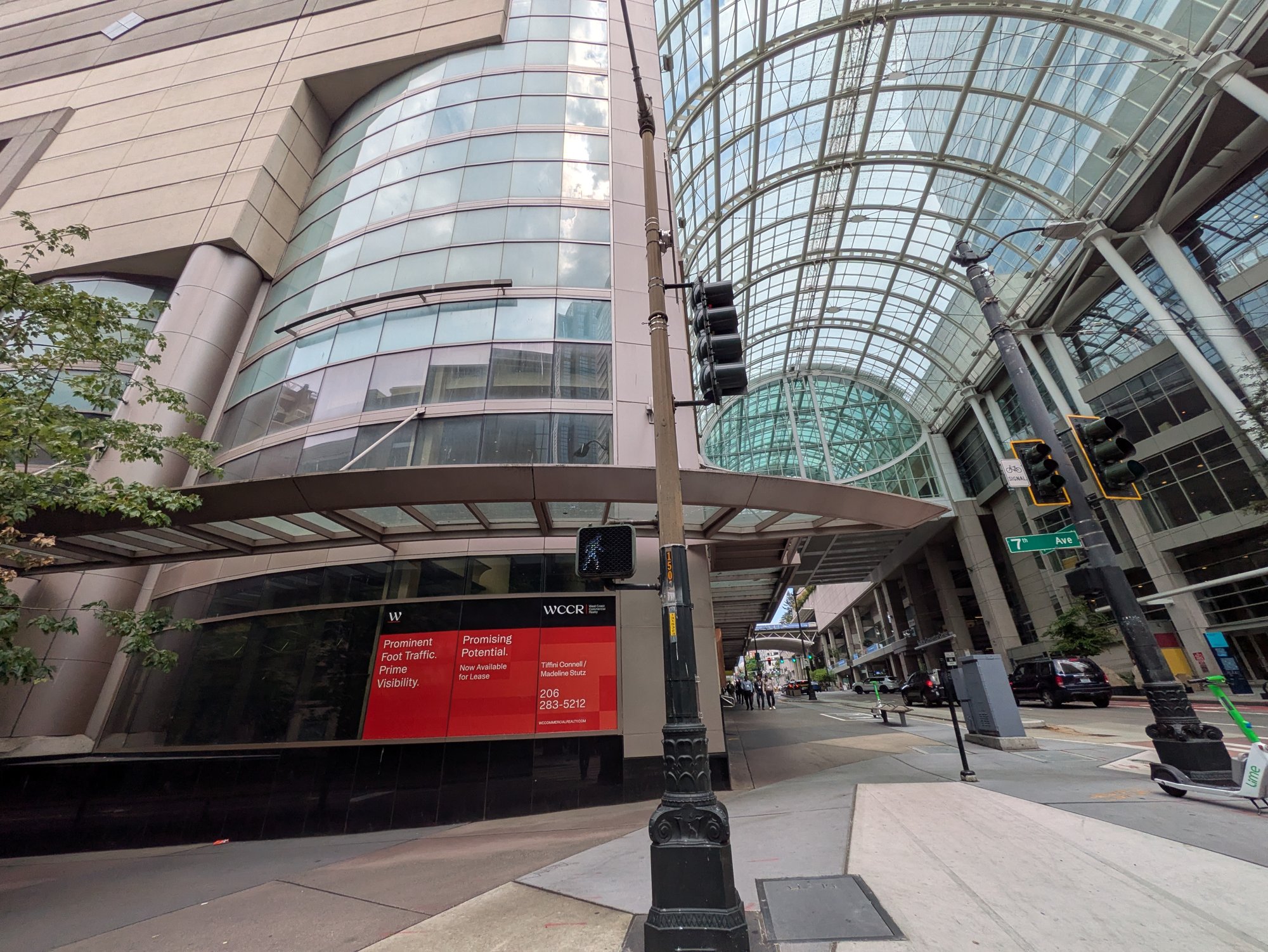
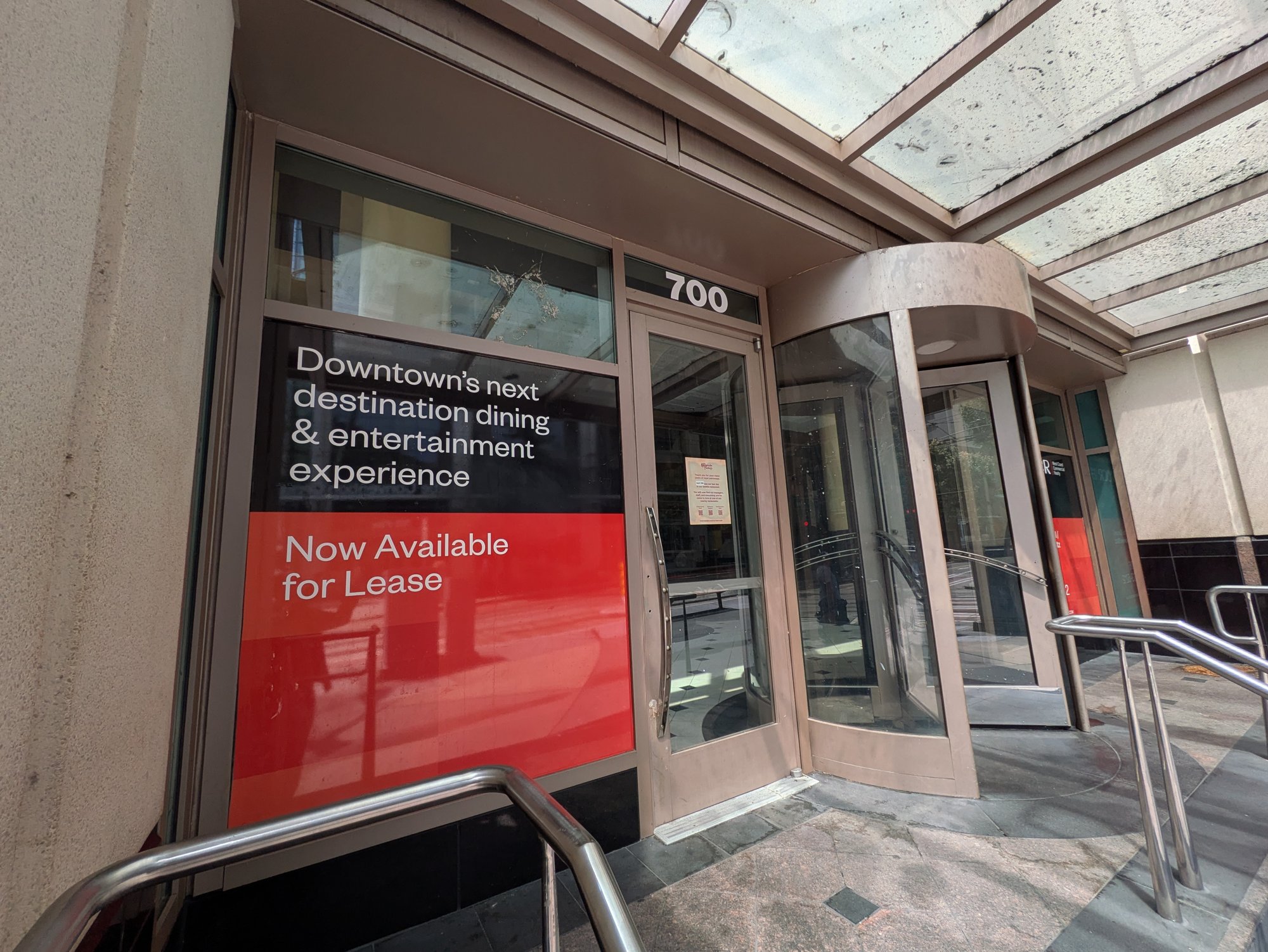
You cannot lease your way out of a standard deviation like that. But that is the pitch on the convention center's own empty storefront: "Prominent Foot Traffic. Prime Visibility. Promising Potential." Prime visibility, sure. The foot traffic is the variable in question.
None of this means Pike Street can't hold a restaurant. Two blocks up, at 9th and Pike, the smaller-format Daawat does fine. It's the format that fails, not the block — 7th and Pike, the Arch's own frontage, closest to the hotels and the downtown core and emptiest of all, is exactly where a big box starves, because the crowd it lives or dies on isn't steady downtown trade, it's the convention spike, in town maybe a third of the year. Daawat is sized to a neighborhood. The Cheesecake Factory was sized to a crowd that only really shows up for Comic Con.
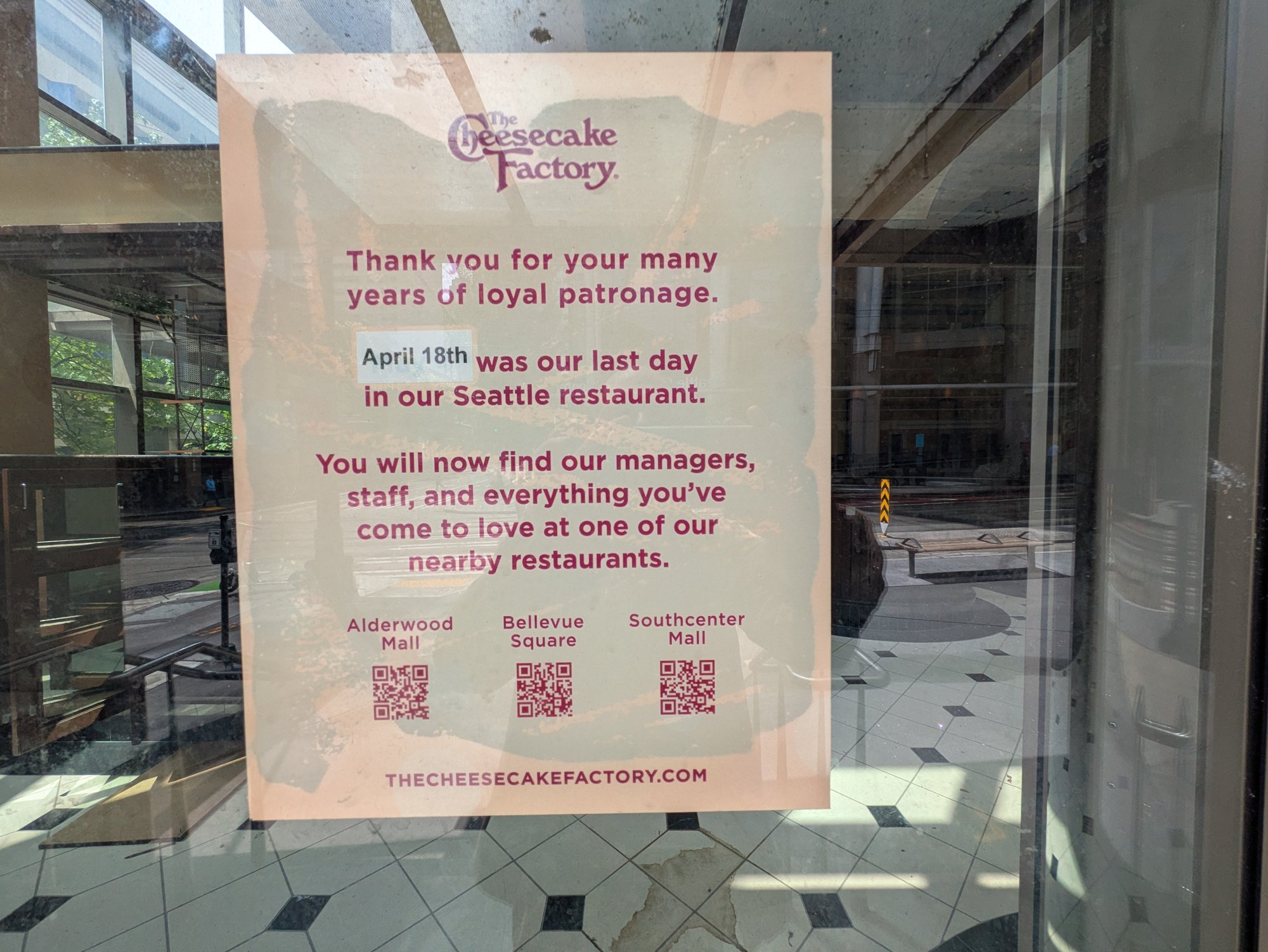
The notice in the window thanks Seattle for many years of loyal patronage and then points you to where the format still works: Alderwood Mall. Bellevue Square. Southcenter Mall. Three suburban malls — steady, captive, a crowd that never spikes to twenty-five thousand and never drops to zero.
So what's the answer? Do we turn the Arch into a mall with wall-to-wall retail to try enticing people to Shop at the Arch, achieving critical mass for a large-format restaurant to reopen? Is that plausible? Is that our future? It sure looks like the plan. (See The Campus Master Plan: What's Been Decided.)
We already see the cost of the status quo: empty streets, vacant storefronts, and expensive architecture sitting idle.
But we can do better.
Imagine every day a "golden day" with 5,000 to 7,000 visitors coming to the Arch, whether for events on the public calendar, the private calendar, or the space-available calendar.
What would it cost to program the Arch in every empty space on every empty day?
I don't know, and I'm out of napkins.
Make a Take / Share a Take▾
Before you pass it on — what's your take?
Sharing a Dispatch piece is taking a position. Take a moment to say what yours is — it travels further, and better, for it.
What do you want to say about this? What struck you — and who needs to hear it?
We don't track clicks. If Make a Take was useful, let us know →
Not sure what to say? Let your own AI help you draft it →
The prompt asks your AI to draft a note in your voice from what the article and its sources actually support — and to push back if you overclaim. Your conversation stays in your AI; nothing is sent to the Dispatch.