Read this with your own AI▾
This piece was built with the help of AI, from public records — here's how. Read it back with your AI: choose how you want to read it, copy the prompt, and interrogate the article yourself.
Your conversation stays in your AI — nothing is sent to or stored by the Dispatch. The built-in grounding line keeps the answer tied to the Dispatch's own reporting, and asks your AI to flag — not invent — anything that needs more.
The visitor population of Convention City Seattle, from the convention center's own calendar — and why its swing, not its size, is what a business on the corner can't survive.
Daily visitor draw, Feb 2026–Feb 2027 — each event counted at its full crowd on every day it runs (a weekend-badge con is there all weekend); rotating day-shows like the Flower & Garden Festival are spread across their run. The dashed line is the average; almost no day sits on it. Gold bars are the 4,000+/day spikes; the biggest are labeled.
A factory runs on a stable daily number — a whistle, a shift, a crowd arriving at a regular pace. Convention City doesn't have one. The day-to-day swing here — the standard deviation, ~4,800 — runs about 2.1 times the average itself (~2,200). Most days draw nobody; then a comic con puts twenty-five thousand on the block.
And this is only the calendar you can see. The private galas and buyouts that never get listed are real — but they're sporadic bookings too, so they add to the swing, not to a stable floor. The events we can't see make the corner harder to staff, not easier.
- Take each public event's expected attendance from the SCC calendar.
- Count that crowd on every day the event runs — a badge con's attendees are present all weekend, so a 25,000-a-day show counts 25,000 each day. (A rotating day-show like the Flower & Garden Festival, whose 60,000 is a 5-day total, is the exception — that one spreads across its run.)
- Sum every event active on each calendar day → that day's draw.
- Take the mean (~2,200) and population standard deviation (~4,800) across all 365 days.
Source: Seattle Convention Center public events calendar. Which building an event books (Arch / Summit / both) is a second-order detail — the population counts all of it. Attendance figures are venue/organizer estimates.
The Cheesecake Factory has been gone for over a year now. Twenty-three years in business, and now, no cheesecake. That shouldn't happen. We have over 100,000 people living downtown, plus more in Capitol Hill. Don't we like cheesecake?
Sure we do. It ain't New Jersey but we can hang. We put cream cheese on hot dogs, putting us in contention for Cream Cheese Capital of the World (non-bagel division). So Cheesecake was never the problem. It was the Factory part. You can't have a factory without a whistle blowing in the morning, a shift clocking in to do the essential business of cheesecake manufacturing to serve hungry crowds arriving at a regular pace.
But there's nothing regular about a restaurant opposite the Seattle Convention Center Arch. Some days it's a gift: twenty-five thousand cosplayers, fifteen thousand oddities-and-curiosities-seekers, twelve thousand sneakerheads, six thousand brides, four thousand dentists, three thousand surgeons, thirty frat brothers, two turtledoves and someone on a smoke break. But most days, it's just us locals.
How might we put a number on the population of Convention City Seattle? It's the sum of two numbers: Residents and Visitors.
We know the total number of downtown residents (108,488) but as that stretches from Uptown to the International District, that's too wide a lens. We might narrow it down to those who live in the neighborhoods adjoining the convention center: First Hill, Capitol Hill, Denny Triangle, and the Central Business District, but even that's too big.
The correct measurement is how many people, when asked for the nearest landmark near their home, would say: "I live near the Convention Center." That's how I say it. But I don't hear that very often from other people. It's more: "I live on First Hill near the hospitals / St. James / Town Hall / The Frye Museum." Or on Capitol Hill near a restaurant or an ice-cream parlor; or in Denny Triangle near the Spheres; or on a named intersection in Downtown Seattle.
Still, I count them all as fellow residents of Convention City Seattle whether they admit it or not.
What about visitors?
Here it gets more complicated because I don't have easy access to the full forward calendar for the convention center. There's an events calendar on their website but it's far from complete -- many private galas, buyouts, and semi-secret societies choose not to list there because they don't want lookie-lous or protesters or groupies or whatever. And so it's not as simple as just adding up the estimated attendance figures and calling it a population. But it's still a useful lower bound for how many people we should expect in Convention City Seattle during any given year.
So let's do the math using the convention center's own public events calendar. Count each event's crowd on every day it runs, and the public draw to the corner averages around fifteen hundred people a day. (For the forensic companion — how the Arch's calendar actually books, drawn from the center's own records — see Fell on Black Days.)
For a restaurant, that's what you can plan for, the public crowd on the public calendar, and it runs hot-and-cold: many days bring no event that pulls outsiders to the block, and then a single Flower & Garden weekend attracts twelve thousand daily visitors.
How many visitors is that on an average day? On the public calendar, the draw averages about 2,200 people a day across Convention City. And that's a lower bound — it misses the private galas and buyouts that never list. But those are sporadic bookings too, so they add to the swing, not to a stable floor.
For our purposes, the daily count or average count are insufficient for descriptive statistics. Here we need standard deviation (look it up), which for a stable population is very low and for a fluctuating population is very high.
In the case of Convention City Seattle, the standard deviation of population is, according to my estimates, about 4,800 people. (Here's the full calculation.)
The visitor draw (about 2,200 a day) is dwarfed by its standard deviation (about 4,800) — the swing runs more than twice the average itself.
This is no place for a factory.
You may be able to staff a hot-dog stand like that, but not a Cheesecake Factory.
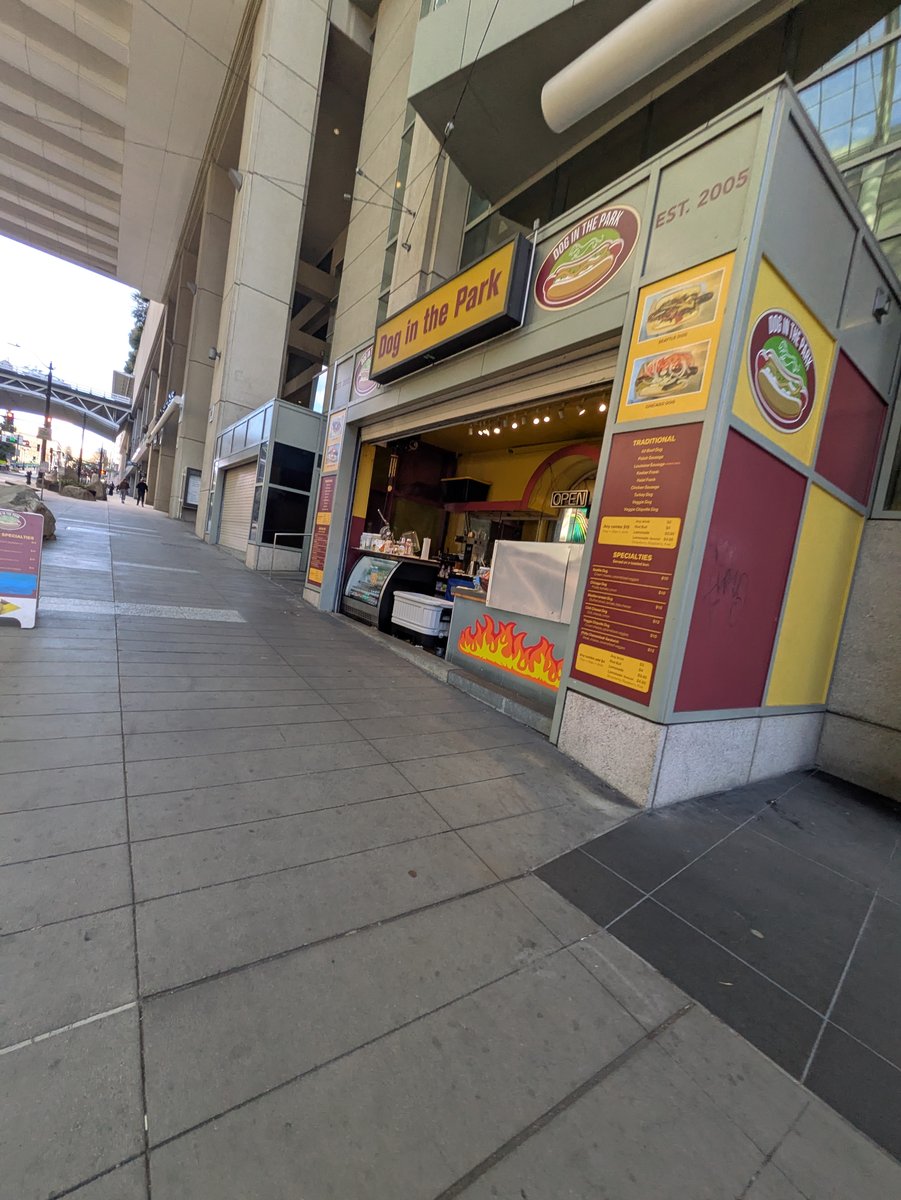
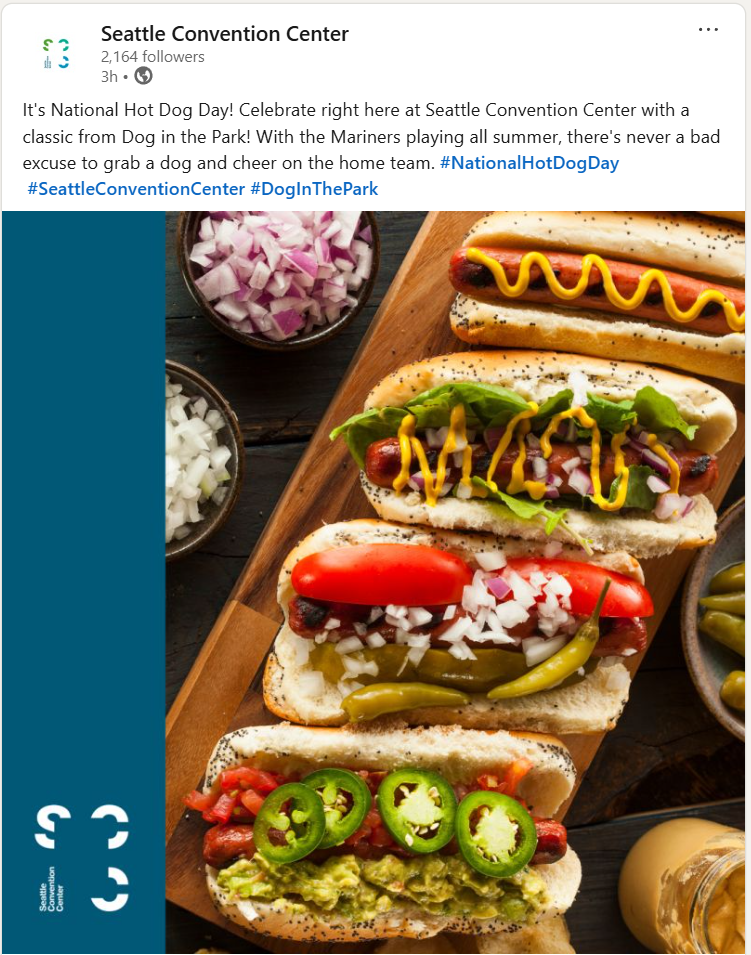
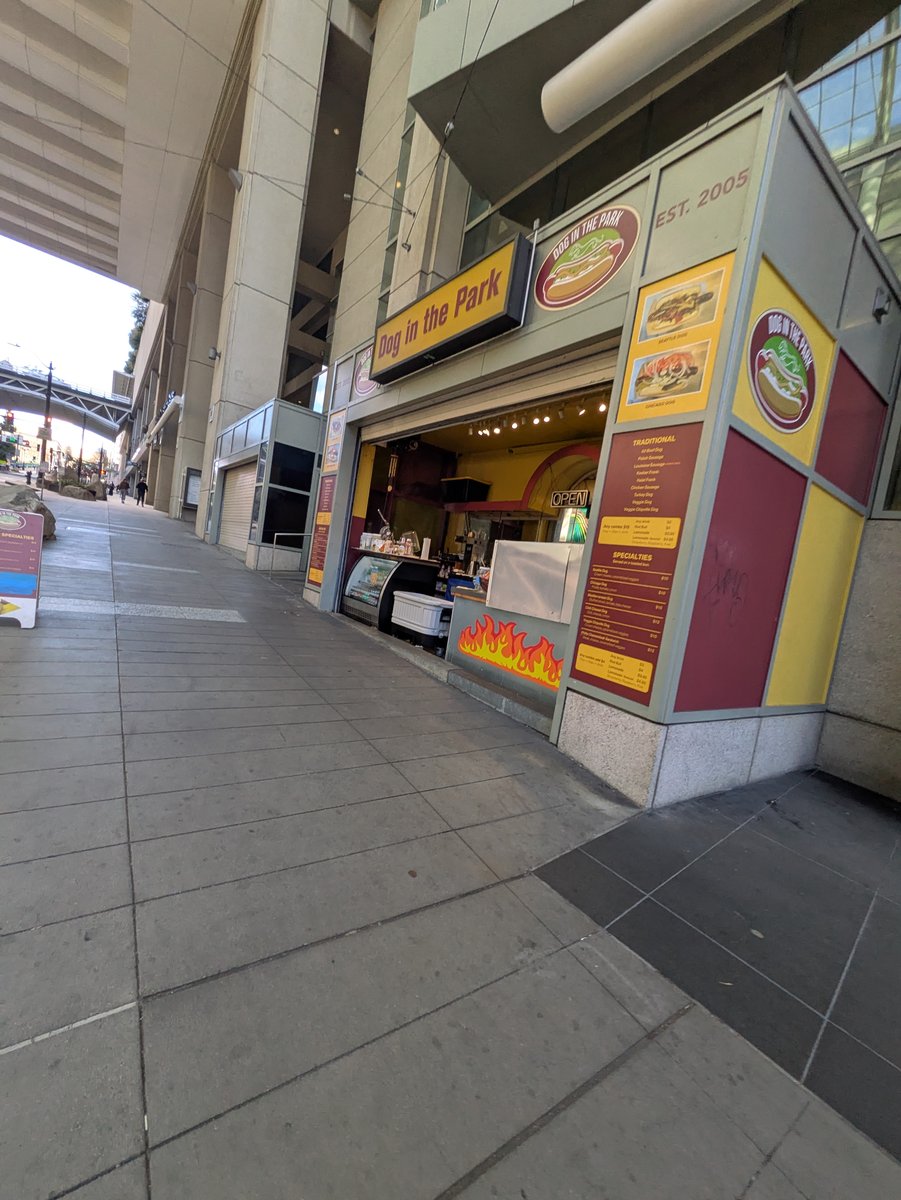
Speaking of which, Happy National Hot Dog Day to those who celebrate.
And it's not just a Seattle problem. The Cheesecake Factory also closed its Inner Harbor location in Baltimore and its Friendship Heights location in DC in the same window (2025-2026) while keeping its suburban stores open. Those are convention-and-tourism districts too, running on the same boom-and-bust crowd.
Lesson learned: You can't staff a site where the standard deviation exceeds the daily count.
Think about what that does to a restaurant trying to build a schedule — especially in a worker-friendly town like Seattle, where the law gives people the basic courtesy of their shifts two weeks out. Two weeks out, you have to commit a crew. But the calendar only tells you a show is happening — not whether its crowd will ever reach your door, and that varies as much as the crowd itself. Some conventions feed their people inside: box lunches, exhibitor spreads, the in-house concession, thousands of badges that never get hungry on the sidewalk. Others turn the whole floor loose at noon to fend for itself. You can't tell which from a calendar listing, and you're guessing two weeks early. Guess low on a hungry crowd and you're slammed — lines out the door, walkouts, a one-star night that follows you around online. Guess high on a crowd that ate inside and it's worse: full crew, full payroll, empty dining room. Every shift is either a fire drill or a wake.
And even if you do deep research on the calendar to figure out expected optimal staffing levels, there's no way to predict the forward calendar when you book a multi-year lease. And if you then get an inkling that the convention center's strategy is "let's hold more high-ticket dinners rather than public-facing events," you might think twice about extrapolating current trends even at their current lackluster levels.
A beach town has a high standard deviation of visitors too, but a beach town gets a season. The crowd comes in summer and leaves in winter, and everyone — the grill, the ice-cream stand, the motel — plans around it: hire in May, close in October, bank the season. Convention City has the variance without the season. The peak is a costume party one day and a catered dinner the next. You can build a business on demand that's high or low, but you can't build one on demand that keeps resetting to zero.
And if you have a business with high demand, as one would expect in a healthy city, the labor cost differential becomes far less important. The Washington Hospitality Association points to Seattle's minimum wage — $21.30 an hour with no tip credit, against Bellevue's $17.13. But the minimum wage is $15 in Baltimore and about $18 in Washington, DC — both well below Seattle's — and the Cheesecake Factory format died in those downtowns anyway.
And no wage cut closes a demand hole. My own view: a healthy business can carry both a fair wage and a humane schedule — what nothing can carry is a corner with no demand under it. The labor fight is an argument over how to split a shrinking pie.
Here's the thing: everyone actually wants the same outcome. The convention center wants a lively street. The city wants a lively street. The neighborhood wants a lively street. Nobody is defending an empty corner. The only real argument is how you spend public money to fix it — and there are two ways, which are not the same bet.
The first way is to spend it on supply — to build the mall. Renovate the hall, subsidize storefronts, put up more retail and wait for the tenants. But we already have the results of that experiment a few blocks away. Pacific Place is professionally built and professionally run, more than half empty, and sold in 2024 for about a quarter of its former value. Westlake Center has gone from more than eighty tenants to nineteen — it lost its Saks Off 5th floor in 2024 and is losing Nordstrom Rack next, the kind of retail national chains now avoid for its "irregular foot patterns," which careful readers may recognize as a high standard deviation. Supply was never the missing piece — those are finished, staffed, discounted spaces a crowd still won't fill. Spend public money adding retail into demand this thin and all you've built is a nicer empty box. And it's a one-way door: a renovation is sunk the day it's poured, a subsidy is committed for years. If it doesn't work, you can't stop the bleeding.
The second way is to spend it on demand — and let the mall build itself. Put public money into the programming that fills the corner every day, and the retail assembles itself around that crowd the way retail always has: where the people already are. You never have to lure a tenant into an empty corner, because the corner isn't empty. Drive the demand and the supply shows up on its own — private businesses opening on their own dime and their own risk, with no lease for the public to sign and no construction bill it can't take back. Same public dollars pointed the opposite way: one bet builds the box and prays for a crowd; the other builds the crowd and lets the boxes fill themselves. And unlike a renovation, it has an off switch — if a night doesn't draw, you find out that night and you change it.
Make no mistake — this is a bet too. It's just the safer one: cheaper going in, reversible if it flops, and you learn whether it's working in a season, not a decade. The supply bet you can't unwind.
But the convention center already stood at this fork in the road and picked the first way, the supply story, the field of dreams. Its campus master plan reworks the Arch's ground floor into a pathway "lined with shops," chosen over a competing plan — one of its own finalists — that would have turned Pike, Pine, and 9th into car-free festival streets of markets and local vendors. To their credit, the demand idea wasn't foreign to them; it was on their own table. They just picked the mall instead, with no public input on the question. The record of how that decision got made, and which vision got waved off, is laid out in The Campus Master Plan: What's Been Decided. This piece is the case for the pick they didn't make.
So what's the best thing to do if you want to fill vacancies in Convention City Seattle?
You give people plenty of reasons to be here when there's no convention in town. Put a reliable daily draw at the Arch. That isn't a capital project. It's a programming decision — the cheapest lever in the box, and the only one aimed at the actual problem. With the added benefit of paying people to put on a show.
A hundred thousand people live within a mile of this corner and we have millions who can get here via bus and light rail. The locals might never fill a destination restaurant, because they were never that chain's customer.
But we'll show up, daily, for something that feels like it's ours.
Do that, and the empty box across the street stops looking impossible. Maybe it's not a factory next time — maybe it's an atelier or a workshop or the World's Largest Hot-Dog Palace.
Whatever it is should be sized to a daily number instead of a convention spike.
Do that, and the operator's whole posture changes: nobody signs a lease betting they can conjure demand out of an empty corner, but plenty would sign the day the corner has demonstrated daily activity.
We used to get that daily activity for free as a byproduct of commuting office workers. Now we have to manufacture that activity using our own creativity and resources. That's a public choice, not a private gamble.
The immediate opportunity: Program the Seattle Convention Center Arch with a goal of maximum utilization. Spend what it takes to reach that goal, and see what happens next. It's a bet on Seattle with tremendous upside potential, and it should play out well before we contemplate changes to the physical buildings themselves.
Programming decides how much life reaches the sidewalk — and how much life reaches the sidewalk decides what can survive in the box across the street, and in the next box, and the one after that. The Arch can become the beating heart of Convention City Seattle, bringing life to every storefront on the Pike/Pine corner. Get it pumping steadily and the leases pencil out; leave it under-programmed and no rent is low enough to matter.
The good news is that the city already agrees. The mayor's stated downtown agenda is "public space activation" and loosening the change-of-use rules that keep a box like this frozen as one thing when it could be another — the city's own words, and a fair description of exactly what this corner needs. The only open question is whether the institution across the street is run to serve that agenda or to treat the sidewalk as someone else's problem. And that isn't settled by the market. It's settled by nine people on a board — five of whose seats turn over on July 30th, two of them the mayor's to fill.
I'm aware that what I'm proposing -- spending on operating costs rather than capital expenditures -- goes against the grain, against the way things are usually done.
But isn't that how we do things here?
Find a formula that works, obvious in retrospect, that takes over the world by storm. Like putting cream cheese on a hot dog.
That's Seattle-style, and that's how we remake Convention City.
Correction, July 16, 2026: An earlier version spread each multi-day event's attendance across the days it runs — which undercounts the daily crowd, since a convention's attendees are in town every day, not one day each. Counting the full crowd on every day an event runs, the draw averages about 2,200 people a day and the standard deviation is about 4,800 — the argument holds, and the swing is if anything sharper. The full calculation is here. A follow-up — Cheesecake Math, Revisited — works the corrected numbers in full and sketches what the corner would take.
Make a Take / Share a Take▾
Before you pass it on — what's your take?
Sharing a Dispatch piece is taking a position. Take a moment to say what yours is — it travels further, and better, for it.
What do you want to say about this? What struck you — and who needs to hear it?
We don't track clicks. If Make a Take was useful, let us know →
Not sure what to say? Let your own AI help you draft it →
The prompt asks your AI to draft a note in your voice from what the article and its sources actually support — and to push back if you overclaim. Your conversation stays in your AI; nothing is sent to the Dispatch.