Read this with your own AI▾
This piece was built with the help of AI, from public records — here's how. Read it back with your AI: choose how you want to read it, copy the prompt, and interrogate the article yourself.
Your conversation stays in your AI — nothing is sent to or stored by the Dispatch. The built-in grounding line keeps the answer tied to the Dispatch's own reporting, and asks your AI to flag — not invent — anything that needs more.
I have a rudimentary stats system, and this past week it started telling me something odd: my most-read article, by a wide margin — roughly 1,600 views in the past week, on a piece that barely registered when I first ran it — is "Sidewalk Sale." Some group, lately, has been reading my article about how Seattle licensed twenty years of its public sidewalks to a Columbus billboard company, with the city last in line for the money.
If that's your jam, I've been on this since September 2024, when the city's own Design Commission voted against recommending the proposal, and when I first published my opposition, ten questions about what the billboards would do to the street.
And now that I have an audience for this topic, whoever it is, I'm pleased to share more of my research about how the kiosks found their way to Seattle's sidewalks.
The chain, in brief:
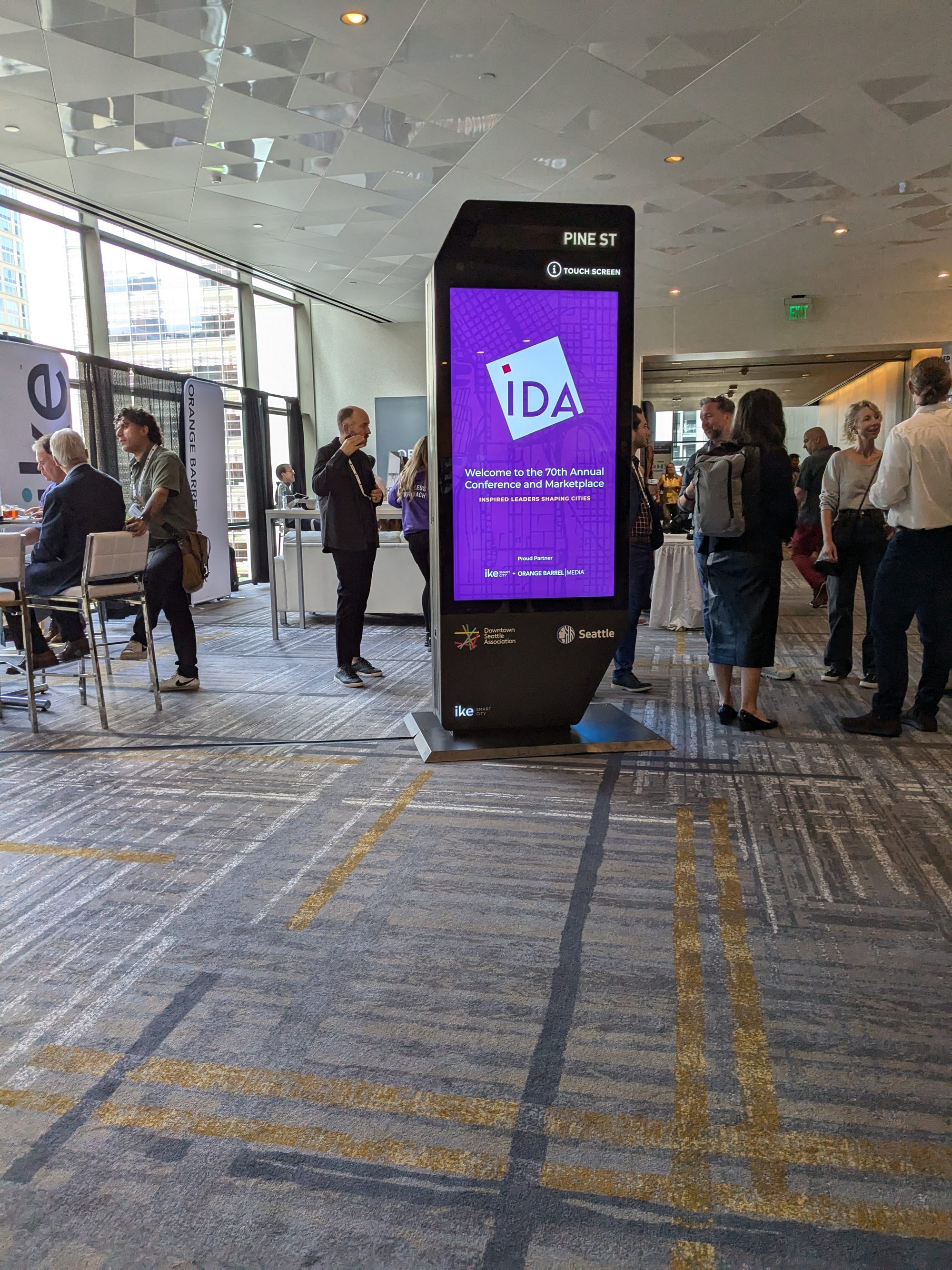
- September 11–13, 2024 — the kiosk vendor sponsors the downtown-management industry's national conference as it meets in Seattle, co-hosted by the Downtown Seattle Association, machines on the show floor. I was there.
- September 19, 2024 — six days after the conference closes, the Design Commission, the city's own design reviewers, votes against recommending the proposal.
- June 2025 — the Council approves the ordinance anyway, and Mayor Bruce Harrell signs it.
- June 2026 — the first kiosk powers up at First and Pike, across the avenue from the Market's neon sign, with a second at Fourth and Pine and fifty planned across downtown and the neighborhoods — on a permit that runs about twenty years.
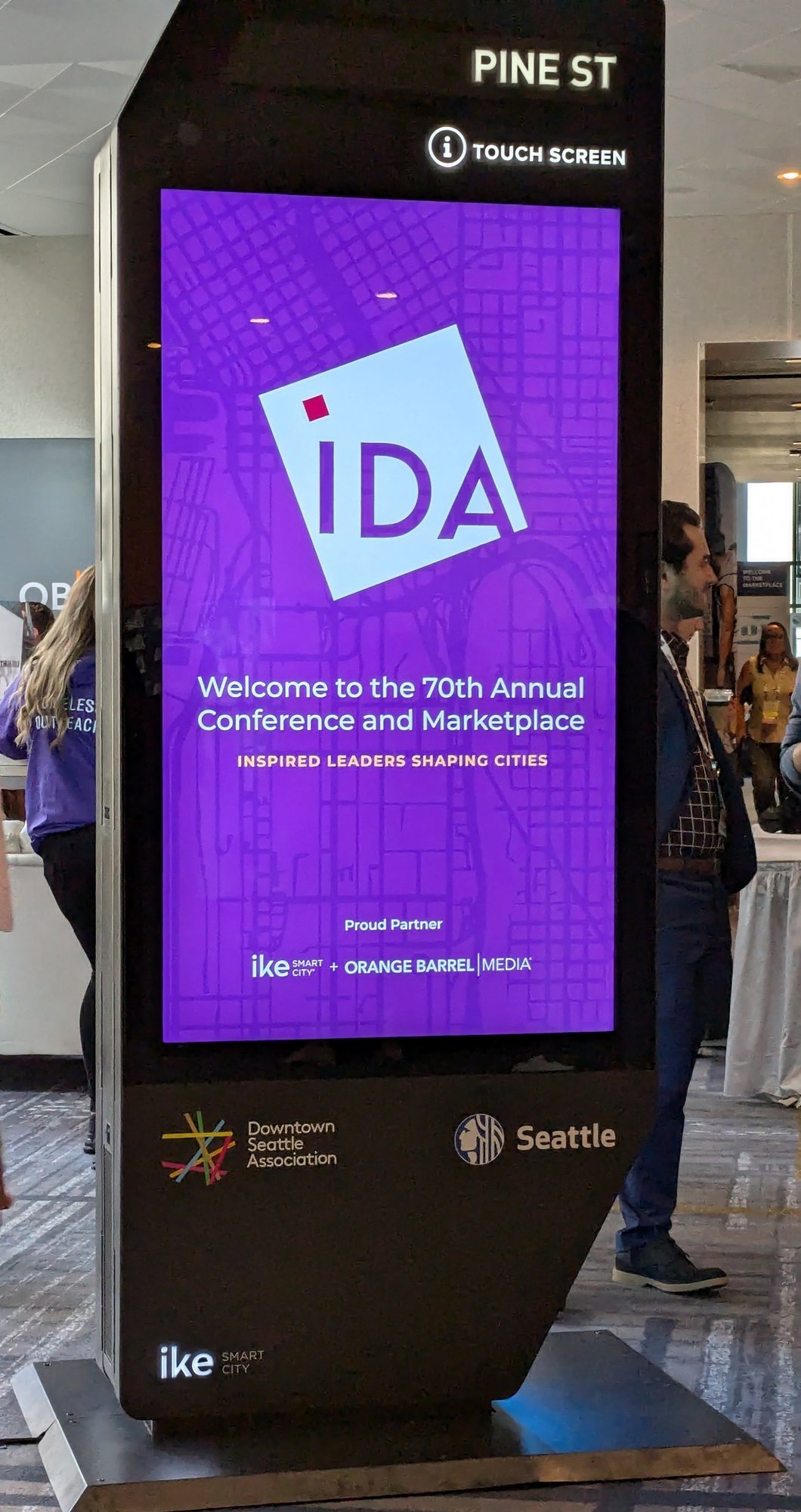
Sidewalk Sale has the money mechanics — the roughly $1.1 million a year the screens are projected to throw off for the association, the split that leaves the city collecting last. It left out one thread that belongs here. The Columbus billboard company has a name, Orange Barrel Media, and a kiosk venture, IKE Smart City — and as the ordinance moved toward its vote, IKE kept a registered lobbyist in Seattle: Sung Yang, principal of Pacific Public Affairs. Yang was, at the same time, the chair of the Downtown Seattle Association — the assessment-funded private coalition that banks that $1.1 million. The seller's paid lobbyist and the host coalition's chair, one person. He rotated off the chair the month after the Council vote. And that's the way it goes; the DSA is a private association and owes the public no fiduciary duty. It sits in the open, in the city's lobbyist database and the state's campaign-contribution filings.
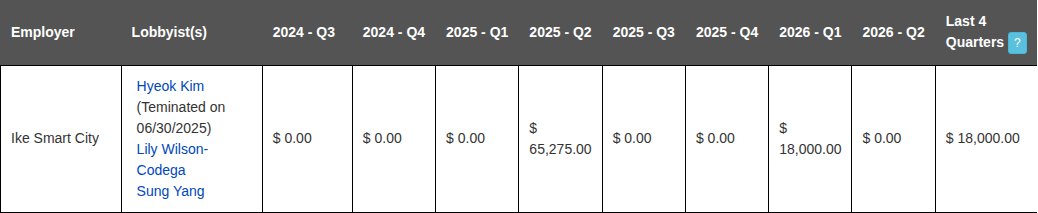
One more thing, because it is current. The lobbying didn't end with the ribbon-cutting: the program's second phase — the neighborhood expansion — is still a live decision, and the filings just below show the operation staffing up for it. In March 2026, Yang amended his own IKE registration, which remains active. And the association he chaired through the campaign? Today he chairs DSA's governance committee.
| Lobbyist | Registered | 2025 | 2026 Q1 | Status |
|---|---|---|---|---|
| Sung Yang | April 2025 | $55,275 | $0 | Active — registration amended January and March 2026 |
| Hyeok Kim | April 2025 | $0 | — | Terminated effective June 30, 2025 — six days after the Council vote |
| Lily Wilson-Codega | February 2026 | — | $18,000 | Active |
| IKE total, as the portal shows it | $65,275 | $18,000 |
Replicate this research The $18,000 filing ▾
Every number in the paragraph above comes from two public portals. This prompt walks you — or your AI — through pulling the same records.
I want to verify some claims about lobbying on Seattle's digital-kiosk program. Walk me through this, step by step, and tell me at the end whether the records match the claims.

1. Open Seattle's lobbyist-disclosure portal, employers view:
   https://web6.seattle.gov/ethics/lobbying/lobbyistEmployers.aspx
   Find the employer "Ike Smart City." Note (a) the lobbyists listed and any termination dates, and (b) the quarterly spending columns — especially 2025-Q2 and 2026-Q1.

2. Open the filings list:
   https://web6.seattle.gov/ethics/lobbying/Reports.aspx
   Find Sung Yang's 2026 rows. Note the Client/Employer Registration amendments (the recent-filings list shows two in March 2026; his registration page also lists a January 2026 amendment) and the Quarterly Expense Reports (filed April and July 2026), with the periods they cover.

3. The claims to check: that IKE Smart City reported $18,000 in Seattle lobbying spend for the first quarter of 2026; that Sung Yang remains a registered lobbyist for IKE; that Hyeok Kim's registration terminated June 30, 2025; and that IKE's spend in the quarter of the June 2025 Council vote was $65,275.

4. Optional state-level context: use the Washington PDC's own search at https://apps.pdc.wa.gov (contributor name "Sung Yang" / "Yang Sung") to see his campaign-contribution history. (Power users: the raw dataset is kv7h-kjye at data.wa.gov, but filter it with a proper SoQL $where clause — and if every query returns the same unfiltered rows, first row a Makah Tribal Council entry, your tool is dropping the query string; use the browser search instead.) Note that his lobbying registration is CITY-level (SEEC), not state — you should find no state lobbyist filings under his name.

5. An open question we could not resolve: the employer-level vote-quarter total ($65,275) exceeds the lobbyists' itemized compensation for that quarter ($55,275 to Sung Yang; $0 to the others) by $10,000. If you can find where that $10,000 is reported, say so.

Report back: does each claim match the records, what explains the $10,000 if you found it, and what else do you notice in the filings that the article did not mention?
For more about the Downtown Seattle Association itself — what it is, who sits on its board, and how it carries itself when its friends hold office and when they don't — see "We Built This City."
Sources: the Seattle Ethics and Elections Commission lobbyist registry and Washington PDC filings (the IKE Smart City lobbyist registrations and filings), the DSA's own board announcements and team page (the role dates), with the dual role independently reported by Erica C. Barnett, PubliCola; the International Downtown Association's 2024 Annual Conference pages and the Downtown Seattle Association's own conference announcement (downtown.org and downtownseattle.org); the Seattle Design Commission's official record of the September 19, 2024 vote (seattle.gov); Seattle City Council records on the kiosk ordinance, June 2025; launch coverage in GeekWire and The Seattle Times, June 2026; and "Sidewalk Sale," June 11, 2026, where the full money mechanics live. Every claim traces to a public filing, record, or published report.
Make a Take / Share a Take▾
Before you pass it on — what's your take?
Sharing a Dispatch piece is taking a position. Take a moment to say what yours is — it travels further, and better, for it.
What do you want to say about this? What struck you — and who needs to hear it?
We don't track clicks. If Make a Take was useful, let us know →
Not sure what to say? Let your own AI help you draft it →
The prompt asks your AI to draft a note in your voice from what the article and its sources actually support — and to push back if you overclaim. Your conversation stays in your AI; nothing is sent to the Dispatch.