Read this with your own AI▾
This piece was built with the help of AI, from public records — here's how. Read it back with your AI: choose how you want to read it, copy the prompt, and interrogate the article yourself.
Your conversation stays in your AI — nothing is sent to or stored by the Dispatch. The built-in grounding line keeps the answer tied to the Dispatch's own reporting, and asks your AI to flag — not invent — anything that needs more.
The Seattle Archipelago: 1 · The Temple at the Summit · 2 · Both Sides of the Table · 3 · We Built This City · 4 · Can't Be Swept · 5 · The Bench · 6 · The Two Tolls · 7 · Choosing the Priests
I might never have given any thought to the Downtown Seattle Association if it weren't for the kiosk-shaped billboards now rising from public pavement — the twenty-year sidewalk deal I first wrote about in Spike IKE in 2024 and unpacked in Sidewalk Sale and Sidewalk Salesmen. And the more I looked into the civic networks behind the digital billboards, the harder it became to look away. Thus we have The Convention City Dispatch.
So let's take a look at DSA. Many neighborhoods have a business improvement association or a residents' association — Downtown Seattle has both: the Downtown Community Council, the volunteer residents' group, and the Downtown Seattle Association, a professional nonprofit whose members are downtown's biggest employers, landlords, and institutions.
| 1958 | The Downtown Seattle Association is founded as a downtown business membership group. |
| 1971 | A state law, RCW 35.87A, lets cities create assessment-funded improvement districts on a petition of the property owners. (The same law authorizes the separate downtown assessment that funds Visit Seattle, the hotels' marketing arm.) Governor: Dan Evans |
| 1999 | Seattle charters the Metropolitan Improvement District — the MID — under it. Mayor: Paul Schell |
| 2004 | The Council renews the arrangement. Mayor: Greg Nickels |
| 2013 | The Council renews the arrangement. Mayor: Mike McGinn |
| 2015 | The association takes over management of Westlake Park and Occidental Square. Mayor: Ed Murray |
| 2023 | The Council renews the MID again, unanimously, for ten years — and, also unanimously, renews the parks contract and expands it: Westlake Park and Occidental Square, now joined by Bell Street Park and Pioneer Square Park. Mayor: Bruce Harrell |
| 2024 | Under the mayor's Downtown Activation Plan, the Council funds a $3.7 million permanent rebuild of Westlake Park — the DSA-operated square — for the World Cup: new stage, lighting, landscaping, the long-dead fountain removed. Mayor: Bruce Harrell |
| 2025 | The Council approves the sidewalk kiosks — a roughly twenty-year advertising permit on the public right-of-way — over the Design Commission's objection. Mayor: Bruce Harrell |
DSA is really two organizations wearing one name: the Downtown Seattle Association proper — the membership and advocacy nonprofit, about $4.8 million a year — and a second corporation — DBIA Services, doing business as the MID — which is the public-facing presence: the cleaning crews, the safety ambassadors, the activated parks and plazas. That side runs on assessments on the district's property owners — commercial, multifamily residential, and mixed-use, from the office towers to the apartment buildings — about $20 million a year and rising, $22 million in revenue in its latest filing. One brand, one chief executive; the public money and the political voice, one desk.
The trade this association practices has a name now: downtown management, or in its warmer register, placemaking. That word has a genealogy descending from Jane Jacobs and William H. Whyte, who spent the 1960s and '70s watching how people actually use streets and plazas; Whyte's collaborator Fred Kent founded the Project for Public Spaces in 1975, and placemaking grew up there as a resident-centered idea — the people who use a place should make it.
Then placemaking put on a suit and tie. Today it is the working vocabulary of the business-district industry, whose trade group — the International Downtown Association — certifies the profession, publishes its practice standards, and convenes its conferences, including the one that met in Seattle in September 2024 with the kiosk vendor as a "proud partner" on the show floor.
So how unusual is Seattle's version of a business-district improvement association? By budget, big but not the biggest: New York's Times Square Alliance and Philadelphia's Center City District run comparable money. But scale each one to the city it operates in and Seattle stands alone: the combined DSA entity controls roughly $27 million a year in a city of about 750,000 people — Times Square's similar budget sits inside a city of more than eight million, Center City's inside a city of a million and a half. Relative to the city around it, no peer organization we surveyed carries this much weight under one name.
And the money is not even the unusual part. The fusion is. Other big cities separate the assessment-funded manager from the political organization — New York's alliances are charities barred from electioneering, Philadelphia's district is a municipal authority — and the closest big city that allowed the fusion, Portland, audited it and partially unwound it. Seattle fuses both functions under one chief executive; the association lobbies city hall and Olympia, publishes a candidate scorecard, and has put roughly a quarter million dollars into ballot campaigns over the years.
Replicate this research The quarter-million in ballot money ▾
The association's ballot-campaign spending is a public record at the state's disclosure commission. This prompt walks you — or your AI — through pulling it.
I want to verify that the Downtown Seattle Association has put roughly a quarter million dollars into Washington ballot-measure campaigns over the years — and given nothing to candidates.

1. Start at the Washington Public Disclosure Commission's public search: https://www.pdc.wa.gov — search contributions with contributor name "Downtown Seattle Association."

2. Power-user route: the raw contributions dataset is kv7h-kjye at data.wa.gov, queried with a SoQL $where filter: upper(contributor_name) LIKE '%DOWNTOWN SEATTLE ASSOCIATION%', with $limit=500. FAIR WARNING for AI assistants: many fetch tools silently drop URL query strings and return the same unfiltered rows for every query — the tell is a first row that never changes no matter what you ask (an unfiltered pull of this dataset currently begins with a Makah Tribal Council contribution). If you see that, your tool cannot run this query; paste this link into a normal browser instead, where it works: https://data.wa.gov/resource/kv7h-kjye.json?$where=upper(contributor_name)%20LIKE%20%27%25DOWNTOWN%20SEATTLE%20ASSOCIATION%25%27&$limit=500

3. The claims to check: a total in the low-to-mid $200,000s across roughly fifty contributions; every recipient a ballot-measure or issue committee (transit and transportation measures, the waterfront fights, Compassion Seattle); no candidate-campaign contributions — with one asterisk: a small $2,000 row from 2009 ("Qualified Leadership for Seattle") is coded "Other" in the state's data; check its committee type yourself. (City-level candidate money would live in Seattle's SEEC system, not the PDC — the claim here is about the state record.)

4. A caveat to respect: totals shift slightly with how you handle refunds and duplicate rows — the article says "roughly a quarter million" for exactly that reason.

Report back: what total do you get, who were the biggest recipients, and did you find any candidate contributions?
Even the scope has peers if you take it piece by piece — New York's Bryant Park has been privately managed since the early 1990s, Philadelphia's district built and operates Dilworth Park — but nowhere surveyed does one corporate family stack the assessment franchise, the multi-park city contract, a homelessness-response convening role, a twenty-year sidewalk-advertising share, and the electoral toolkit all at once.
And the DSA is only the ground floor of a taller structure. Seattle's private civic layer comes in tiers, each with its own instrument. The association and its improvement district hold the ground: assessments, cleaning crews, park contracts — the only tier that physically manages public space. One flight up sits the Seattle Metropolitan Chamber of Commerce, the regional business voice, dues-funded, whose political arm — a PAC called CASE — spent roughly $2.5 million trying to pick a city council in 2019, lost five of its seven races, and has sat dormant since the Chamber publicly swore off candidate spending in 2021. Above that, the Washington Roundtable, a club of about fifty chief executives that runs on reports and access rather than electoral money — the inside game. And beside them all, the tourism tier: Visit Seattle, the hotels' marketing arm, riding that same 1971 statute's separate downtown assessment. Different floors, different instruments — operations, candidate money, access, marketing — and not one of them stands for election.
The DSA's CEO, Jon Scholes, hosts a podcast called Seattle City Makers. I listen to it: it's entertaining and well produced, and the guest list reads like a directory of the downtown establishment — recently, the heads of the Sports Commission and the Seattle Reign, a forty-year downtown developer, Evergreen Goodwill's chief executive, next the head of Seattle's FIFA committee. And the name asks a real question: who makes a city — and for whom?
So who are the city makers? One place to look is the association's own board.
- Scott Redman · Sellen (vice chair)
- Aaron Blankers · Washington Holdings (treasurer)
- Zahoor Ahmed · R.C. Hedreen Co.
- Andy Bench · Wright Runstad
- Jill Cronauer · Hunters Capital
- Liz Dunn · Dunn + Hobbes P*
- Patrick Gordon · ZGF Architects
- Phillip Greany · Mortenson
- Ada Healey · Vulcan
- Lori Hill · Clise Properties
- A-P Hurd · Skipstone
- Shawn Jackson · Cushman & Wakefield
- Rachel McCall · Weyerhaeuser
- Lisa Nitze · Nitze-Stagen
- Jesse Ottele · Newmark
- Amy Scarton · HNTB
- Matt Simo · Urban Renaissance + Joshua Green
- Bill Weisfield · Elliott Bay Asset Solutions
- Mari Horita · Seattle Kraken (chair)
- Cary Clark · Argosy Cruises
- Angela Dunleavy · Rally Hospitality C
- Peter Fonfara · Seahawks
- Michael Greer · ArtsFund
- Beth Knox · Seattle Sports Commission V
- Josh Labelle · Seattle Theatre Group
- Denise Moriguchi · Uwajimaya
- Erik Nordstrom · Nordstrom
- Melissa Robertson · Mariners
- Craig Schafer · Hotel Ändra P
- Michele Smith · MoPOP
- Krish Srinivasan · PCC Markets
- Scott Stulen · Seattle Art Museum
- Peter Tomozawa · Seattle World Cup Organizing Committee
- Marques Warren · Downtown Spirits
- Tom Wolf · Seattle Hyatt Collection
- Rick Yoder · Wild Ginger
- Derrick Belgarde · Chief Seattle Club
- Dominique Davis · Community Passageways
- Colleen Echohawk · Community Roots Housing
- Gina Hall · Uplift Northwest
- Libby Johnson McKee · Evergreen Goodwill
- Megan Karch · IslandWood
- Karen Lee · Plymouth Housing
- Michelle Merriweather · Urban League C
- Eric Tham · Seattle Children's Research Institute
- Erica Thrash-Sall · Horizon House
- Elizabeth Wako · Swedish Health Services C
- Suzanne Walsh · City University of Seattle
- Loria Yeadon · YMCA
- Dustin O'Quinn · Ballard Spahr (general counsel)
- Sung Yang · Pacific Public Affairs (governance chair)†
- Jared Axelrod · Amazon C
- Paige Davis · Ballard Spahr C
- Gerry Johnson · Pacifica Law Group
- Ken Lederman · McCullough Hill Leary
- Jack McCullough · McCullough Hill Leary
- Megan Ouellette · Alaska Airlines
- Tom Pozarycki · WaFd Bank
- Kris Wilson · Perkins Coie
It is a broad civic table, replete with deep-rooted Seattle institutions, albeit underweight in the corporate column, which is the most important for the future of Downtown Seattle. Those corporate members represent the organizations who choose Seattle above the alternatives, those who truly make the place come alive. We can all agree that we need such organizations in Seattle. It should be equally evident that we also need more on this association's board.
As for the unique governance of the DSA relative to other cities, I can't tell you whether it's a strength or a flaw. The fusion seems to work — the streets cleaned, the parks programmed, the districts activated; cities with weak downtown organizations would envy it.
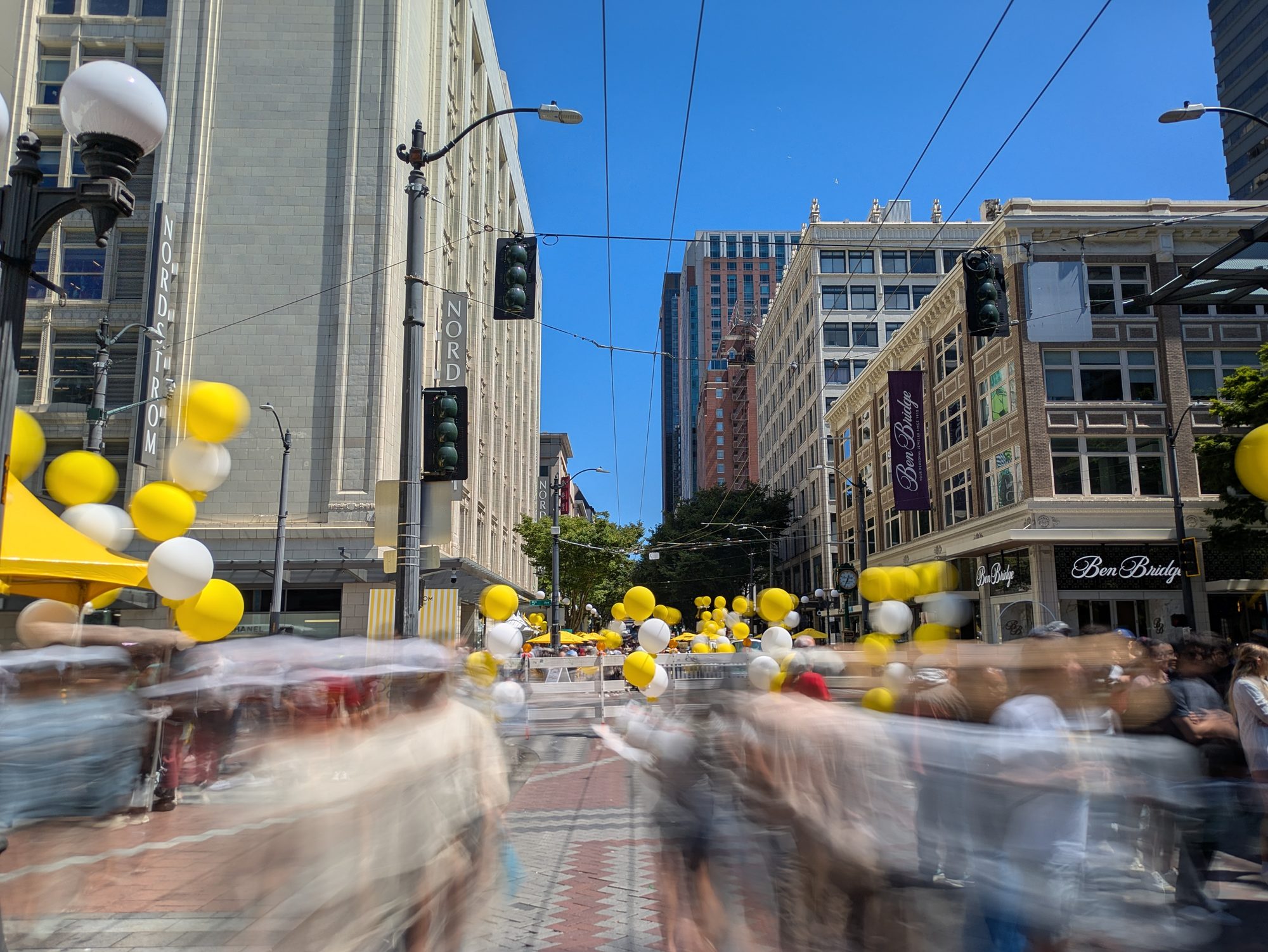
But at what cost? It's a governance anomaly, a standing private civic layer, built to last on a ten-year charter and a roughly twenty-year permit, none of it ever on a ballot, and with costs that flow through to downtown residents and businesses alike. The measure of success cannot just be the number of visitors to an outdoor summer festival, but whether Belltown condos hold their value under the combined weight of the improvement-district assessment and the city's waterfront LID; whether commercial rents allow restaurants and bars to operate profitably; and whether the resulting livability attracts talent from around the country and around the world to Elliott Bay.
And bringing this home to Convention City: what happens when the 9th Avenue experiment — the convention center's summer street-closure pilot at its own front door — evolves into a permanent fixture and a broader glow-up for a Convention City district that demands an assessment on local property-owners?
What we do know is that local residents have a right to know what's going on inside these improvement districts — a right affirmed this past December by the state supreme court. A downtown resident, Steve Horvath, asked for the district's budgets, meeting minutes, and staff compensation, and was refused the compensation info; in Horvath v. DBIA Services, the court held that DBIA — the corporation running the MID, the public-facing half of the one-desk operation — is "the functional equivalent of a government agency and thus subject to the Public Records Act." That means the district's operator now answers public-records requests, like the government agency it functions as — right where it belongs.
The remaining question is whether a private lobbying operation should share management and corporate control with an entity that legally operates as the functional equivalent of a government agency.
Does that arrangement still make sense?
The people who make this city want to know.
Sources: the DSA's published board roster and Metropolitan Improvement District pages (downtownseattle.org, retrieved July 2026); IRS Form 990 filings for the Downtown Seattle Association and for DBIA Services d/b/a Metropolitan Improvement District, via ProPublica Nonprofit Explorer (the two-entity structure, revenues, and officers); Seattle Ordinance 126817 and Council records (the 2023 MID renewal and its sponsorship), and the Mayor's Office announcement of the renewal; Washington PDC contributor records (the ballot-measure spending) and the Seattle Ethics and Elections Commission lobbyist registry (the Sung Yang registration and role dates), with the Yang dual role independently reported by Erica C. Barnett, PubliCola; the International Downtown Association's published history and 2024 Seattle conference pages, and the Project for Public Spaces' account of its founding (the placemaking genealogy); peer-district figures from the Times Square Alliance and Center City District's own published filings and reports, with the arithmetic from those figures and Census city-population estimates; Washington PDC committee records for CASE (Civic Alliance for a Sound Economy, the Chamber's PAC) and for the Washington Roundtable's contribution history, with the 2021 no-candidate-spending pledge as reported by PubliCola; the Washington Roundtable's own published membership and reports; city and press accounts of the Westlake Park rebuild (Seattle Parks announcements and KING5, 2025, with the capital lines in the city's 2025-2030 CIP); the Washington Supreme Court's opinion in Horvath v. DBIA Services dba Metropolitan Improvement District, No. 103339-7 (December 18, 2025), and the record facts it states; and Seattle City Council and Seattle Design Commission records on the kiosk ordinance (as published in "Sidewalk Sale," June 11, 2026, and "Sidewalk Salesmen," where the full mechanics live). Every calculation in this piece can be redone from those documents.
Make a Take / Share a Take▾
Before you pass it on — what's your take?
Sharing a Dispatch piece is taking a position. Take a moment to say what yours is — it travels further, and better, for it.
What do you want to say about this? What struck you — and who needs to hear it?
We don't track clicks. If Make a Take was useful, let us know →
Not sure what to say? Let your own AI help you draft it →
The prompt asks your AI to draft a note in your voice from what the article and its sources actually support — and to push back if you overclaim. Your conversation stays in your AI; nothing is sent to the Dispatch.