Read this with your own AI▾
This piece was built with the help of AI, from public records — here's how. Read it back with your AI: choose how you want to read it, copy the prompt, and interrogate the article yourself.
Your conversation stays in your AI — nothing is sent to or stored by the Dispatch. The built-in grounding line keeps the answer tied to the Dispatch's own reporting, and asks your AI to flag — not invent — anything that needs more.
The Seattle Archipelago: 1 · The Temple at the Summit · 2 · Both Sides of the Table · 3 · We Built This City · 4 · Can't Be Swept · 5 · The Bench · 6 · The Two Tolls · 7 · Choosing the Priests
Two strangers check into Seattle on the same summer night — one at a downtown hotel, the other at a licensed Airbnb a few blocks away. Each pays $300 for the room, about what downtown hotels averaged last July. Each pays the same $47 in lodging tax. And on both bills the biggest dedicated line is the same one: a 7 percent convention and trade center tax, $21 on the night. The sales tax is larger and goes to general funds; this one has a name on it. Then the two $21s part ways completely.
The first toll: The lodging tax on visitors
Follow the hotel guest's money first. Her $21 stays with the convention center. Because her hotel is one of the seventy-odd downtown houses big enough to sit inside the assessment district, she also pays a line-item fee to Visit Seattle, the hotels' own marketing arm. And a third slice reaches the convention center straight out of her sales tax — two percent the state credits over for the campus's debt, and that the district must hand back to the state every June, with interest, unless it has had to spend the money on debt service instead. Four times in four years it has. Nothing on her bill is earmarked for housing.
The Airbnb guest's $21 is sent to the convention center, but the funds end up with the City for "community-initiated equitable development and affordable housing programs." No fee for Visit Seattle is collected.
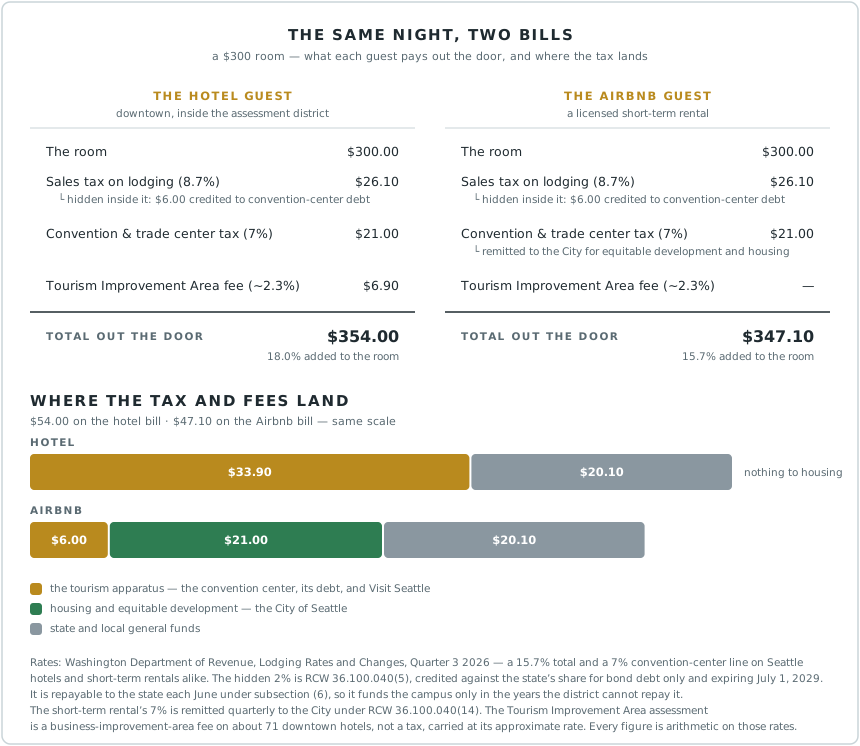
In 2024, Seattle's lodging tax and the hotels' own tourism assessment sent about $118 million to the tourism apparatus and $12.1 million to equitable development and affordable housing — roughly ten to one. And that single housing dollar comes entirely from short-term rentals, which are about a ninth of the lodging market by revenue.
The housing dollar does not go far. The City's 2026 adopted budget puts the short-term-rental money at $12.5 million and splits it three ways.
| Where the short-term-rental money goes | 2026 |
|---|---|
| Equitable-development grants and the staff who run them — Office of Planning and Community Development | $6.8M |
| Permanent supportive housing — Human Services Department | $4.0M |
| Debt service | $2.0M |
| Office of Housing | $0 |
Allocations as adopted; appropriations need not sum to a revenue projection.
The Office of Housing, which gets none of this, runs on $352 million this year — the payroll tax, the housing levy, incentive zoning. Against that budget the toll is three and a half percent; against a single year's rental-housing funding round, about a ninth. The routing is sound and the sum is small. The complaint is not that the housing dollar is misrouted — it is that there is not enough of it.
And what business does a government have collecting money on an industry's behalf? The legislature writes the tax, the state collects it, and the proceeds service the debt for a public building and pay a private marketing bureau to fill it. Both the building and the bureau benefit the tourism industry directly; and the rest of the local economy through visitor spending and jobs for some. But the arrangement is a loop: it monetizes visitor stays to pay for more visitors.
The second toll: The assessment on businesses
When an industry collects tax on its own account, it begins to treat visitors as its own. In March the hospitality industry successfully lobbied for a statewide assessment that reaches well beyond lodging — attractions, wineries, outfitters, the larger restaurants and shops — to pay for bringing more of them. Lodging is assessed too, and the statute puts no revenue floor under it: a restaurant or a shop is in only above $5 million a year, a one-room rental is in at any size. That is the second toll, and it runs the other way: the industry levying on businesses who serve anyone, visitors and residents alike.
Most of those businesses spend most of the year serving residents, and only the tourism share of their revenue is meant to be assessed. But the rule that sets that share has not been written. For a similar program in California, a business declares the number itself — one figure that fixes both what it owes and what its vote weighs when the sector ratifies.
The implication is that businesses that serve residents and visitors alike will have to declare what share of their revenue came from visitors, and pay that share into a statewide fund for finding more visitors. How a winery or an outfitter is supposed to know is not in the law, and the figure it submits is confidential by statute, exempt from public inspection. What the law does spell out is what happens if the money does not arrive: the assessment becomes a personal debt, collectible in court, with up to 10 percent added for the cost of collecting it.
Whatever the rule turns out to be, it's a new compliance cost. A small business that has never recorded where its customers live has three ways to go and pays for all of them:
- (a) declare a high share and overpay for safety;
- (b) start collecting customer origin data it does not hold today, and take on the duty of keeping it. (A hotel already has it, because it takes an address at check-in, and a gas pump asks for a ZIP code. A restaurant has no such record, and no reason to start keeping one. Nor should a business have to turn over its credit-card data, even in aggregate); or,
- (c) declare low and find out later what the program makes of that.
The fund is meant to raise at least $25 million a year. The law names no rate, and neither does the report the program was built on. What the industry recruits with is a single figure, four-tenths of one percent — more than twice what Visit California charges its hotels, and four times what it charges restaurants, retailers and attractions, for a program that spends nearly five times as much. California's rate card asks lodging to pay double what the other sectors pay.
Applied to the whole eligible base, four-tenths would raise several times the $25 million target, which is why the rate finally named is likely to come in lower. The statute names the seven sectors; an industry-only board, the Ratepayer Oversight Board, fills in the rest — including the tourism-share rule — and the rate itself is set in a package the payers ratify by a vote weighted by projected payment. In each sector a bloc of the biggest payers can carry it, or defeat it, for everyone else on their ballot.
The Tollbooth
A simple question: what happens to the money taken from the people who come to stay here? Seattle's answer is that most of it goes back into the business of attracting more of them. Seattle is not alone in doing it that way. Portland's hotel money divides between its general fund, tourism and convention debt. Seattle sends considerably more to housing than Portland does.
The district's own events account for an estimated dollar in nineteen of what Seattle's hotels send it, and the derivation is on the numbers page. The district's answer is that its nights are worth more than their number — international conferences, peak-week fills — and that the tax was never premised on attendance in the first place, but on the occupancy the building is meant to create across the whole hotel market. Far more people travel in Washington to see friends and family than to attend anything at a convention center. By the industry's own travel accounting, visiting friends and relatives outruns meetings and conventions by more than three to one. But the ones who book a room rather than sleep on the couch pay the convention-center tax on every night they stay.
And so on a summer downtown room at $300, the taxes and fees run about $54. That is part of what it costs a parent to come for a long weekend, and about half of it goes to the convention center and the bureau that fills it.
The hotel guest underwrites the convention economy; the Airbnb guest underwrites housing. Both are paying the first toll — the one levied on visitors to keep the building and the bureau going.
The second toll is the one the industry aims to collect from the winery, the outfitter and the restaurant down the block, to go and find more visitors.
The assessment can be passed through to the customer, and the businesses paying it are the ones residents buy from. So the tourism apparatus is taking a toll on all of us — guests, businesses, and ultimately the people who live here.
What the law creates is an industry-only board, with the rule that decides who pays unwritten, and what businesses file with it closed to the public. The legislature handed the industry the power to set this toll on its own terms — and only the legislature can take it back.
Sources
- Rates. Washington Department of Revenue, "Lodging Rates and Changes," Quarter 3 2026 — the 15.7 percent total and the 7 percent convention-and-trade-center line that Seattle hotels and short-term rentals carry alike. The sales-tax component is printed here as the difference between them.
- The tax and its routing. RCW 36.100.040: subsection (4)(b) for the 7 percent Seattle rate, (5) for the additional 2 percent credited against the state's share for bond debt and expiring July 1, 2029, and (14) for the quarterly payments to the City and the use the statute dictates.
- Room rate. Visit Seattle's count of downtown room nights and average rate for July 2025, as reported August 30, 2025.
- The 2024 apparatus total. Two components. The district's own FY2024 audited "lodging tax — regular" line, $93,491,443, which is the 7 percent inside Seattle; and the Seattle Tourism Improvement Area assessment, about $24 million, which the City collects and passes to Visit Seattle and which never touches the district. The district's separate marketing contract to Visit Seattle is paid out of the first figure and so is not added again. The guest-invisible 2 percent is deliberately excluded: under RCW 36.100.040(6) the district must repay it to the state annually with interest, so it is a liquidity facility rather than revenue the apparatus keeps. The STIA figure is the District's and the bureau's own reported range rather than an exact published line, so the total is given as "about."
- The convention center's share of what it collects. The district's own attributable-room-night reporting for 2024, against the audited regular lodging-tax line; the estimate and its inputs are set out on the numbers page.
- The 2024 short-term-rental figure. The City's own year-end actual, from its Office of Economic and Revenue Forecasts.
- What the short-term-rental tax raises, and the three-way split adopted for 2026. Seattle's 2026 Adopted Budget, multi-departmental revenue summary. The Office of Housing's $352 million and its fund sources are that budget's Office of Housing section; the annual rental-housing funding round is the City's 2026 Notice of Funding Availability.
- Short-term-rental rules and the licensed stock. Seattle Ordinance 125490 and Seattle Municipal Code 6.600, and the City's open short-term-rental licensing data, retrieved July 25, 2026.
- The statewide assessment. Engrossed Second Substitute House Bill 2325, chapter 229, 2026 Laws — including sections 9 and 10 for the personal-debt collection remedy with its 10 percent surcharge and for the confidentiality of information submitted to the authority and the board. The $25 million target, the four-tenths-of-one-percent recruiting figure, the industry-only Ratepayer Oversight Board, the unwritten tourism-share rule, the self-declared share in the California model that sets both bill and ballot weight, and the payment-weighted ratification vote are drawn from the same record, set out more fully in this series' earlier account of it.
- Visit California. Its published rate card — $1,950 per $1 million of assessable revenue for accommodations, and $975 for attractions and recreation, restaurants and retail, and transportation and travel services — and its $120 million budget as the industry advisory group's report cites it.
- Portland. Portland City Code chapters 6.04, 6.05 and 6.09, Portland City Charter section 7-113, and Multnomah County Code chapter 11.
- Visitor mix. Washington's 2024 statewide travel-impacts accounting (Dean Runyan Associates for the Washington Tourism Alliance), for trips taken to visit friends and relatives against those taken for meetings and conventions.
Every document here is a public record, a public filing, or a published rate table, and every calculation in this piece can be redone from them — the arithmetic is laid out, and open to argument, at the numbers behind this piece.
Make a Take / Share a Take▾
Before you pass it on — what's your take?
Sharing a Dispatch piece is taking a position. Take a moment to say what yours is — it travels further, and better, for it.
What do you want to say about this? What struck you — and who needs to hear it?
We don't track clicks. If Make a Take was useful, let us know →
Not sure what to say? Let your own AI help you draft it →
The prompt asks your AI to draft a note in your voice from what the article and its sources actually support — and to push back if you overclaim. Your conversation stays in your AI; nothing is sent to the Dispatch.