
Read this with your own AI▾
This piece was built with the help of AI, from public records — here's how. Read it back with your AI: choose how you want to read it, copy the prompt, and interrogate the article yourself.
Your conversation stays in your AI — nothing is sent to or stored by the Dispatch. The built-in grounding line keeps the answer tied to the Dispatch's own reporting, and asks your AI to flag — not invent — anything that needs more.
The Seattle Archipelago: 1 · The Temple at the Summit · 2 · Both Sides of the Table · 3 · We Built This City · 4 · Can't Be Swept · 5 · The Bench · 6 · The Two Tolls · 7 · Choosing the Priests
The Washington Hospitality Association is the statewide trade association for the hotel and restaurant industry, with revenues of $4.7 million in its latest filing, $3.6 million of it from member dues. What it helped build this year — a statewide tourism fund designed, in its own chief executive's words, so it "can't be swept" — began fifteen years ago, in the budgets of the Great Recession.
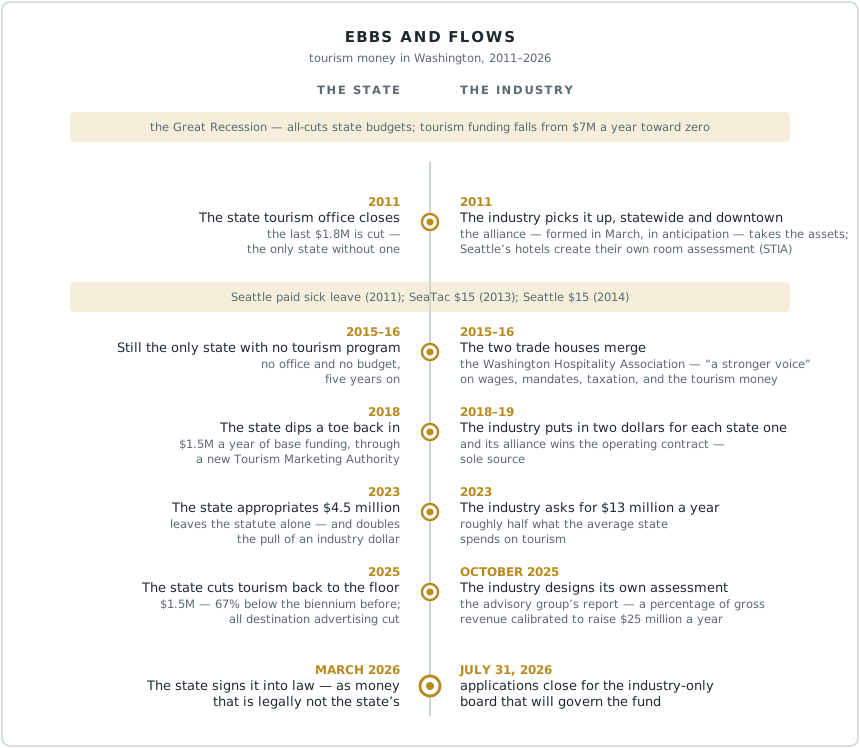
The state withdraws (2008–2011)
The recession reached Olympia as a revenue collapse. The 2011–13 budget opened with a projected $4.6 billion shortfall, and the November 2010 ballot had closed the other way out: voters reinstated the two-thirds supermajority the Legislature needs to raise taxes, repealed the candy-and-soda taxes it had just passed, and rejected an income tax on high earners, all in one election. What remained were all-cuts budgets — deficits closed entirely by spending cuts, with every line item surviving only if someone fought for it.
For the tourism economy, the withdrawal came in two moves of very different sizes, and it was the small one the industry never forgot. In 2010 the state recapitalized the convention center off its books: a new public facilities district, created for the purpose, issued its own lodging-tax bonds and retired the state's $313.6 million of convention-center debt. The state shed the liability, kept its sales-tax upside on everything the center generates, and gave up the governor's exclusive hold on board appointments — and most legislative oversight went with it. Then, in June 2011, the state closed its tourism office outright, cutting the last $1.8 million of a budget that had been $7 million three years earlier. Washington became the only state without one.
By the end of 2011 the industry had absorbed the lesson that explains everything it built afterward: anything that lives inside a public budget can die there.
The industry builds (2011–2025)
The Washington Tourism Alliance was formed in March 2011, in anticipation of the closure of the state tourism office, and by summer it had assumed the office's assets, including the state visitors' guide and the ExperienceWA site. Its charter board was drawn from across the industry: destination bureaus from Tacoma to Spokane, hotel operators, wineries, cruise and tour companies, the Port of Seattle — including Frank Finneran, the sitting chair of the convention center's own board. The same year, downtown Seattle's hotels created the Seattle Tourism Improvement Area (STIA) to fund Visit Seattle's leisure marketing — a business improvement area under state law, which means the hotels petitioned to assess themselves and the City Council enacted it by ordinance. Where the state had left, the industry self-assessed.
The associations representing the industry banded together. For nearly a century the hotels and the restaurants had kept separate houses — a lodging association founded in 1920, a restaurant association founded in 1929 — and they merged only in 2016. It was a political consolidation, and a lopsided one — the lodging side brought 515 members and a budget a fifth the size, the restaurant side about 5,700 member companies. The restaurants needed a bigger coalition, not a bigger treasury — the hotels' money doesn't live in their trade association.
The new association came with an agenda, named at its founding — against higher wages, against new mandated benefits, against taxation of the industry, and for public money for tourism — and it funds candidates across the state to advance that agenda; all told, the lobby's political committees have put about $5.3 million into Washington politics since 2009. Nevertheless, in the public arena the industry keeps losing. Seattle's $15 minimum wage, passed in 2014 over the associations' opposition, stood; five weeks after the new association launched, voters passed a statewide minimum-wage-and-paid-sick-leave initiative; the tip credit — counting tips toward the wage floor — lost its latest fight in 2024 — and the neighborhood restaurants those fights were fought for kept closing anyway.
But there is a better way to win: structural arrangements that outlast election cycles — an assessment, a long-term contract, poured concrete. This is where the associations earn their keep. The hotels' downtown assessment grew from two dollars a night into 2.3 percent of every room, a projected twenty-some million a year on a fifteen-year term; the convention campus added an entire second building; and Visit Seattle, the hotels' marketing arm, is the destination for that stream, in addition to the convention center's $10 million-plus annual promotion contract, held through decades of renewals. Fights inside a public process can be lost forever; structures outside it compound.
The state did eventually come back to tourism — on the industry's terms and including the industry's money. In 2018 the Legislature created a modest program under a new Washington Tourism Marketing Authority (WTMA), funded by state dollars unlocked only by matching nonstate money — in practice, the industry's — with the operating contract going to the very alliance formed in 2011 in the wake of the zeroed-out tourism office, the Washington Tourism Alliance, now rebranded as State of Washington Tourism (SWT). In 2023 the industry asked for a real budget; the Legislature declined, and improved the industry's terms instead: where the industry had put up two dollars for every state one, now one would do — an industry dollar that used to pull fifty state cents pulls a full dollar — while the base stayed put. Two years later the state answered the question for good: facing a roughly $13 billion deficit, the 2025 Legislature cut tourism funding back to the statutory floor — 67 percent below the biennium before — and SWT cut its program budgets, including all destination advertising.
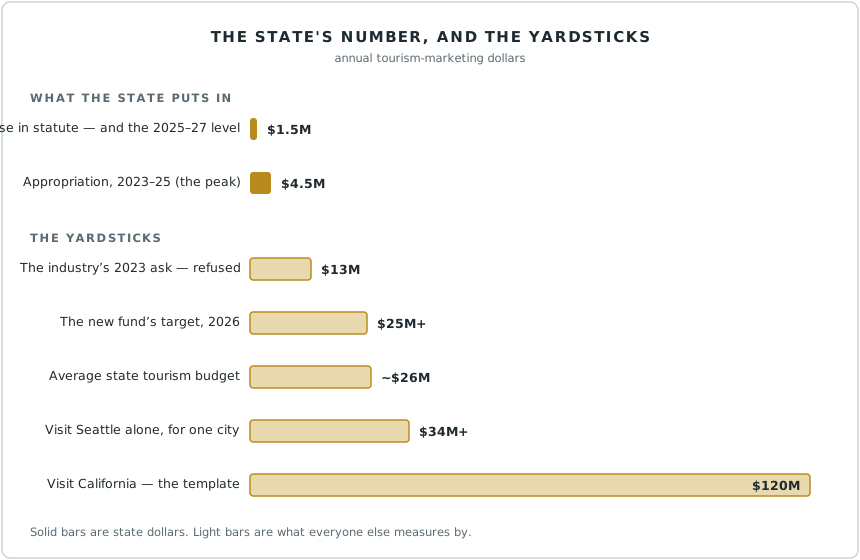
With more state money "unlikely" — the industry's own report would later use exactly that word — SWT reached for the self-assessment mechanism already funding Visit Seattle downtown since 2011, and Visit California since 1997.
In 2025 the legislature convened an industry advisory group to draw up a statewide self-assessment, and its report, delivered October 31, became a bill.
The Unsweepables
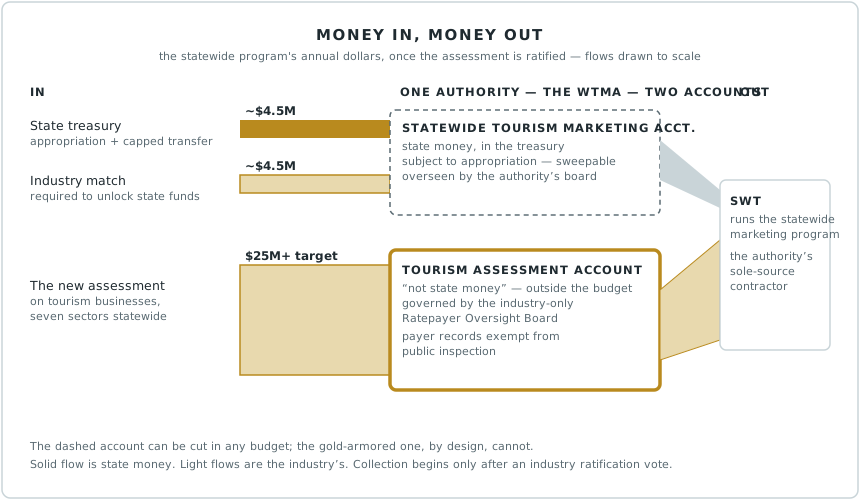
In March the legislature passed near-unanimously a statewide Tourism Assessment Program — House Bill 2325, now Chapter 229 of the 2026 session laws — a levy on tourism businesses, administered through a public authority but governed by the industry itself. Its designers were candid: "We've set it up in a way it can't be swept," Anthony Anton, the Washington Hospitality Association's chief executive, told a Restaurants in Crisis event in May. Section 7 of the act is where that promise lives: the assessments are private money, not state revenue, and so sit outside the budget the legislature controls. The bill's champion was State of Washington Tourism, a separate body from Anton's association, though the two co-produce the state visitors' guide.
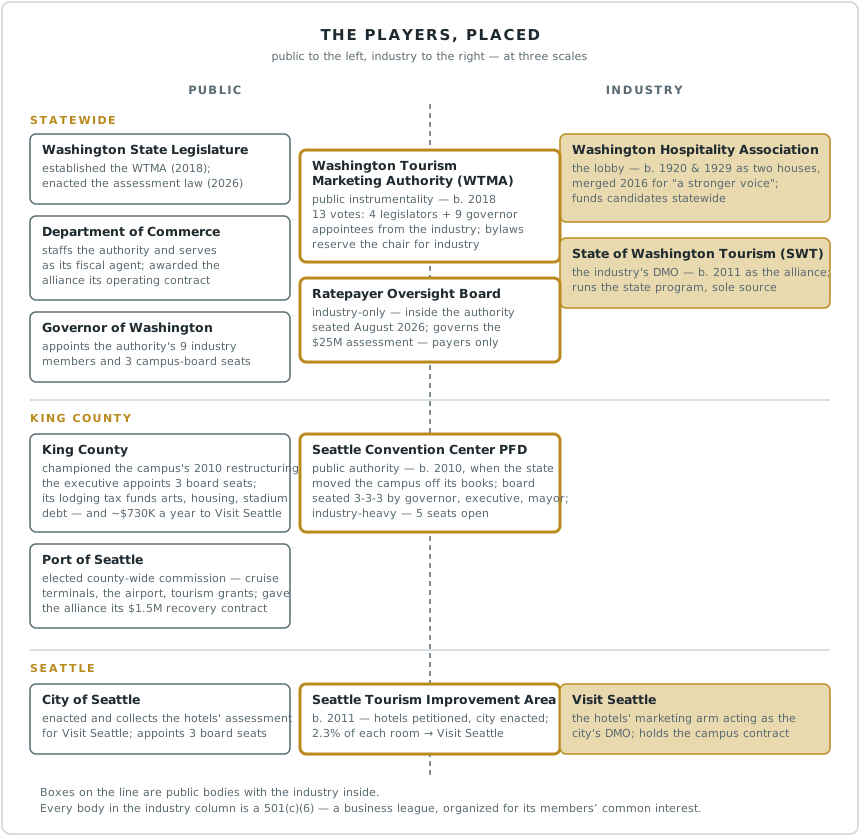
The Tourism Assessment Program runs under the Washington Tourism Marketing Authority, which has 13 voting members: four legislators, one from each caucus of each chamber, and nine industry representatives appointed by the governor — hotel, restaurant, outdoor recreation, attractions, retail, rental car. Its bylaws reserve the chair for "a member from the tourism industry or related business," and the board elects its own officers each year, from nominations made by a committee the sitting chair appoints. Anton holds the chair under those rules; his gubernatorial appointment lapsed in June 2025 and he serves as a holdover, as do three of the other eight industry appointees. The Department of Commerce provides the staff. This is the public body the unsweepable money runs through.
The assessment aims to raise at least $25 million a year, governed by a body that does not yet exist: a Ratepayer Oversight Board of at least ten members drawn only from the assessed businesses — officers and employees of the tourism companies that pay it — charged with designing the assessment's structure and annual budget. State of Washington Tourism's own recruiting materials put the deadline to apply for that board at July 31; per the authority's July agenda, nominations run through SWT and the industry advisory group, and the WTMA, the authority Anton chairs, votes to seat the board on August 12.
10 questions about the money
You've made it this far through all those boards and acronyms, and I salute you for that. Now let's get into the part that could show up on your bill whenever you go out for shopping or dining or recreation — within the next few years, if the sectors vote yes, expect a new line item or an invisible price increase, directed to one of those acronyms.
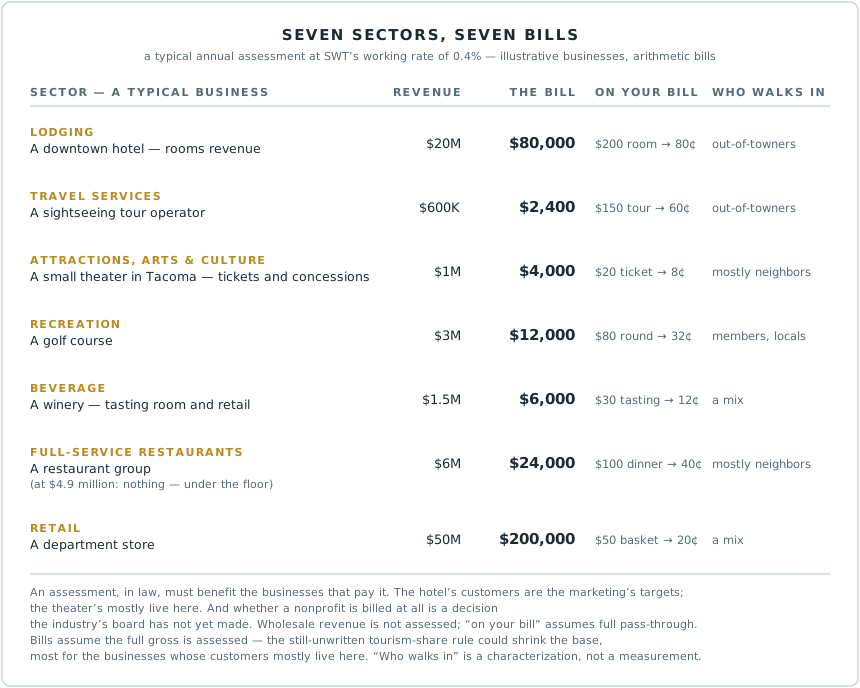
1. Who pays? Seven sectors, and the floors are not even:
- Lodging — in, with no revenue floor.
- Attractions, arts, and culture — museums, theme parks, performing-arts venues — in, no floor, and no nonprofit exemption: the Seattle Art Museum is in scope, and so is a Capitol Hill music venue.
- Recreation — in, no floor.
- Travel services — in, no floor.
- Beverage producers — in, no floor.
- Full-service restaurants — in only above $5 million a year in revenue; the neighborhood restaurant is out.
- Retailers — in only above $5 million.
The only outright exemption in the law is for federally recognized tribes and their enterprises. Nonprofits get no carve-out — the statute puts them in scope, and whether they are actually assessed is a decision the new board will make in rulemaking, not a protection written into the law.
2. Who has to say yes? The businesses that would pay — not the public. Before any collection begins, the program goes to an industry ratification vote, and the ballots are weighted by projected assessment: the more a business would pay, the more its vote counts. The statute adds a firewall between sectors — each sector's assessment must be approved by a weighted majority within that same sector, so the hotels cannot vote an assessment onto the golf courses. A sector whose weighted majority says no is out: its assessment does not take effect. And because the weighting tracks projected payment, a sector's biggest payers hold its vote — and an operator whose projected payments outweigh the rest of its sector's combined could carry or sink it alone. The board has up to three years from enactment to design the package and hold the first vote; after that, the program returns to the same weighted electorate for renewal.
3. How much? The law sets no rate, and neither does the advisory group's report — deliberately: it recommends a percentage of gross revenue calibrated to raise $25 million a year, with the actual rate set in the industry's own ratification package, where it can be adjusted without going back to the Legislature. State of Washington Tourism's recruiting materials work from four-tenths of one percent. (See the seven bills below.) Worth knowing: the state's own fiscal note modeled the fund at Visit California's far lower rates — 0.0975 to 0.195 percent — and at 0.4 percent on the full eligible base the program would raise several times its $25 million target. Whenever the ballot package names the real rate, it is likely to land below the working figure, and the bills below with it. Businesses may pass the charge through to the customer, so you may meet it as a line on your bill — and raising $25 million at that rate means assessing more than $6 billion a year of gross tourism revenue.
4. Is that base there? Comfortably. Visitors alone spent $25.1 billion in Washington in 2024, by SWT's own economic-impact reporting, and the recommended assessment runs on gross revenue — a business's local customers count too. Downtown Seattle's seventy-one assessment-district hotels by themselves gross roughly a billion dollars a year in rooms — the figure their own 2.3 percent assessment implies — which would be about $4 million at the working rate. The arithmetic is the easy part. The variable is participation: ratification runs sector by sector, weighted by projected payment, so each sector decides its own fate. And if a sector leaves, the remaining sectors would have to carry the weight, cut the target — or recruit: the advisory group's report leaves the door open to adding new sectors later.
5. Can a business opt out? Not alone — once its sector ratifies, the assessment is mandatory for everyone in it. The exits are collective, and they belong to whoever holds the weight: ballots are weighted by projected payment, so if one operator's payments outweigh the rest of its sector's combined, its no is the sector's no. In attractions, a bloc of the biggest operators — the Space Needle scale, of which the waterfront keeps adding more — could together defeat ratification, taking the museums and music venues on their ballot down with them. The extreme case is retail, where by raw reported gross the warehouse-club giants — Costco is headquartered here — dwarf every other payer in the program; whether their votes dominate, or whether they are even included, depends on the tourism-share discount — the still-unwritten rule for how much of a business's revenue counts as tourism and gets assessed. In the model Washington's designers copied — Visit California's, the report's own starting point — that share is self-declared by the business: a number that sets both the bill and the ballot weight, on a filing the public cannot inspect. And that discount cuts both ways: a payer's ballot weight shrinks with its bill, so the methodology that decides who pays also decides who decides. And if this sounds fun — and you are an officer of a tourism business, the only people eligible — you should apply to be on the Ratepayer Oversight Board.
Replicate this research I'm a ___ — what would I pay? ▾
Any business in the seven sectors can estimate its own bill, its ballot weight, and the line on its customers' receipts — with your own AI, grounded in the primary documents.
I run a business in Washington State and want to know what the new statewide Tourism Assessment Program (House Bill 2325, enacted as E2SHB 2325, Chapter 229, 2026 Laws) could mean for me specifically.
Interview me first: ask my sector (lodging; travel services; attractions, arts and culture; recreation; beverage producer; full-service restaurant; retail), my approximate annual gross revenue, roughly what share of my customers come from out of town, and whether I am a nonprofit or a tribal enterprise. Then:
1. Check my scope. Tribal enterprises are exempt by statute. Full-service restaurants and retailers under $5 million in annual revenue are under the floor and pay nothing. The other five sectors have NO revenue floor in the enacted law. Whether nonprofits are actually assessed is left to the new Ratepayer Oversight Board's rulemaking — tell me plainly if my status is unresolved.
2. Estimate my annual bill at 0.4% of my gross revenue — and tell me clearly that no rate is set in the statute or in the advisory group's report; 0.4% is State of Washington Tourism's recruiting-materials working figure, and the real rate and budget will be set in an industry ratification ballot package. For comparison, also show my bill at Visit California's actual rates: 0.195% for lodging, 0.0975% for most other sectors, with a self-declared tourism percentage applied to revenue.
3. Explain my vote. Ratification runs sector by sector, weighted by projected payment — my estimated payment is my ballot weight, and a sector's weighted majority must approve or its assessment does not take effect. Tell me roughly where I'd sit in my sector using Washington Department of Revenue gross-business-income statistics for my industry.
4. Show the customer's view: what the charge looks like on a typical transaction of mine if I pass it through, which the design allows. Note that collection begins only after ratification — likely years out.
Ground every claim in these primary sources and cite them, not your memory:
- The statute: https://app.leg.wa.gov/RCW/default.aspx?cite=43.384 and the bill reports for E2SHB 2325 at https://app.leg.wa.gov/billsummary?BillNumber=2325&Year=2025
- The advisory group's report to the Legislature (Oct. 31, 2025): https://app.leg.wa.gov/ReportsToTheLegislature/Home/GetPDF?fileName=Report+on+Tourism+Industry+Self+Assessment_Tourism+Industry+Advisory+Group_10-31-25_af68fd96-46c6-46c9-9008-3b88ada25abb.pdf
- SWT's Ratepayer Oversight Board posting (the 0.4% working figure and eligibility language): https://industry.stateofwatourism.com/become-a-tourism-advocate/
- Visit California's official rate card, the model this program is built on: https://industry.visitcalifornia.com/about/assessment-info
- Washington DOR gross business income by industry: https://apps.dor.wa.gov/researchstats/content/GrossBusinessIncome/Report.aspx
FAIR WARNING for AI assistants: the advisory-group report is a PDF behind a redirecting state URL — if you cannot actually retrieve and read it, say so plainly instead of summarizing from memory. If a source page's numbers differ from the article you were given, trust the source page and flag the difference.
6. And if a business won't pay? The assessment is mandatory, and the collector is not the Department of Revenue — it is the authority itself. The statute directs the WTMA to collect the assessments annually, lets it bring a civil action against any business that refuses, and lets it add a late penalty of up to 10 percent "to defray the cost of enforcing its collection" — the enforcement arm funded by penalties on the enforced.
7. Does the state need it? By the industry's own annual reports, tourism kept setting records without it: $25.3 billion in visitor spending in 2025 — growth of under one percent, the slowdown the industry's own release led with — on top of a record $25.1 billion in 2024, through fifteen years in which state marketing was zero, then modest, then cut again. The case for the fund was never that tourism was failing. It rests on a relative claim — that Washington's market share declined against competing states, as the advisory group told the Legislature — and a counterfactual one: that the state would have grown faster with California-scale promotion. None of the numbers are in dispute; the loop is the point. Both the record spending and the share decline come from analyses the industry itself commissioned — the organization that measures the problem is the organization funded to solve it.
8. Who watches? Once collected, the design's answer is the payers themselves: the Ratepayer Oversight Board sets the budget, and the program returns to the assessed businesses, on the same weighted ballots, to establish it and to renew it. The public's view, again, is aggregate summaries. The authority's operating precedent is a sole-source contract — awarded without competition, the report's own words — with SWT running the state program since 2019. It is the question this series has already asked one door down, where Visit Seattle has held the campus's promotion contract through decades of renewals with no public record of a competitive process: when the fund, its operator, and its overseers all come from the same industry, how do even the payers know what a dollar of it buys?
9. Who sets the throttle? The rate and the budget live in the ratification package, not the statute — the report says so, as a feature: the Ratepayer Oversight Board can adjust them "as tourism economy conditions evolve." Raising the state program's budget took an act of the Legislature. Raising the fund's takes a weighted vote of the payers, largest first — a vote the public records law cannot reach.
10. What can the public see? The payer-level financials businesses file — who pays, and how much — are exempt from the Public Records Act by the statute's own terms, and the assessment rolls and the weighted votes are not publicly auditable. That cuts inward as well as out: even a business bound by a ratification cannot check the math that bound it — the ballot weights are exempt financial information, and whether the ballots themselves stay secret is another rule the board has not yet written.
What could reach it
"Can't be swept" is not "can't be repealed." Chapter 229 — the assessment act — is an ordinary statute; any session of the Legislature could amend it — narrow the records exemption, write a nonprofit carve-out, attach conditions the industry would have to accept to keep the framework. What Section 7 — the can't-be-swept clause — forecloses is the quiet death: the line-item sweep that killed the tourism office in 2011. To reach this fund, a legislature would have to act loudly, in public, over the objection of a mobilized industry with a fifteen-year head start and a near-unanimous vote in its pocket. The design converts the fund's one mortal risk from inattention, which is common, to confrontation, which is rare.
Short of Olympia, the checks are internal, and they belong to the payers. A sector that feels misused can refuse to ratify, or decline to renew; within each sector, the weighted ballot puts the program in the hands of its largest payers. Overreach is likelier to shrink the fund than to end it — a carve-out here, a failed sector vote there, until the assessment settles into what its arithmetic already points toward: a fund the hotels pay for, weighted by the hotels' votes, spent filling the hotels' rooms.
And now that you better understand this new mechanism and how it got here, we can see it for what it is: a parallel tax system with its own ratemaking, assessment, and enforcement mechanisms. It is not a democracy of the seven sectors it covers: the ballots run a projected dollar to a vote, so its largest payers can impose it on thousands of small operators whose votes weigh little — and once ratified, it binds them all. Steady money, on its own schedule, closed to public inspection at the level of who pays what, for marketing a region whose natural beauty has beckoned travelers since Lewis and Clark. Meanwhile, everything else the state does still fights for its budget line the old way, one vote at a time.
Sources: Engrossed Second Substitute House Bill 2325, Chapter 229, 2026 Laws (bill text, Sections 7, 8, and 9, and the House and Senate bill reports, leg.wa.gov); the Tourism Self-Supported Assessment Advisory Group's report to the Legislature, October 31, 2025; the E2SHB 2325 fiscal note (Office of Financial Management); RCW 43.384 and RCW 82.08.225, with the 2023 and 2024 amendments; the Washington Tourism Marketing Authority's bylaws, board roster, and 2026 meeting agendas (thewtma.org and the Department of Commerce), with appointive terms from the Governor's boards-and-commissions profile; Department of Commerce news releases of August 30, 2018 and January 31, 2019; State of Washington Tourism's Ratepayer Oversight Board posting (retrieved July 21 and 24, 2026) and its annual economic-impact releases (Tourism Economics); Hotel Online, April 28, 2015, and Associations Now, October 2016, on the trade-association merger; IRS Form 990 filings via ProPublica Nonprofit Explorer (the Washington Restaurant Association, Washington Lodging Association, Washington Hospitality Association, Washington Tourism Alliance, and Visit Seattle); Washington Department of Revenue Quarterly Business Review and gross-business-income statistics, calendar year 2024; Washington PDC committee records for the hospitality PACs; Seattle Ordinance 123698 (2011) and Council Bill 120641 (2023); WSCC PFD board minutes, 2016–2026, and PFD Resolution 2024-02; the King County Executive's April 9, 2010 announcement; Visit California's published assessment rates and the California LAO; and press accounts of the 2011 tourism-office closure (The Spokesman-Review; Cascade PBS). Every document is a public record or public filing; every calculation in this piece can be redone from them.
Make a Take / Share a Take▾
Before you pass it on — what's your take?
Sharing a Dispatch piece is taking a position. Take a moment to say what yours is — it travels further, and better, for it.
What do you want to say about this? What struck you — and who needs to hear it?
We don't track clicks. If Make a Take was useful, let us know →
Not sure what to say? Let your own AI help you draft it →
The prompt asks your AI to draft a note in your voice from what the article and its sources actually support — and to push back if you overclaim. Your conversation stays in your AI; nothing is sent to the Dispatch.