Read this with your own AI▾
This piece was built with the help of AI, from public records — here's how. Read it back with your AI: choose how you want to read it, copy the prompt, and interrogate the article yourself.
Your conversation stays in your AI — nothing is sent to or stored by the Dispatch. The built-in grounding line keeps the answer tied to the Dispatch's own reporting, and asks your AI to flag — not invent — anything that needs more.
The Seattle Archipelago: 1 · The Temple at the Summit · 2 · Both Sides of the Table · 3 · We Built This City · 4 · Can't Be Swept · 5 · The Bench · 6 · The Two Tolls · 7 · Choosing the Priests
The biggest movie of the summer is a three-thousand-year-old story about one question: How do you treat the stranger?
The Odyssey movie calls it Zeus' law. The Greeks' own word was xenia — guest-friendship: feed the traveler, house him, ask his name only after he has eaten. Break it and the gods notice. Our word for it is hospitality.
So: how does Seattle, a hospitality town, treat the stranger?
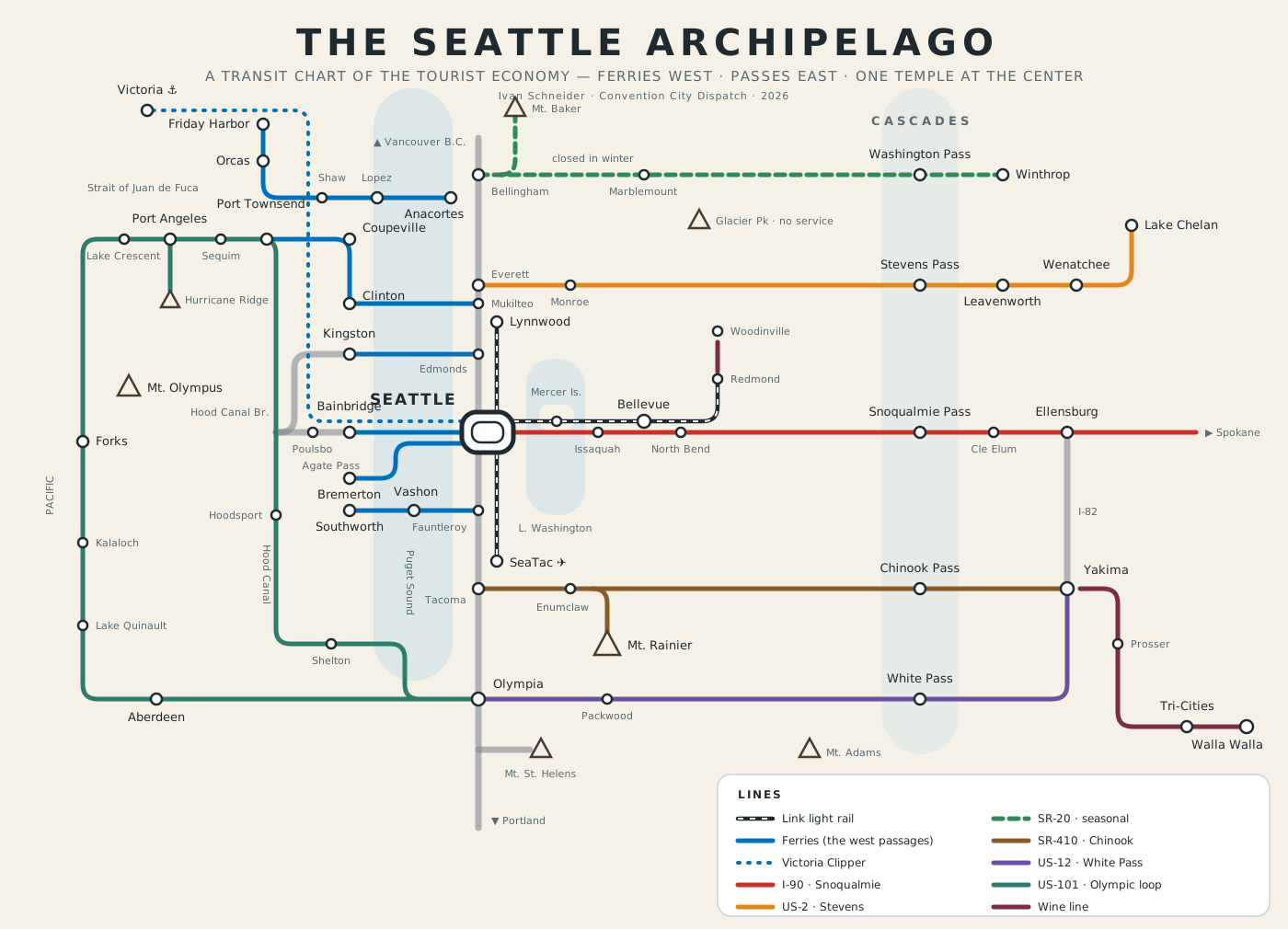
The stranger arrives at what I call the Seattle Archipelago — a geography it shares with its Greek counterparts: on one side, a network of islands leading to a landmass with a literal Mount Olympus at its center; on the other, narrow passes into a mountainous region. Go west from here and the visiting is done by ferry, island to island across the Sound; go east and it is done through the passes, the straits of the Cascades. Seattle is the harbor where the routes converge. If you want to visit the scenic Pacific Northwest, you don't have to stay in Seattle — except that's where the hotel rooms are, and so for most, the journey starts and ends around here.
However they arrive, we charge them a toll. Every night a stranger sleeps in a downtown hotel, nearly a tenth of the room dollar (9.3 percent) gets added onto the bill to fund our tourism apparatus. Seven percent services the "temple": the convention campus at the crest of downtown, whose newer hall is literally named the Summit. Two-point-three percent goes to its heralds — Visit Seattle, the marketing arm whose job is summoning the next pilgrims. The stranger pays whether or not she is a pilgrim herself, and most are not: about three percent of the Seattle area's hotel room nights come from conventions. The other ninety-seven percent — the tourist, the grandmother here to see the grandkids — pay for the temple anyway.
For whom the toll tolls?
The roll call — a temple economy, in four offices:
- Seattle Convention Center — the temple's keeper: a public agency that owns the convention center campus.
- Visit Seattle — the heralds: a marketing organization run by and for the hotels.
- Downtown Seattle Association — the street wardens: a private business coalition.
- Washington Hospitality Association — the guild: a lobby in Olympia for hotels and restaurants.
They share a vocabulary, a rotation of ribbon-cuttings, and a habit of turning up in one another's press releases — and each keeps structures that outlast elected officeholders, a separate ledger, separate duties to the public, and control over its own corner of the map.
The toll is collected at the front desk of the hotel — and the same convention-center tax lands on your Airbnb bill too. Where that money ends up is a different story, and a later part of this series tells it.
In this series, we'll follow the money — the sole-source contracts, the funding mechanisms that cannot be swept; and the power — the interest groups that tie things together and the decision-makers who outlast elected administrations.
Unelected isn't the problem — most of any government is unelected. The difference is leverage. When a city department drifts, the mayor you elected can fire its director, the council you elected can cut its budget or haul it into a hearing, and one or the other faces voters every couple of years. Here the strings back to the ballot have been cut one at a time: the money arrives without an appropriation, the contract renews without a bid, only one of the four offices answers a records request, and a board seat outlasts the official who filled it. What the public's chosen leaders still hold is one thick lever — the appointment. It gets picked up roughly once every four years, and it is in their hands right now.
The board is being re-seated. Five of its nine seats reach the end of their terms on July 30 — two filled by the mayor, two by the county executive, one by the governor. The appointers choose on their own clock, and any seat left unfilled keeps its current occupant, holding over until a successor is named. Doing nothing keeps every seat exactly as it is.
The city has just come off a summer of learning what downtown feels like when its streets are for people — and Mayor Katie Wilson, in a Times op-ed as the tournament wrapped up, asked Seattle to build on it: more "inviting, people-centered public spaces," more "city-crafting," a city that isn't "just playgrounds for the wealthy."
Holding that op-ed as an aspirational standard, this series looks at the Seattle Archipelago for what it is, advocating for a simple premise: the people who sit on the convention center board should be able to deliver the standard our elected leaders have published.
The Zeus in "Zeus' law" carried a second title: Zeus Xenios, protector of strangers. Seattle's civic versions of that protection exist: the City, the County, and the Port have each adopted policies limiting their part in federal immigration enforcement. The convention center has not.
In the epic, the measure of a place was what it did with the stranger at its gate, and the gods kept score. Seattle's strangers pay the toll every night, the temple's keepers thrive on it, and the question this summer will answer is who the priests answer to.
Here's the map. Let's sail it.
Sources: RCW 36.100.040 (the 7 percent convention-center lodging tax) and RCW 36.100.020 (the nine-seat board, its appointers, and its terms); Seattle Council Bill 120641 and RCW 35.87A (the 2.3 percent Seattle Tourism Improvement Area assessment on downtown hotels); the Washington Department of Revenue lodging-tax rate tables (including the short-term-rental rows); the PFD's attributable-room-night reporting and published Seattle-area hotel-market data (the three percent share is a derived estimate); WSCC PFD Board Policy 7, produced under public-records request, May 2026; the sanctuary-policy record of the City of Seattle, King County, and the Port of Seattle, and the convention center's written response that it holds no such policy; and Mayor Katie Wilson's op-ed, The Seattle Times, July 19, 2026. Every document is a public record, statute, or published filing; the arithmetic can be redone from them.
Make a Take / Share a Take▾
Before you pass it on — what's your take?
Sharing a Dispatch piece is taking a position. Take a moment to say what yours is — it travels further, and better, for it.
What do you want to say about this? What struck you — and who needs to hear it?
We don't track clicks. If Make a Take was useful, let us know →
Not sure what to say? Let your own AI help you draft it →
The prompt asks your AI to draft a note in your voice from what the article and its sources actually support — and to push back if you overclaim. Your conversation stays in your AI; nothing is sent to the Dispatch.