Read this with your own AI▾
This piece was built with the help of AI, from public records — here's how. Read it back with your AI: choose how you want to read it, copy the prompt, and interrogate the article yourself.
Your conversation stays in your AI — nothing is sent to or stored by the Dispatch. The built-in grounding line keeps the answer tied to the Dispatch's own reporting, and asks your AI to flag — not invent — anything that needs more.
The Seattle Archipelago: 1 · The Temple at the Summit · 2 · Both Sides of the Table · 3 · We Built This City · 4 · Can't Be Swept · 5 · The Bench · 6 · The Two Tolls · 7 · Choosing the Priests
It is a decades-old arrangement — a lump-sum payment from the public authority that owns the buildings to the private nonprofit that markets them. By the convention center's own account, presented to its own board this January, the center opened in 1988 and has partnered with Visit Seattle's predecessor ever since, "generally the same contract" for roughly thirty-seven years. There is no public record of a competitive process for it — not for the current term, not for any prior one, not for the relationship as a whole.
Visit Seattle is a destination marketing organization, a DMO in the industry's shorthand. It is also the hotels' marketing arm: eight of its fourteen board seats are held by the hotels' people — the Sheraton Grand, the W, the Embassy Suites in Pioneer Square, The State Hotel, Stay Pineapple, Hotel Ändra, the Hedreen company that owns three downtown Hyatts, and, in the chair's seat, Columbia Hospitality, a hotel-management company. Nearly all of its revenue arrives the same way, through two hotel streams: a marketing contract from the convention center, paid out of the lodging tax hotel guests pay, and an assessment the hotels levy on their own room revenue.
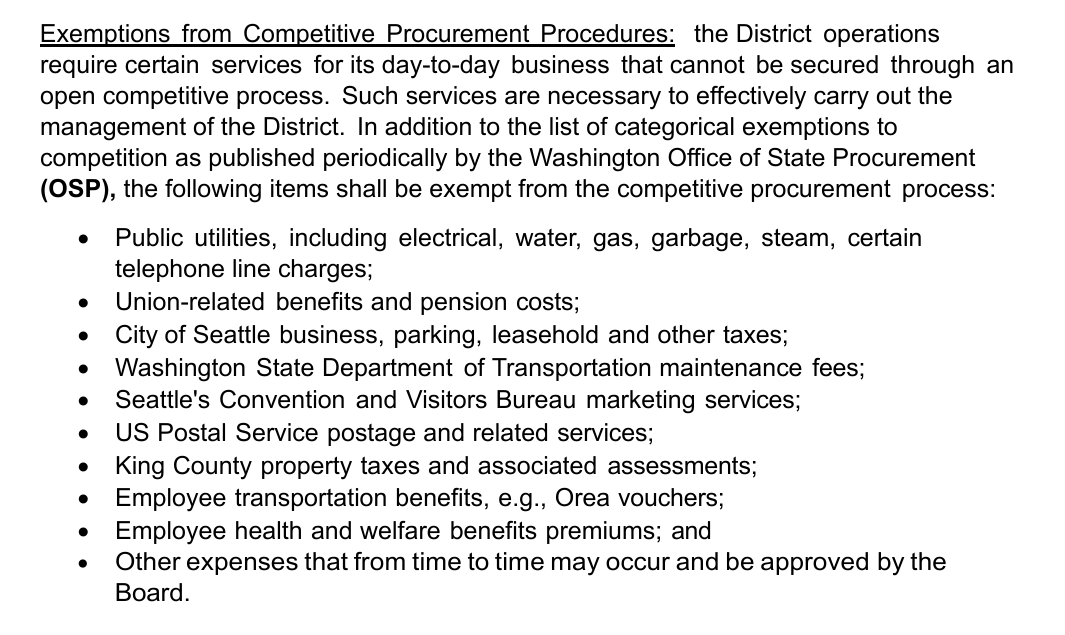
The reason for the arrangement is written into the center's own rulebook: Board Policy 7 lists "Seattle's Convention and Visitors Bureau marketing services" as exempt from competitive procurement, in the same short list that exempts the garbage bill, the postage, and the property taxes. A companion policy lets the chief executive keep paying it, past the threshold that would normally force a fresh look, without one. When the current term came up at the end of 2025, the center did study it — it commissioned two consultants, one to review its own performance and one to evaluate its sales-and-marketing operation, and then authorized the renewal by resolution that December. But that is a process to re-up a thirty-seven-year incumbent, not a search for the best available one. The contract is not skipped past the rules; it is written into them.
The price rises on its own schedule
The payment was $10.6 million in the last audited year, 2024, $11.5 million budgeted the next, and $12.0 million budgeted for 2026 — still short of its pre-COVID peak of $13.1 million, but up every year since the cut.
Visit Seattle told the board in May that roughly 54,000 room nights had cancelled out of the 2027 pipeline, for reasons it named itself and no marketing campaign could reverse: a twelve-year client leaving because the international scientific community is not traveling to the United States, a national conference that lost its federal grant funding, and a 2027 client wavering under a new state tax on event registrations. The building is running about 20 percent below the room-night pace its own stabilization plan assumed. None of that softness is the marketer's doing — but none of it moves the payment either, because the contract has no performance gate in either direction: no clawback when the bookings come in light, no scaling to what the sales function actually delivers. The price is set by agreement and rises on its own schedule, so the public holds no lever, up or down, to tie what it pays to the result it gets.
Are we getting our money's worth?
The payment is about 18 percent of the center's operating revenue. Set against output — the 2025 payment, $11.5 million, divided by the 541,528 future room nights Visit Seattle booked as definite in 2025 for upcoming years — it comes to about twenty-one dollars for every future room night. Whether that is a good price is exactly the question, and it is a question the current arrangement cannot answer. What the payment actually buys, the center does not say: brand marketing, a national sales force, convention servicing, and research are paid in a single lump sum, with no accounting that would separate the dollars spent on booking from the dollars spent on everything else.
The arithmetic has no other half, either. An operator paying twenty-one dollars to bring in a room night would also keep a number for what a room night returns; the center publishes none. Its reporting measures the payment's return the way the industry measures it — economic impact, room nights generated — never as a yield on the eight-figure sum itself.
And the proportions are lopsided at both ends. Follow the fund. In 2024, the convention center's district took in $99.9 million of lodging tax — $93.5 million of it from guests at Seattle hotels, the rest from the expanded base across King County — the fund that services the campus's expansion debt. By its own count, the center's events generated 367,375 room nights that year — about three percent of a Seattle-area market of roughly twelve million. In other words: on an average night, of every thirty visitors sleeping in Seattle hotels, about one is here for a convention. All thirty pay.
Both sides of the table
What follows is not a claim about any person's conduct. The arrangement predates everyone now in it and, unless it changes, will outlast them; nothing here alleges an improper act. The point is the structure: it seats the same people on both sides of a transaction, discloses the overlap, and asks nothing further of anyone.
Jennifer LeMaster, the convention center's own chief executive, sits on Visit Seattle's board. So does Craig Schafer, the vice chair of the public board and a downtown hotelier. Jeff Blosser sat on Visit Seattle's board while he was the convention center's chief executive, a role he held from 2011 to 2024.
The public board itself has been chaired for over two decades by Frank Finneran, whose career is the hotel industry and who once led the Seattle-King County bureau that became Visit Seattle. One of the five seats expiring July 30 is held by Tom Norwalk, who ran Visit Seattle for fifteen years and was appointed to the funder's board less than a year after he left it — a gap no statute forbids, because the law carries no cooling-off period to forbid it.
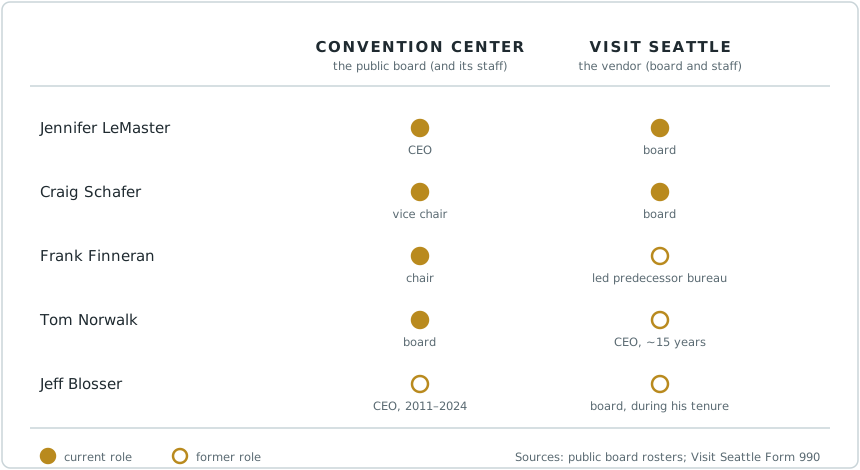
It is all on the published rosters and the public 990s, and interlocking venue and marketing boards can be ordinary, even useful, governance. The question is what happens at the vote, and the record answers it: across a decade of the board's own minutes, members have stepped aside from a decision exactly twice, and neither time was the Visit Seattle contract, which — like every bond and budget — has passed unanimously. No PFD-specific recusal rule requires a member financially tied to the contract to abstain; the overlap falls only under general municipal ethics law. So the CEO who runs the payer and a member of the board that votes the payment both sit on the vendor, and when the contract comes up, no one steps aside. And the vendor's side of the table keeps its own counsel: Visit Seattle's federal return states that it "does not make its financial statements, governing documents, or conflict of interest policy available to the public."

Seattle is the outlier
The sales staff are good at a genuinely hard job; competing for out-of-state conventions is the right thing for Seattle to do; and Visit Seattle's free drone scoreboard over the skyline this summer was a merit-based civic win that earned the world's attention without a hotel booking attached. The trouble is not the work. It is the shape of the deal around it — and set against its peers, that shape is what makes Seattle the outlier.
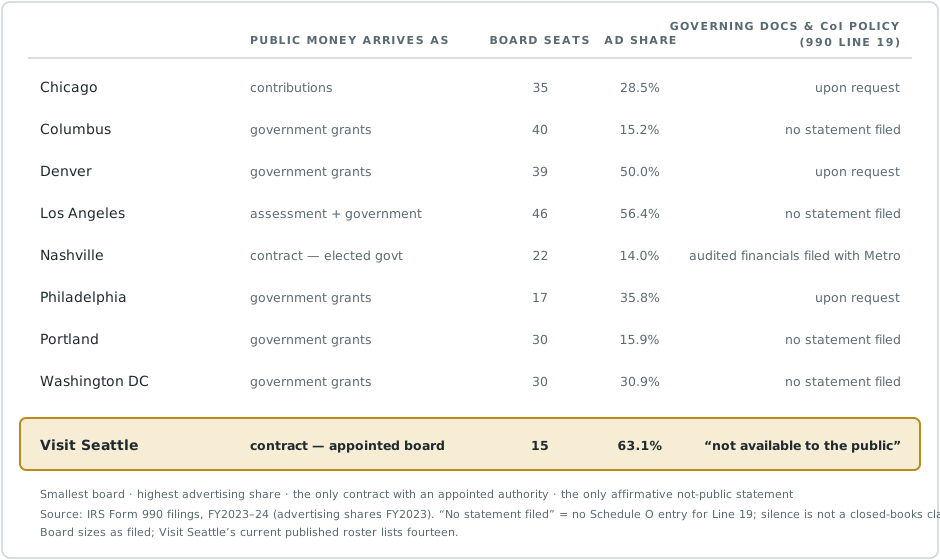
Line the big-city bureaus Seattle compares itself to up beside it and most fund their marketing arm by formula grant — five of the eight closest comparables do — with no board discretion to vote at all; the closest structural analog to Seattle's contract model, Nashville, writes its deal with an elected government that requires audited reporting back. Seattle alone pairs an appointed funder, an annual discretionary vote, no published performance standard, and a vendor — the hotels' own marketing arm — that keeps its books and governing documents from the public, while spending the highest share of its budget on advertising of any bureau in the set and carrying the smallest governing board of the group. That combination is the anomaly, and it is a governance choice, not a fact of nature.
Turn the table
Five of the board's nine seats reach the end of their terms on July 30 — two filled by the mayor, two by the county executive, one by the governor. The appointers act on their own clock, and any seat left open keeps its current occupant until a successor is named.
Which is why the appointments, not the contract, are where the table turns. The appointers cannot bid the marketing out this month; what they can decide is who grades it for the next four years — a finance voice, an operator, a resident, or one more person on both sides of the table. The July 2026 appointments decide who judges whether the public is getting its money's worth — and whose story we tell the world.
Sources: WSCC PFD FY2024 audited financial statements (lodging-tax receipts, operating results, and Note 16, the Visit Seattle payment); SCC board deck of January 27, 2026 (the thirty-seven-year history, 2025 definite room nights, and the payment schedule); PFD Resolution 2025-11 (December 9, 2025); WSCC PFD Board Policy 7, produced under public-records request, May 2026; the PFD's attributable-room-night reporting (2024); published hotel-market room-night and rate estimates (HVS; Visit Seattle; STR); Visit Seattle Form 990 filings, including Schedule O; the peer-bureau 990 set (Chicago, Columbus, Denver, Los Angeles, Nashville, Philadelphia, Portland, Washington, D.C.); the visitseattle.org leadership roster (retrieved May 28, 2026); and WSCC PFD board minutes, 2016–2026. Every document is a public record or public filing; every calculation in this piece can be redone from them.
Updated July 31, 2026: Visit Seattle receives its convention-center money as an annual marketing contract paid out of the lodging tax, not as the lodging tax itself. Corrected above.
Make a Take / Share a Take▾
Before you pass it on — what's your take?
Sharing a Dispatch piece is taking a position. Take a moment to say what yours is — it travels further, and better, for it.
What do you want to say about this? What struck you — and who needs to hear it?
We don't track clicks. If Make a Take was useful, let us know →
Not sure what to say? Let your own AI help you draft it →
The prompt asks your AI to draft a note in your voice from what the article and its sources actually support — and to push back if you overclaim. Your conversation stays in your AI; nothing is sent to the Dispatch.