Read this with your own AI▾
This piece was built with the help of AI, from public records — here's how. Read it back with your AI: choose how you want to read it, copy the prompt, and interrogate the article yourself.
Your conversation stays in your AI — nothing is sent to or stored by the Dispatch. The built-in grounding line keeps the answer tied to the Dispatch's own reporting, and asks your AI to flag — not invent — anything that needs more.
I'm back on this beat after two weeks and my heart's no longer in it. Six months is plenty. Whenever I leave my condo, there's the Summit where I used to work, there's the same walk down Pike Street, every minute there's another space I've written about. Sure, I can find more angles. But I'm thinking this whole project needs a change of medium.
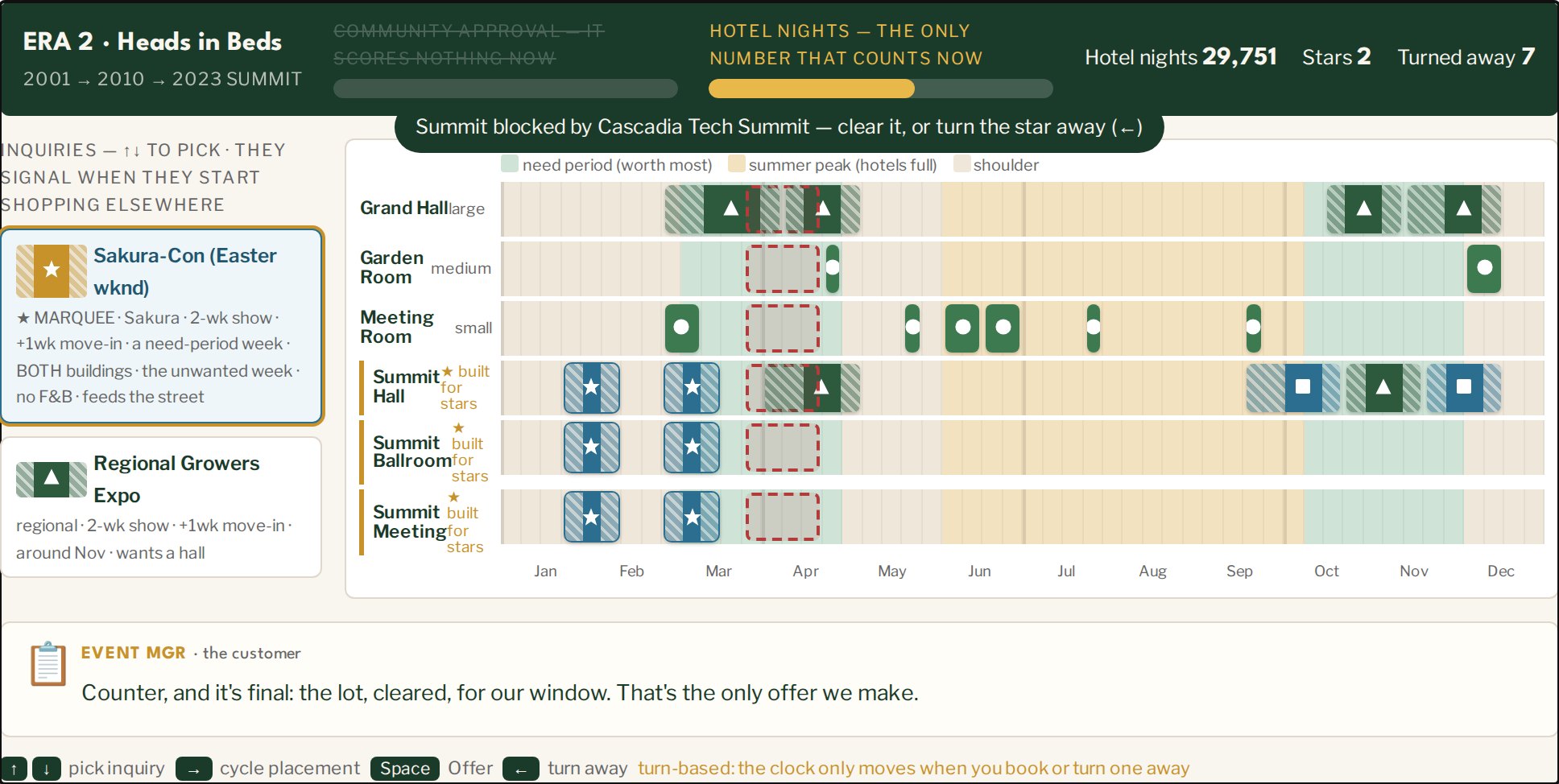
That's why I built a game about the convention center's booking calendar: Heads in Beds.
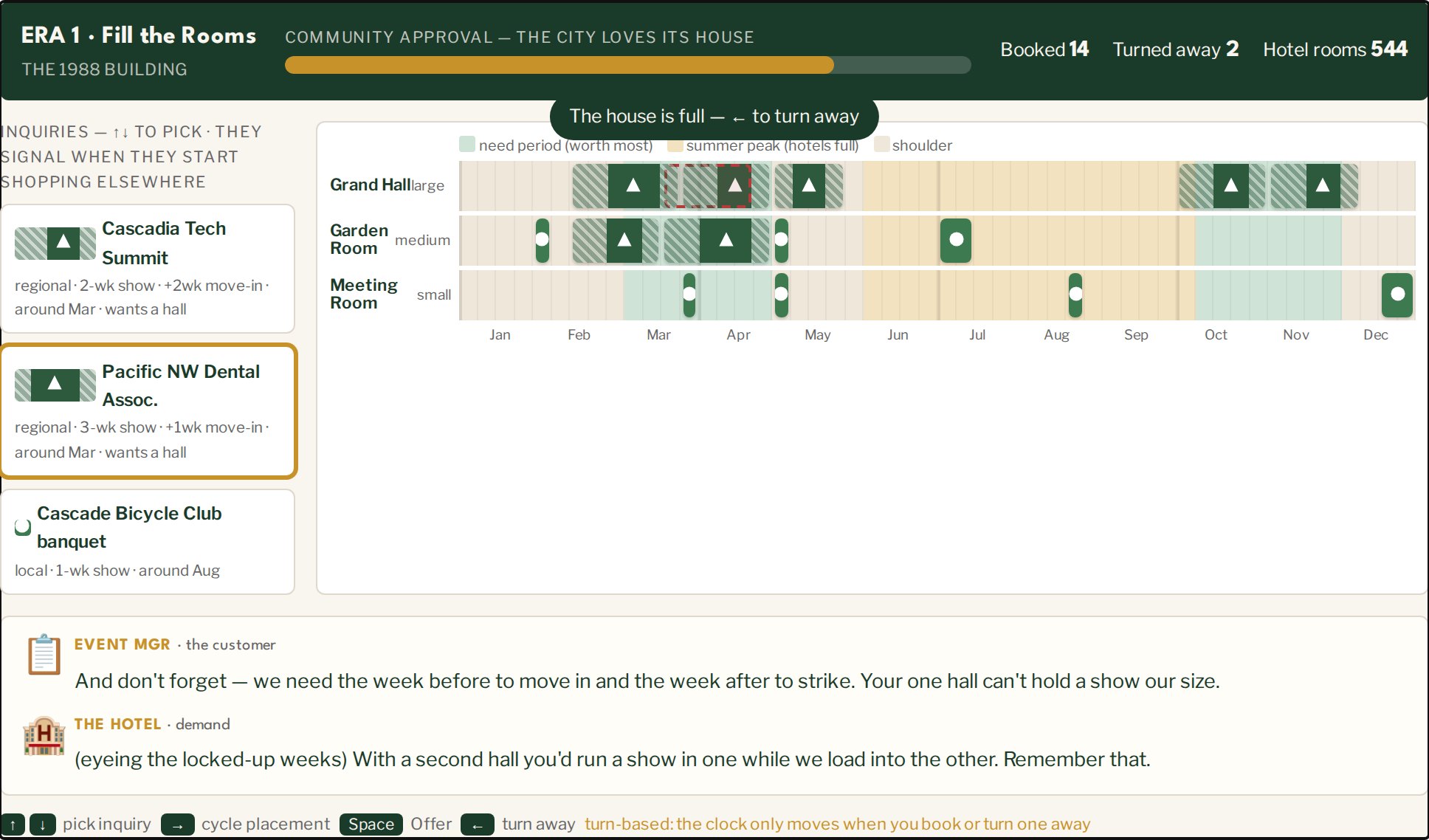
You play the conference booker.
In the first era you fill the rooms of the building and it feels like a civic job.
In the second the chair changes hands — the founder out, the hotels in — and the only score becomes heads in beds: hotel nights. You learn what that metric does to the calendar and to the street.
In the third you get two new levers — the room rent and the captive catering charge, which together set the price at the door — and the dead weeks magically fill themselves. That third era is my own proposal — the Commons — so play it knowing whose it is.
Not everybody reads longform writing, but everyone loves Tetris. Think of this as slow-motion Tetris that just so happens to teach a valuable lesson about convention center economics.
Yeah, okay, it's not Tetris.
Maybe I need a different medium to adequately describe what I've been writing about these past months: a well-connected downtown coalition that's nearly seventy years old and heavier, for the size of its city, than any peer I could find; a hospitality industry that designs its own funding mechanisms and gets them written into law at the state and city level; a hotel-run marketing arm that holds a private marketing contract with a public entity, renewed across thirty-seven years with no competitive process on record; and the convention center campus at the center of the expanding hospitality machine.
Some loglines:
THE EVERGREEN CLUB. An inquisitive East Coast transplant uncovers the secrets of the Seattle establishment.
THE HILLCLIMB. In near-future post-collapse Seattle, a group of teenagers turn the city's new convention center into a giant skate park, inspiring the world with their gnarly tricks.
THE CONVENTION CITY DANCERS. If writing about music is like dancing about architecture, then dancing about public finance is like writing about the physics of musical sound, which is to say that it's super sexy and terribly interesting. Don't miss the kick line in reflective vests.
Or I take it to the streets:
SUMMIT SKETCHER. Set up my easel at Plymouth Pillars and do quickie paintings of the Summit and sell them to tourists while giving them extended riffs on the building and the neighborhood.
PIKE-PINE WALKING TOURS. Let me tell you the story of C-STAR, the security hub the center built on Pike Street. And look, there's where the Cheesecake Factory used to be!
The reality is I'm living the dream here in Convention City, the neighborhood nobody else has named yet. It's near everything, close to transit, and a short walk to Pike Place Market and the Waterfront. I have much to be thankful for.
I'm a part of the Convention City family, and we all want this neighborhood to thrive. I'll keep celebrating what works, and I won't watch silently when it doesn't.
The first step: Recognizing this as a neighborhood. Not just a commercial zone or convention district, but a living place where the neighbors are invited inside, welcome at the table as we plan for our future.
This site itself isn't going anywhere, and I'll be applying my tech superpowers to make it more useful, with maps and other features, including:
- Punch List: a numbered and sourced list of what should change in how the convention center is governed, managed, and programmed — each item with the record it came from and the test that would settle it.
- Findings: what I've discovered, documented for the use of other researchers.
- Welcome Guide: past writing organized into thematic groupings.
All will get updated as things move.
I've said my piece, and I'll say it again — but never the same way twice.
Make a Take / Share a Take▾
Before you pass it on — what's your take?
Sharing a Dispatch piece is taking a position. Take a moment to say what yours is — it travels further, and better, for it.
What do you want to say about this? What struck you — and who needs to hear it?
We don't track clicks. If Make a Take was useful, let us know →
Not sure what to say? Let your own AI help you draft it →
The prompt asks your AI to draft a note in your voice from what the article and its sources actually support — and to push back if you overclaim. Your conversation stays in your AI; nothing is sent to the Dispatch.